
API Integration Services for UK Businesses
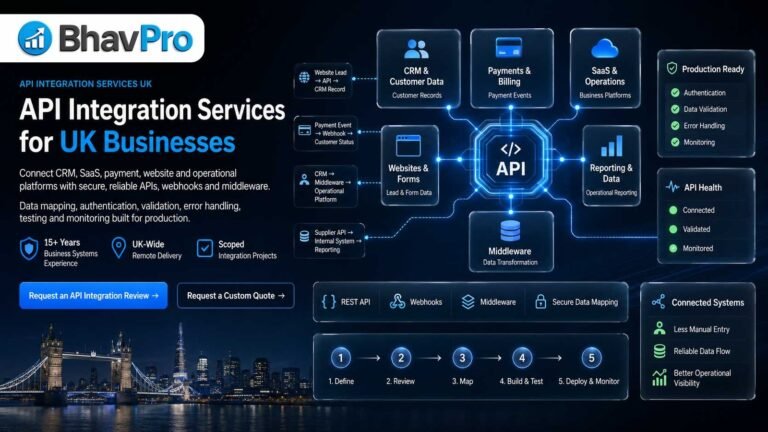
BhavPro provides API integration services for UK businesses that need existing software to exchange data reliably. We connect CRM, SaaS, payment, website and operational platforms using supported APIs, webhooks and middleware, with authentication, data mapping, validation, error handling, testing and monitoring carefully built into every production integration from the outset.
API Integration Services UK
15+ Years Business Systems Experience
UK-Wide Remote Delivery
Scoped Integration Projects
Connect Existing Business Systems Without Rebuilding Everything
Most growing businesses already use useful software for CRM, payments, websites, communications, reporting, customer service or operations. Problems appear when those systems cannot exchange the information needed to complete a business process.
BhavPro’s API Integration Services focus on implementing reliable connections between existing, approved systems. We define what data should move, which system is authoritative, how access is authenticated, how records are mapped and validated, and what should happen when a request fails or arrives more than once.
The objective is not to replace working platforms unnecessarily. It is to make them exchange the right information through supported APIs, webhooks or middleware in a maintainable way.
API Integration Capabilities
Implementation Scope
Build dependable system connections around documented interfaces, controlled data movement and production-ready operational safeguards.
API Discovery & Feasibility Review
Review available API documentation, endpoints, authentication methods, permissions, rate limits, webhook support and supplier constraints before development begins. The goal is to confirm that the required business action is technically supported and identify any dependencies that could affect scope or delivery.
REST API & Endpoint Integration
Implement approved read, create, update or transactional operations using supported REST APIs and other documented interfaces. We define request and response handling, required parameters, identifiers and expected outcomes so the connection is tied to a clear business requirement rather than a one-off technical call.
Webhook & Event Integration
Receive event-driven notifications when supported platforms report actions such as form submissions, payment events, status changes or completed transactions. Webhook handling can include signature verification, payload validation, duplicate-event protection and controlled processing before the destination system is updated.
Authentication & Access Configuration
Configure supported authentication methods such as API keys, bearer tokens and OAuth flows. Access should be limited to the permissions required for the integration, with production credentials handled separately from exposed front-end code and test environments wherever the platform allows.
Data Mapping, Validation & Middleware
Map source fields, identifiers and statuses to the destination system and validate required values before submission. Where direct connections are unsuitable, middleware can transform formats, apply integration-specific rules or coordinate data exchange without turning the page’s scope into a broader workflow-automation project.
Error Handling, Testing & Monitoring
Design for failed requests, timeouts, rejected records and unexpected responses rather than assuming every API call will succeed. Testing covers agreed success and failure scenarios, while logging and monitoring provide a practical way to investigate production exceptions and supplier-side changes after launch.
How BhavPro Delivers API Integration
A defined delivery path keeps technical implementation tied to the business outcome, authorised interfaces and measurable connection behaviour.
1. Define the Business Data Flow
Identify the source system, destination system, trigger, required fields and expected result. We also clarify which platform owns each record and whether the integration is one-way, event-driven or requires controlled synchronisation.
2. Review APIs & Technical Constraints
Assess documentation, authentication, endpoint availability, permissions, data formats, rate limits and vendor restrictions. This prevents development around an operation that the provider does not support or the account is not authorised to perform.
3. Map Data & Design the Connection
Define identifiers, required fields, status mappings, validation rules and the direct connector or middleware pattern. Where duplicate events are possible, the design can include idempotency or prior-processing checks appropriate to the transaction.
4. Build, Secure & Test
Implement the connection using the agreed interfaces and test expected success, rejection and failure conditions. Authentication, secret handling, input validation and logging are addressed as part of the production integration rather than being treated as optional extras.
5. Deploy, Monitor & Hand Over
Move the approved integration into production using the agreed deployment route. Where included, handover covers configuration, operational notes, exception review and a clear process for responding to API changes, expired credentials or other connection failures.
Business Systems & Integration Patterns
Integration Examples
BhavPro can connect supported business platforms where suitable APIs, permissions and account capabilities are available. Compatibility is assessed per project rather than assumed from a brand name alone.
CRM & Customer Data
Connect websites, forms, customer portals or operational systems with CRM platforms such as HubSpot, Salesforce or Zoho where the required API operations are supported. Where CRM architecture, process or data ownership still needs defining, use CRM consulting before implementing the connector.
Payments & Billing
Handle supported payment or billing events from platforms such as Stripe or PayPal, including status updates, customer references and webhook-driven transaction events.
SaaS & Operations
Connect approved SaaS products and operational tools where native connectors are missing or cannot support the required data mapping and business-specific integration behaviour.
Websites & Forms
Send website enquiries, registrations or approved account data into destination systems through authenticated endpoints instead of relying on repeated manual entry.
Reporting & Data
Transfer approved operational data into reporting, database or spreadsheet environments while retaining consistent identifiers and a clearly defined source of truth.
Middleware & Connector Platforms
Use middleware, custom connector code or appropriate integration platforms where transformation, routing or supplier-specific compatibility is required between existing systems.
Types of API Integration We Implement
Integration Approaches
Different business requirements need different connection patterns. BhavPro selects the simplest supported approach that can meet the required data flow, reliability and operational controls without adding unnecessary architecture.
Direct API Integration
Connect two approved systems directly where both expose suitable documented endpoints and compatible authentication. This approach is often appropriate for focused data exchange without an additional middleware layer.
Webhook Integration
Receive event-driven notifications when a platform reports a change, payment, submission or status event. Webhook handlers can verify signatures, validate payloads and protect against duplicate processing.
Middleware Integration
Introduce a controlled intermediary when systems use different formats, identifiers or connection rules. Middleware can transform data, coordinate API calls and isolate supplier-specific logic from the destination application.
One-Way Data Synchronisation
Move approved records from an authoritative source into another system while keeping ownership clear. This is useful where one platform should remain the source of truth for a defined dataset.
Two-Way Synchronisation
Exchange selected updates in both directions where the business requirement genuinely needs it. Conflict rules, identifiers, timestamps and ownership must be defined carefully to avoid overwriting valid information.
Scheduled & Batch Integration
Process records at agreed intervals when real-time exchange is unnecessary. Scheduled integration can reduce avoidable API traffic while still keeping business systems aligned within an acceptable operational window.
Common API Integration Use Cases
Business Use Cases
API projects are easiest to understand through the business outcome. The examples below show where a defined system-to-system connection can remove repeated data entry, improve information flow or expose an approved external capability inside another business system.
Website Leads → CRM
Capture approved website enquiries and create or update CRM records with source information, identifiers and required fields. If the CRM itself needs redesigning or migration, use CRM Implementation Services instead.
Payments → Customer or Account Status
Use supported payment events and webhooks to update approved customer, order or account records after verification. This can reduce manual reconciliation between payment activity and operational systems.
CRM → Operational Platform
Send approved customer, opportunity or status information from CRM into a delivery, service or operational system so downstream teams do not need to re-enter the same data.
Supplier API → Internal System
Retrieve authorised product, order, availability or status information from a supplier API and map it into an internal application, database or reporting layer using controlled identifiers.
SaaS Platform → SaaS Platform
Connect specialist business tools when the native connector is unavailable or cannot support the required fields, rules or data ownership model. The integration remains focused on data exchange rather than broader workflow orchestration.
Messaging & Communications
Connect approved communication events with business records where an API is suitable. For dedicated business messaging delivery and SMS-specific requirements, use BhavPro’s SMS Integration Services.
Security, Reliability & Production Readiness
Production API connections need more than a successful demo request. BhavPro designs the agreed integration around controlled access, validated data and recoverable failure states.
Authentication & Least-Privilege Access
Validation & Duplicate Protection
Failure Handling & Operational Logging
Scenario Testing & Production Monitoring
What You Receive From an API Integration Project
Project Deliverables
Deliverables depend on scope, but a production API integration should leave the business with more than working code. BhavPro structures delivery around clear requirements, controlled implementation, verification and an understandable handover.
Requirements & Data-Flow Definition
A documented view of the systems involved, trigger, source data, destination action, ownership and expected result for the agreed integration scope.
API Feasibility Assessment
Review of available documentation, authentication, permissions, endpoints, rate limits, webhook support and supplier constraints before implementation is committed.
Field Mapping & Integration Rules
Source-to-destination mapping for identifiers, statuses and required values, including transformation or validation rules needed for reliable exchange.
Connector or Middleware Implementation
The agreed API connector, webhook handler or middleware component configured for the approved systems and business requirement.
Testing, Error Handling & Deployment
Agreed success and failure scenarios, validation, exception handling, production deployment and checks that the intended business result can be verified.
Documentation & Handover
Practical implementation notes, configuration information and operational guidance so the integration can be understood, supported and reviewed after launch.
What Affects API Integration Scope, Cost & Delivery?
- Existing systems already work, but staff repeatedly copy information between them
- Two SaaS or business platforms expose suitable APIs but lack the connector you need
- A website, payment event or supplier status must update another approved system
- Native integrations exist but cannot support the required field mapping or connection logic
- You need a maintainable connection while keeping the existing specialist platforms in place
API integrations vary substantially in complexity. BhavPro scopes the implementation after reviewing the required systems, supported interfaces and expected outcome.
| Scope factor | Why it matters |
|---|---|
| Number of systems | Every additional interface can add authentication, mapping, exception handling and testing requirements. |
| API documentation and access | Clear supported documentation speeds feasibility work; limited access or supplier approval can introduce dependencies. |
| Authentication model | OAuth flows, tenant-specific credentials and permission scopes can require more implementation and test coverage than a simple server-side key. |
| Data complexity | Nested records, custom fields, different identifiers and transformation rules increase mapping and validation work. |
| Direction and frequency | Two-way or near-real-time synchronisation usually needs more conflict handling and monitoring than a controlled one-way transfer. |
| Business-critical actions | Payments, customer records or operational transactions may require stronger verification, duplicate protection and acceptance testing. |
| Volume and rate limits | Higher transaction volume can affect batching, retry behaviour, throttling and supplier API limits. |
| Support requirements | Monitoring, alerting and ongoing supplier-change support are scoped according to the operational importance of the integration. |
If the systems and expected result are already defined, request a custom quote. If the correct connection route is still unclear, start with an API Integration Review.
When API Integration Is the Right Solution
- Existing systems already work, but staff repeatedly copy information between them
- Two SaaS or business platforms expose suitable APIs but lack the connector you need
- A website, payment event or supplier status must update another approved system
- Native integrations exist but cannot support the required field mapping or connection logic
- You need a maintainable connection while keeping the existing specialist platforms in place
| Requirement | Best Route | Why |
|---|---|---|
| Connect two existing systems | API Integration | The core requirement is authenticated data or action exchange. |
| Reconfigure the CRM itself | CRM Implementation | The main work is CRM setup, migration, fields, pipelines or adoption. |
| Coordinate multi-step rules, AI actions or approvals | AI Workflow Automation | The requirement extends beyond the connector into a wider operational process. |
| Plan AI-specific architecture before implementation | AI Integration Advisory | Data exposure, model access, identity, permissions or governance still need deciding. |
| Build a new portal, SaaS platform or business application | AI Apps & Business Software | The requirement is a new application, not only a connection between existing tools. |
Relevant Business Systems Integration Experience
Why BhavPro
API delivery benefits from understanding the operational context around the connection. BhavPro combines integration work with practical experience across CRM, communications, websites, billing-related processes and custom business systems, while keeping claims limited to relevant capability rather than unsupported platform guarantees.
CRM & Customer Operations
Experience across CRM structure, lead capture, customer records, pipelines, ticketing and operational processes helps BhavPro design integrations around the business record and ownership model rather than treating the API as an isolated endpoint.
Telecom & Communications
BhavPro’s telecom and VoIP background supports integration requirements involving communication events, customer records and connected service environments. Specialist telephony-to-CRM projects are routed to VoIP CRM Integration.
Websites & Lead Generation
Website, form and digital lead-generation experience helps define how enquiries, attribution and customer information should pass into CRM or downstream systems without repeated manual entry.
Billing & Commercial Systems
Where supported APIs are available, integrations may involve transaction states, account references, billing events or fulfilment hand-offs. These require explicit identifiers, verification and failure handling rather than simple data copying.
Custom Business Software
BhavPro builds connected portals, CRM platforms and operational applications where APIs form part of a larger system. When the main requirement is a new application rather than connecting existing tools, use AI Apps & Business Software.
Business-System Architecture
For broader system design, CRM architecture and integration planning, explore BhavPro’s CRM Development & Integration expertise. The API service remains the implementation route for a defined connection.
Related Services — Use the Right Route
Intent-Safe Service Routing
These services solve adjacent problems. Use them when the main requirement is broader than implementing a defined API connection.
CRM Implementation Services
Choose this when the CRM itself needs configuration, migration, pipeline design, fields, dashboards or adoption support.
AI Workflow Automation Services
Choose this when the requirement is a multi-step operational process involving rules, AI-assisted actions, approvals, verification or recovery.
VoIP CRM Integration
Choose this for specialist telephony-to-CRM requirements such as click-to-call, caller matching, call logging, CTI or screen-pop behaviour.
AI Integration Advisory
Choose this before implementation when AI-specific data, model, identity, permission, architecture or governance decisions are still unresolved.
CRM Consulting
Choose this when CRM strategy, data structure, process design, ownership or wider customer-lifecycle requirements need defining before integration.
SMS Integration Services
Choose this for dedicated SMS, messaging-provider, template, consent and delivery requirements that extend beyond a general API connector.
AI Apps & Business Software
Choose this when the main requirement is a new portal, SaaS platform, bespoke business application or connected operational system rather than only an API connection.
Supporting resources: Explore CRM Development & Integration for the broader expertise area, read RPA vs API Automation vs AI Agents to compare implementation approaches, or return to Business Technology Services for the wider BhavPro service portfolio. For a dedicated messaging requirement rather than a general system connector, use SMS Integration Services.
When API Integration Is Not Enough
Integration vs Custom Software
API Integration Services are designed for connecting existing systems. If the requirement includes a new customer portal, SaaS product, multi-role platform, bespoke CRM, billing application or operational workspace, the project has moved beyond connector implementation into custom software development.
Need a New Application Around Multiple Integrations?
BhavPro’s AI Apps & Business Software capability covers new portals and business applications that may depend on several APIs, user roles, permissions, workflows, dashboards and connected services. API Integration remains the correct service when the existing platforms already perform their main functions and simply need to exchange approved data reliably.
Discuss Your API Integration Requirement
Request an API Integration Review
Tell us which systems need to connect, what information should move and what should happen after a successful exchange. We can review likely API availability, integration dependencies and the most appropriate next step.
Request a Custom Quote
If the required systems, data flow and expected outcome are already defined, send the project details for a scoped API integration quotation.
Email BhavPro
Have API documentation or a specific integration question? Email the systems involved and the outcome you need to hello@bhavpro.com.
Where suitable supported interfaces exist, BhavPro can help turn disconnected business systems into a controlled integration that is easier to operate, test and maintain.
Frequently Asked Questions
Answers to common questions about API integration scope, compatibility, security, failure handling and when another BhavPro service is more appropriate.
API integration services connect existing software through supported programming interfaces so approved data or actions can move between systems. A production integration may include authentication, data mapping, validation, webhook handling, error management, testing, logging and monitoring.
Potential integrations include CRM platforms, websites, forms, SaaS applications, payment services, customer portals, reporting tools, databases and operational systems. Feasibility depends on the interfaces, permissions, account capabilities and supplier restrictions available for the specific platforms.
Where both sides provide suitable interfaces, yes. A website integration can create or update CRM records, preserve agreed source information and pass approved enquiry or account data. If the CRM itself needs wider configuration or migration, CRM Implementation Services is the more appropriate primary service.
Many platforms use API keys, bearer tokens, OAuth or another documented authentication method. BhavPro reviews the supported approach and configures access for the agreed integration. Credentials should be handled securely and limited to the permissions required for the connection wherever the provider supports that control.
The required response depends on the business process. Production integrations can include validation, logging, controlled retries, duplicate protection, exception handling and operational alerts where appropriate. The important point is to define failure behaviour explicitly rather than treating a successful development test as proof that every future request will complete.
Potentially, but only after reviewing authorised and supplier-supported connection options. Some platforms provide private partner interfaces, webhooks, exports, imports or other approved methods. BhavPro does not assume unsupported access is suitable simply because a public API is unavailable.
No. API integration provides the technical connection through which systems exchange data or actions. Workflow automation coordinates a wider process involving triggers, rules, approvals, AI-assisted steps or recovery across multiple actions. BhavPro keeps those intents separate so the correct service owns the main requirement.
Often, where the provider supplies the required API or webhook capabilities. Payment integrations need careful handling of transaction states, identifiers, duplicate events, failed notifications and reconciliation requirements. The exact implementation depends on the provider, account permissions and the business action that must follow each event.
No. API Integration connects existing systems. If the requirement is to build a new portal, SaaS product, multi-role platform or bespoke business application around several integrations, BhavPro’s AI Apps & Business Software service is the more appropriate route.
Useful starting information includes the systems involved, the business outcome required, available API documentation, example fields or records, the event that should trigger the connection, the expected destination action and any known supplier, security or access restrictions. BhavPro can then assess feasibility and define the implementation scope.