
Digital Transformation Consulting for UK Businesses
BhavPro provides digital transformation consulting for UK businesses that need to modernise processes, systems, data and ways of working. We assess digital maturity, identify operational gaps, prioritise technology and change initiatives, and build a phased transformation roadmap that connects business goals, people, platforms, governance and measurable implementation priorities for growth.
15+ Years Cross-Functional Experience
UK & Remote Delivery
Phased Transformation Planning
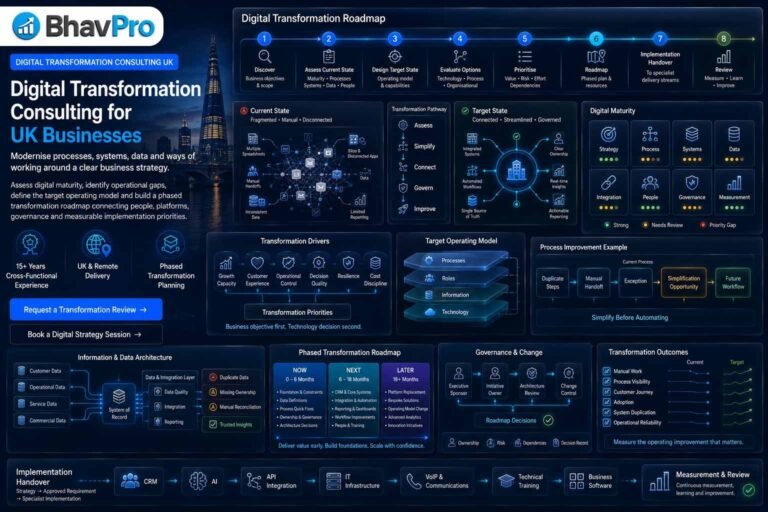
Digital Transformation Consulting at a Glance
BhavPro helps businesses turn broad modernisation goals into a governed sequence of decisions. The consulting work looks across processes, systems, data, people and technology dependencies so transformation initiatives can be prioritised before specialist implementation begins.
Digital maturity
Assess how well current processes, technology, data and operating practices support the organisation's priorities.
Target state
Define how the organisation should work in the future, including the capabilities and systems that need to support that model.
Transformation roadmap
Prioritise initiatives into a phased sequence with owners, dependencies, risks and measurable decision criteria.
Implementation hand-off
Translate the approved roadmap into specialist CRM, AI, integration, IT, training or process-delivery work.
What Is Digital Transformation Consulting?
Digital transformation consulting helps an organisation decide how technology, data and new ways of working should support its business strategy. It is not simply a software-selection exercise: the work connects business outcomes with processes, operating roles, information flows, technology capabilities, governance and a realistic implementation sequence.
The consulting question
What should change, why does it matter, what should the target state look like, and in what order should the organisation act?
The implementation question
Once the transformation decisions are approved, which systems, integrations, workflows, controls and training activities need to be built or changed?
What This Service Is — and Is Not
Digital Transformation Consulting owns the organisation-wide transformation direction. It deliberately does not absorb every specialist implementation discipline into one broad page.
Digital Transformation vs AI Business Systems Audit
These services are related but answer different questions. The audit is a bounded diagnostic of the current environment; transformation consulting uses that evidence—or equivalent discovery—to design a broader future-state programme.
| Requirement | AI Business Systems Audit | Digital Transformation Consulting |
|---|---|---|
| Map current systems and major gaps | Primary service | May use the audit as an input |
| Identify immediate system risks and integration issues | Primary service | Uses findings in prioritisation |
| Define organisation-wide target state | Supporting input | Primary service |
| Prioritise transformation initiatives | Supporting input | Primary service |
| Build multi-phase roadmap and governance | Not the main scope | Primary service |
| Coordinate change across people, process, data and technology | Not the main scope | Primary service |
Digital Transformation vs Business Strategy
Business Strategy determines how the organisation should compete, operate and scale. Digital Transformation determines how digital capabilities, systems and data should support that operating model.
Business Strategy
Business goals, operating processes, SOPs, organisational priorities and scalable ways of working. See Business Strategy Services.
Digital Transformation
Digital maturity, technology capabilities, data flows, integration priorities, target systems, governance and the phased modernisation roadmap.
Used together
A business operating model provides the context; the digital transformation roadmap identifies the technology and capability changes needed to support it.
Digital Transformation vs AI Integration Advisory
AI can be one part of transformation, but not every business problem needs an AI solution. Digital Transformation Consulting remains technology-neutral enough to recommend process improvement, integration, system optimisation or no immediate change when those options are more appropriate.
Digital Transformation
Compares multiple routes across process, data, CRM, cloud, communications, automation, software and governance.
AI Integration Advisory
Focuses on where AI should or should not be introduced into business systems. See AI Integration Advisory.
AI implementation
Production workflow automation can be routed into AI Automation once a use case and controls are approved.
When Does a Business Need Digital Transformation Consulting?
Transformation consulting becomes valuable when the organisation has more than one disconnected technology problem and needs a coherent decision framework rather than a sequence of isolated purchases.
Systems no longer fit growth
Existing tools worked at a smaller scale but now create manual work, reporting gaps or operational friction.
Technology has accumulated
Teams use overlapping SaaS products, spreadsheets and local workarounds without a clear system of record.
Data is fragmented
Management cannot obtain reliable information without manual reconciliation across several systems.
Automation efforts are ad hoc
Different teams automate individual tasks without shared architecture, controls or ownership.
A major platform change is being considered
The business needs to understand process, data, integration and change dependencies before committing.
Leadership needs a roadmap
There are many legitimate improvement ideas but no agreed priority, business case or phased sequence.
Digital Maturity Assessment
A maturity assessment provides a structured current-state view. It does not exist to assign an arbitrary score; it helps identify the dimensions that materially affect transformation readiness and business performance.
| Dimension | Questions to examine |
|---|---|
| Strategy | Are digital investments tied to explicit business priorities and measurable outcomes? |
| Process | Which workflows are manual, duplicated, inconsistent or poorly owned? |
| Systems | Do current platforms support the required operating model and user roles? |
| Data | Can teams access reliable, timely information for decisions and service delivery? |
| Integration | Do important systems exchange data at the correct points and with appropriate controls? |
| People | Do employees have the skills, ownership and capacity needed for change? |
| Governance | Are architecture, access, risk, change and investment decisions controlled? |
| Measurement | Can leadership see whether transformation initiatives are creating the intended operating improvement? |
Business Objectives & Transformation Drivers
Technology should be selected after the business problem is understood. BhavPro connects proposed transformation initiatives to the outcome the organisation actually needs to improve.
Growth capacity
Support more customers, transactions, employees or services without proportionally increasing manual administration.
Customer experience
Reduce avoidable hand-offs, delays, inconsistent communication or fragmented service journeys.
Operational control
Create clearer ownership, process visibility, exception management and reporting.
Decision quality
Improve the availability and consistency of business information used by managers.
Resilience
Reduce unnecessary single points of failure and clarify operational recovery dependencies.
Cost discipline
Identify overlapping systems and avoid technology investment without a supported business case.
Map the Current Operating Model
Before defining a future digital environment, BhavPro documents how important work actually happens today across people, process, information and systems.
- Key customer and operational workflows.
- Teams, roles and ownership.
- Systems used at each step.
- Manual spreadsheets, workarounds and duplicate entry.
- Handoffs between departments or external partners.
- Information required to make decisions.
- Approvals, exceptions and controls.
- Current reporting and management routines.
Define the Target Digital Operating Model
The target state describes how the organisation should operate after the priority changes are implemented. It gives system and implementation decisions a common destination.
Where the target operating model requires deeper process, SOP, ownership or organisational design, use business strategy and operations consulting.
Processes
Which steps should remain human-led, which can be simplified, and which are suitable for automation?
Roles
Who owns each stage, approval, exception and system responsibility?
Information
What data is required, where should it originate and which system should be authoritative?
Technology
Which platforms, integrations and controls are required to support the agreed operating model?
Process & Workflow Assessment
Digital transformation should not automate a poorly designed process without first asking whether the process itself still makes sense.
- Remove unnecessary duplicate steps before considering automation.
- Identify hand-offs that exist only because systems are disconnected.
- Separate standard paths from exceptions.
- Clarify approvals and decision rights.
- Assess whether required information is available at the correct point.
- Identify tasks suitable for deterministic automation, AI assistance or continued human judgement.
Where the requirement becomes a deeper operating-process or SOP redesign, BhavPro can route the work into Business Strategy Services.
Data & Information Assessment
Transformation decisions are difficult to sustain when data ownership, quality and system-of-record responsibilities are unclear. BhavPro reviews the information requirements that the future operating model depends on.
Data ownership
Identify which team and system is responsible for important customer, service, product or operational information.
Quality
Surface duplication, missing values, inconsistent definitions and manual reconciliation that weaken reporting.
Availability
Determine whether the right people can access the right information at the point decisions are made.
Lifecycle
Consider collection, use, migration, retention and deletion requirements when system changes are planned.
Technology Landscape Assessment
The technology landscape assessment looks at the role each system plays rather than creating an inventory for its own sake.
Core platforms
CRM, finance, ERP, ticketing, project, communications, website and other systems essential to operations.
Point solutions
Specialist applications solving a narrow problem that may still be justified.
Workarounds
Spreadsheets, shared inboxes or manual exports being used because a core system does not meet the need.
Dependencies
Authentication, APIs, data feeds, hosting, communications and vendor relationships that affect change sequencing.
Integration & Dependency Mapping
Transformation programmes often fail when a platform is changed without understanding what depends on it. BhavPro maps the flows that need to survive, change or be retired.
- System-to-system data exchanges.
- Manual imports and exports.
- Website or form integrations.
- CRM and communications dependencies.
- Finance, billing or reporting feeds.
- Authentication and access dependencies.
- Third-party supplier connections.
- Downstream reports or automations that rely on existing fields.
Where the roadmap requires technical connectivity, use API Integration Services for implementation.
Customer & Employee Journey Considerations
Transformation affects the people using the process as well as the systems behind it. BhavPro reviews where technology changes may improve—or accidentally complicate—customer and employee journeys.
Customer journey
Entry points, hand-offs, communication, self-service, waiting time and access to consistent information.
Employee journey
Number of systems touched, repeated data entry, task visibility, training burden and exception handling.
Management journey
Availability of reliable reporting, escalation paths and operational oversight.
Partner journey
Where suppliers, partners or external teams need controlled access to information or workflow steps.
Build, Buy, Improve, Integrate, Automate — or Wait?
Transformation does not automatically mean replacing systems. BhavPro compares practical options against the business requirement, risk and readiness.
| Option | When it may fit | Key question |
|---|---|---|
| Improve | Existing platform is suitable but badly configured or adopted | Can the current system meet the requirement with controlled changes? |
| Integrate | Systems work individually but important information or workflow hand-offs are disconnected | Would integration remove material manual work without replacing useful platforms? |
| Replace | Current system creates capability, support or architectural constraints | Is the replacement business case stronger than optimising the incumbent platform? |
| Build | The organisation has genuinely distinctive workflow requirements | Does bespoke software create enough value to justify ownership and maintenance? |
| Automate | The process is stable, repetitive and rules can be defined | Should the task be automated deterministically, assisted by AI or remain human-led? |
| Wait | Readiness, evidence or business case is insufficient | What must become true before investment is justified? |
Technology Portfolio Rationalisation
Technology sprawl can increase cost and complexity without increasing capability. BhavPro identifies where tools overlap, where a system remains essential and where consolidation might be justified.
- Duplicate CRM, project, communication or collaboration tools.
- Unused or lightly used licences.
- Applications retained because nobody owns the retirement decision.
- Shadow spreadsheets replicating core-system data.
- Tools purchased for features that are already available elsewhere.
- Point solutions creating manual export/import dependencies.
- Vendor contracts or dependencies that affect the timing of change.
Rationalisation identifies decision opportunities; it does not promise a specific cost saving before usage, contracts and business dependencies are verified.
Legacy System Modernisation Strategy
A legacy system should not be replaced purely because it is old. BhavPro assesses whether it creates material constraints in supportability, integration, user experience, data access, security or business capability.
Retain
Continue using the platform where it remains fit, supportable and economically sensible.
Contain
Limit change and surround the system with controlled integration while a longer-term plan is developed.
Modernise
Improve configuration, interfaces or adjacent services without replacing the entire platform.
Replace
Plan migration when the platform creates sustained capability or operational constraints that cannot be resolved proportionately.
Cloud & Infrastructure Strategy
Digital transformation may involve cloud services, SaaS platforms or infrastructure changes, but the correct route depends on the workload, resilience needs, security model, cost and operational capability.
- Assess whether a workload or system genuinely benefits from cloud or SaaS delivery.
- Consider identity, access and administrative ownership.
- Map backup, recovery and resilience requirements.
- Identify integration and connectivity dependencies.
- Plan migration sequence and fallback requirements.
- Clarify who will operate and support the environment after change.
For ongoing operations and infrastructure support, connect the roadmap with Managed IT Services and, where relevant, Web Hosting Services.
CRM & Customer-System Strategy
CRM is often a central transformation dependency because customer data, sales processes, service history and reporting cross several departments. Digital Transformation Consulting identifies the role the CRM should play within the wider operating model.
CRM role
Clarify whether the CRM is the authoritative customer record, pipeline system, service platform or part of a wider architecture.
Process alignment
Define which customer workflows and hand-offs should be supported by CRM.
Data alignment
Identify the customer, account, opportunity and activity information required across teams.
Delivery route
Use CRM Consulting for detailed strategy and CRM Implementation for build and migration.
AI & Automation Opportunity Assessment
BhavPro assesses AI and automation in the context of the process rather than assuming the newest technology is automatically the best option.
Deterministic automation
Use explicit rules where the input, logic and required outcome are stable.
AI assistance
Use AI where interpretation, drafting, summarisation or flexible language handling adds value and human review can be defined.
Human decision
Retain judgement where context, accountability, sensitivity or material risk makes automation inappropriate.
No change
Avoid automating a low-value, unstable or poorly understood process.
For deeper AI design, use AI Integration Advisory; for implementation, use AI Automation.
Reporting & Analytics Requirements
Transformation should improve decision visibility, not merely create more dashboards. BhavPro defines what leadership and operating teams need to know, which source data is required and where definitions must be standardised.
Operational reporting
Work queues, exceptions, service levels, overdue actions and current-state control.
Management reporting
Process performance, capacity, quality and trend information supporting regular decisions.
Commercial reporting
Pipeline, revenue, customer or service metrics where the underlying data supports them.
Data confidence
Document limitations so incomplete attribution or inconsistent source data is not presented as precise evidence.
Digital Workplace & Collaboration
Modernisation can also improve how distributed teams communicate, share information and coordinate work. The objective is a clearer operating environment rather than adding more collaboration tools.
- Document where information should be stored and shared.
- Reduce avoidable duplication between chat, email, files and project tools.
- Define access and ownership around shared workspaces.
- Improve task and hand-off visibility.
- Consider remote and hybrid working requirements.
- Plan adoption and training when ways of working materially change.
Security & Operational Resilience Considerations
Security and resilience should be included in transformation decisions early enough to influence architecture, access and supplier choices. BhavPro keeps this at a planning and control level unless a specialist implementation is separately scoped.
- Identity and access dependencies.
- Privileged administration and role separation.
- Backup and recovery requirements.
- Business continuity dependencies.
- Supplier and third-party reliance.
- Data movement between systems.
- Monitoring and incident-escalation ownership.
- Risks created during migration or coexistence periods.
For operational security and support controls, use Managed IT Services.
Privacy & Compliance-Aware Transformation Planning
Transformation can change how information is collected, stored, shared and retained. The consulting process should identify these implications before implementation decisions become difficult to reverse.
- Identify systems processing personal or sensitive business information.
- Consider access requirements and data minimisation.
- Map information transferred to third parties or external platforms.
- Review retention and deletion dependencies when systems are replaced.
- Consider records, approvals and auditability where relevant.
- Document where specialist legal, privacy or regulatory advice is required.
For broader implementation-readiness support, connect relevant work with Compliance Advisory.
Prioritise Transformation Initiatives
A transformation roadmap should not be a list of everything the organisation could improve. BhavPro uses explicit criteria to decide what should happen first, later or not at all.
| Criterion | What it tests |
|---|---|
| Business impact | Does the initiative materially support a defined business priority? |
| Customer / employee impact | Does it remove significant friction or enable a needed capability? |
| Risk reduction | Does it address an operational, supportability, security or compliance concern? |
| Readiness | Are process, data, ownership and stakeholders sufficiently prepared? |
| Dependency | Must another initiative happen first? |
| Delivery complexity | How much change, integration, migration or specialist work is required? |
| Time to value | When can the organisation realistically expect usable operational benefit? |
| Reversibility | How difficult is it to unwind or change direction if assumptions prove wrong? |
Build the Business Case Before Committing to Technology
A credible transformation proposal should explain the problem, expected operating change, costs, dependencies and evidence required to judge success. BhavPro avoids turning early estimates into guaranteed ROI claims.
Problem statement
What measurable or observable limitation exists today?
Target improvement
What should be different after the initiative is implemented?
Investment
Technology, implementation, migration, training, internal time and ongoing operating costs.
Evidence plan
Which baseline and post-change measures will show whether the initiative achieved its intended operating effect?
Create a Phased Digital Transformation Roadmap
The roadmap converts analysis into a sequence that leadership and delivery teams can act on. BhavPro groups initiatives by urgency, dependency, value and readiness rather than forcing every change into one large programme.
| Horizon | Typical focus | Examples |
|---|---|---|
| Now | Foundation and high-priority constraints | Ownership, urgent system risk, data definitions, quick process fixes, architecture decisions |
| Next | Capability improvements enabled by the foundation | CRM improvement, integrations, reporting, workflow automation, training |
| Later | Larger or dependency-heavy modernisation | Major platform replacement, bespoke software, broader data or operating-model changes |
Quick Wins vs Foundational Work
A visible quick win can build confidence, but transformation programmes fail when fast activity is allowed to bypass foundational decisions.
Quick win
Low-dependency change with a clear operational benefit and limited implementation risk.
Foundation
Data, ownership, architecture, process or governance work required before later initiatives can be reliable.
Strategic initiative
Larger change justified by the target operating model and supported by the necessary foundations.
Avoided initiative
An attractive idea that does not currently have enough business value, evidence or readiness.
Digital Transformation Governance
Transformation needs decision ownership. Without governance, departments can make locally sensible changes that collectively increase complexity.
Executive sponsor
Provides authority, resolves major trade-offs and keeps transformation connected to business priorities.
Initiative owner
Owns the operating outcome, not simply the technology task.
Architecture / technical review
Checks important dependencies, data flows and integration implications.
Change control
Records approved scope, major decisions, risks and material changes to the roadmap.
Stakeholder Alignment
Transformation affects teams differently. BhavPro identifies the people who operate, manage, support or depend on the process so design decisions are not made from one department's perspective alone.
- Identify process owners and operational users.
- Include managers responsible for the intended outcome.
- Identify system administrators and support responsibilities.
- Include security, privacy, finance or procurement input where material.
- Document decisions and unresolved trade-offs.
- Separate genuine requirements from preferences that do not materially affect the target outcome.
Change Management & Adoption
Technology implementation is only one part of transformation. Teams need to understand what is changing, why it matters, what they are responsible for and where to get help.
Impact mapping
Identify roles, tasks, measures and responsibilities that change.
Communication
Explain the business reason, implementation sequence and practical effect on each audience.
Readiness
Confirm managers, administrators and users have the information and access required before go-live.
Reinforcement
Review adoption, questions and process drift after launch instead of treating training as the final step.
Training & Capability Development
The transformation roadmap should identify skills that need to exist inside the organisation after implementation. BhavPro can separate system configuration from the learning programme required for sustainable adoption.
- End-user system training.
- Administrator and process-owner training.
- AI and automation capability.
- Reporting and dashboard interpretation.
- New process or SOP training.
- Implementation handover and internal support responsibilities.
For practical learning programmes, use Technical Training Services.
Vendor & Platform Evaluation
Digital transformation consulting can define the requirements and evaluation framework before a business commits to a vendor. BhavPro should not recommend replacement merely because a newer platform exists.
Requirements
Define mandatory, desirable and future capabilities based on the target operating model.
Fit
Compare workflow, data, integration, administration and reporting fit.
Operating model
Assess who will administer, support and govern the platform after go-live.
Commercial considerations
Compare licence, implementation, migration and ongoing support implications using available evidence.
When Bespoke Business Software Is the Better Route
Sometimes an organisation's workflow does not fit standard products without extensive compromise. Bespoke software should be considered only when the business case justifies owning a custom application.
- Confirm the requirement is genuinely distinctive rather than a configuration problem.
- Identify users, roles, data and process boundaries.
- Compare custom build against suitable SaaS options.
- Consider maintenance, security, hosting and future ownership.
- Define integration and migration requirements before development begins.
Where a custom application is justified, explore AI Apps & Business Software.
Implementation Planning & Specialist Handover
The transformation engagement should finish with enough detail to scope the next stage without pretending that advisory work has already implemented the change.
Programme Risks & Dependencies
Transformation roadmaps become more realistic when major dependencies are visible before delivery starts. BhavPro documents the factors that can delay, weaken or change an initiative.
Data readiness
Migration, reporting or automation may be blocked by inconsistent data or unclear ownership.
Process readiness
Automating a process before rules and exceptions are understood can create more failure modes.
People readiness
Ownership, capacity, skills or management support may be insufficient for the planned pace of change.
Technical dependency
An integration, platform contract, identity service or infrastructure change may need to happen first.
Supplier dependency
External vendors may control APIs, contracts, timelines or migration access.
Decision dependency
Unresolved scope, policy or governance decisions can stop implementation even when technology is ready.
Digital Transformation KPIs
Success measures should be linked to the business problem rather than relying on a generic 'digital transformation score'. BhavPro defines metrics where reliable baseline data exists.
| Objective | Possible measure | Caution |
|---|---|---|
| Reduce manual processing | Manual touches, handling time, rework | Confirm the process definition is stable |
| Improve visibility | Time to produce report, missing-data rate | Better dashboards do not fix poor source data |
| Improve customer process | Response time, hand-off time, completion rate | Separate process improvement from demand changes |
| Improve adoption | Active users, workflow completion, support issues | Usage alone does not prove business value |
| Reduce duplication | Applications retired, duplicated data entry | Confirm dependencies before retirement |
| Improve reliability | Incidents, failed jobs, recovery performance | Measurement depends on consistent incident data |
What You Receive
Deliverables are shaped by the agreed scope, but a transformation engagement should leave the organisation with concrete decisions, priorities and implementation requirements rather than a generic presentation.
Current-state assessment
Documented maturity, operating, system, data and dependency findings.
Target-state model
A clear description of the future process, capabilities and technology responsibilities.
Initiative register
Prioritised transformation opportunities with rationale, dependencies and ownership.
Roadmap
Now/Next/Later sequencing and implementation hand-offs.
Governance framework
Recommended decision ownership, controls and review structure.
Measurement plan
Practical success measures linked to the intended operating improvement.
BhavPro's Digital Transformation Consulting Process
The process moves from evidence to target state, prioritisation and an implementation-ready roadmap. Smaller engagements may combine stages; complex transformation programmes may require deeper stakeholder work.
Discovery
Define business priorities, transformation drivers, stakeholders and scope.
Current-state assessment
Map processes, systems, data, dependencies and operating constraints.
Target-state design
Define the capabilities, workflows, information and technology the future model requires.
Option evaluation
Compare improve, integrate, replace, build, automate or defer decisions.
Prioritisation
Rank initiatives by value, risk, dependency, readiness and complexity.
Roadmap
Create phased delivery sequence, ownership and decision gates.
Implementation hand-off
Route work into CRM, AI, API, IT, software, VoIP or training specialists.
Review
Reassess priorities as implementation evidence and business conditions change.
Digital Transformation Consulting Engagement Models
BhavPro can scope transformation work around a defined decision rather than forcing every organisation into a large programme.
Digital Maturity Review
Focused assessment of current capability, constraints and priority gaps.
Transformation Strategy
Current-state assessment, target model, initiative prioritisation and roadmap.
Technology Decision Support
Structured evaluation around a major platform, architecture or modernisation decision.
Programme Advisory
Ongoing review of roadmap, dependencies, governance and specialist implementation streams.
What Affects Digital Transformation Consulting Cost?
Cost depends on the size and complexity of the decision environment, the number of stakeholders and the depth of evidence required. BhavPro scopes the engagement around the transformation problem rather than one universal package.
- Number of departments and workflows in scope.
- Number and complexity of current systems.
- Availability and quality of process, system and data documentation.
- Stakeholder interviews and workshops required.
- Depth of target-operating-model design.
- Number of technology options or vendors being assessed.
- Whether business-case modelling or programme governance is required.
- Whether BhavPro is providing advisory work only or coordinating specialist implementation streams.
Request a transformation scope with the main business problem, current systems and desired decision timeframe.
How Long Does Digital Transformation Consulting Take?
A focused maturity review and an organisation-wide transformation strategy are different engagements. BhavPro defines the expected discovery, stakeholder and roadmap work before delivery begins rather than promising one generic 4–12 week timeline.
Evidence & Recommendation Standard
BhavPro should not recommend major technology investment because a tool is fashionable or promise that transformation will automatically create a fixed efficiency or revenue uplift.
Evidence-led recommendations
Recommendations should connect to observed process constraints, supported business priorities, available system evidence and explicit assumptions.
Measured outcomes
Where baseline data exists, post-change results can be assessed using agreed operating metrics. Where evidence is incomplete, BhavPro states the limitation rather than inventing precision.
Review available delivery evidence through the BhavPro Portfolio and client reviews.
Related BhavPro Services
Digital Transformation Consulting owns the cross-functional transformation direction. Use the specialist service that owns the detailed strategy or implementation requirement once priorities are approved.
AI Business Systems Audit
Business Strategy
AI Integration Advisory
CRM Consulting
API Integration
Technical Training
AI Apps & Business Software
Frequently Asked Questions About Digital Transformation Consulting
Digital transformation consulting helps a business decide how processes, systems, data, technology and ways of working should change to support its strategic objectives. BhavPro assesses the current state, defines the target state, prioritises initiatives and creates a phased roadmap into specialist implementation.
Depending on scope, the service can include digital maturity assessment, operating-model review, process and technology landscape assessment, data and integration requirements, option evaluation, initiative prioritisation, governance, change planning, transformation roadmap and implementation hand-off.
It is most useful for organisations dealing with several connected technology and process problems, major platform decisions, fragmented data, overlapping tools or a need to modernise operations across more than one department.
A digital maturity assessment reviews how well strategy, processes, systems, data, integrations, people, governance and measurement support the organisation’s priorities. It is used to identify meaningful capability gaps rather than simply produce a maturity score.
No. BhavPro compares improve, integrate, replace, build, automate and defer options. An existing platform may remain appropriate if configuration, process or integration changes can meet the requirement proportionately.
The AI Business Systems Audit is a bounded diagnostic of the current environment. Digital Transformation Consulting uses current-state evidence to define a broader target operating model, investment priorities, governance and multi-phase transformation roadmap.
Business Strategy focuses on how the organisation should operate and scale. Digital Transformation focuses on how technology, data and digital capabilities should support that operating model. Deeper SOP and operating-process work can be handled through Business Strategy Services.
Yes, at the requirements and evaluation level. BhavPro can define mandatory capabilities, compare fit, identify dependencies and consider implementation and operating implications. Recommendations should be based on the target operating model and evidence rather than vendor popularity.
Yes, where they form part of the same transformation scope. Digital Transformation Consulting looks at how the systems relate to the business process and target state; detailed strategy or implementation is then routed to the relevant CRM, VoIP, AI, API, IT or hosting service.
The consulting engagement defines priorities, architecture decisions, requirements and implementation sequence. Technical implementation is scoped separately through the specialist BhavPro service that owns the work, such as CRM Implementation, API Integration, AI Automation or Managed IT.
BhavPro can compare initiatives using business impact, customer or employee impact, risk, readiness, dependencies, delivery complexity, time to value and reversibility. The aim is to create a defensible sequence rather than a list of every possible improvement.
Transformation planning considers stakeholder impact, ownership, communication, readiness, training and post-launch reinforcement. Practical role-based learning can be delivered separately through Technical Training Services.
Timescales depend on scope. A focused maturity or technology assessment can be relatively contained, while an organisation-wide transformation strategy requires broader discovery, stakeholder input, target-state design and prioritisation. BhavPro defines the expected consulting sequence before delivery begins.
Cost depends on the number of departments, processes, systems, stakeholders and decisions in scope, plus the depth of target-state design, vendor evaluation, governance and roadmap work required. BhavPro scopes the engagement around the actual transformation decision.
Yes. Approved initiatives can be routed into connected services including CRM Consulting, CRM Implementation, API Integration, AI Automation and Managed IT.
Share the main business problem, current systems, departments affected and the decision you need to make. BhavPro can then determine whether the correct first step is a focused systems audit, digital maturity review, transformation strategy or specialist service. Contact BhavPro to scope the requirement.
Turn Digital Transformation into a Prioritised Roadmap
Book a Digital Strategy Session
Discuss the business problem, current technology environment and the decisions leadership needs to make before committing to implementation.
Request a Transformation Scope
Share the departments, systems, process constraints and transformation goals so BhavPro can define an appropriate assessment and roadmap scope.
Email a Transformation Enquiry
Have a specific modernisation, platform, integration or operating-model question? Send the current situation and desired decision outcome.
BhavPro can start with a focused review or a broader transformation strategy, then route approved initiatives into the specialist service that owns implementation.