
Growth Operations Audit: Assess CRM, Automation & Sales
Assess how effectively your marketing, lead capture, CRM, automation, sales process, customer lifecycle and performance reporting work together. Identify disconnected handoffs, manual work, data gaps and the operational improvements most likely to strengthen your growth system.
36 guided questions
12 operating dimensions
Instant maturity result
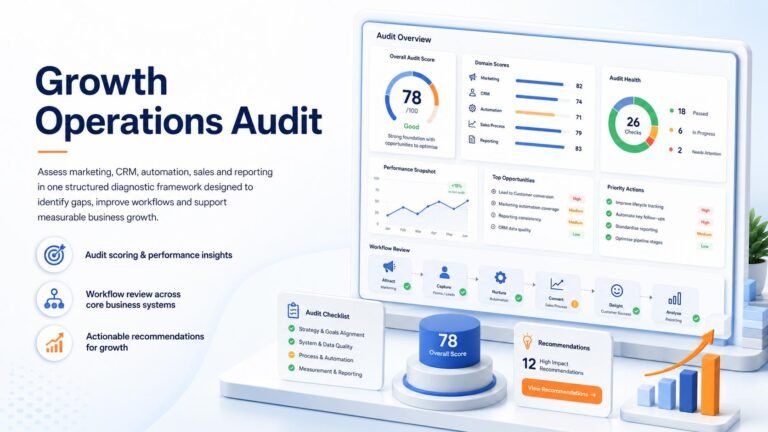
Find the gaps slowing your growth
The audit looks across the full customer and revenue journey rather than scoring individual tools in isolation. Complete one guided question at a time and the tool builds your maturity profile automatically.
Assess Today
Choose the statement that most accurately reflects how the business normally operates now.
Build the Profile
Your answers are scored across twelve operating dimensions covering demand, CRM, sales, lifecycle and AI readiness.
Find the Constraint
The result highlights the strongest capabilities and the weakest handoffs that can restrict the wider system.
Prioritise Action
Use the recommended sequence to stabilise foundations before adding more automation, AI or technology.
The assessment runs in your browser and does not require passwords, confidential customer records, financial account details or sensitive personal information.
What the Growth Operations Audit evaluates
The framework follows the connected customer and revenue journey. It looks for the operating gaps between teams, data and workflows that a software-only audit can miss.
Strategy & Objectives
Commercial priorities, ownership, targets and growth constraints.
Market Intelligence
Customer needs, demand signals, competitor activity and segment insight.
Visibility & Demand
Acquisition channels, source visibility and commercial performance.
Content & Experience
Journey coverage, content ownership, proof and next actions.
Conversion & Capture
Enquiry capture, response speed, routing and form design.
CRM & Customer Data
System of record, data quality, lifecycle stages and customer history.
Lead Management
Qualification, prioritisation, ownership and follow-up.
Automation & Workflow
Repetitive work, integrations, monitoring and failure handling.
Sales & Pipeline
Stage definitions, bottlenecks, handoffs and commercial progression.
Customer Lifecycle
Onboarding, retention, renewal, expansion and feedback loops.
Revenue Intelligence
Attribution, dashboards, trusted metrics and investment decisions.
AI Readiness
Use cases, permissions, human approval, reliable data and governance.
Choose the statement that most closely reflects how the business normally operates today.
Dimension complete
Result
Your strongest capabilities
Your highest-priority gaps
Your 12 dimension scores
What your overall score means
The headline score gives you a maturity band. The more important diagnostic is how the twelve dimensions compare, because one weak handoff can restrict the complete growth system.
0–24: Fragmented
Establish control around lead capture, ownership, CRM structure, response processes and trusted data.
25–49: Developing
Connect and standardise CRM data, qualification, routing, automation, handoffs and reporting.
50–74: Connected
Improve conversion, lifecycle automation, workflow monitoring, attribution and cross-functional performance.
75–89: Orchestrated
Increase adaptability, integration resilience, predictive signals, data governance and controlled AI use.
90–100: Adaptive
Protect governance and operating quality while continuously improving as complexity and channels evolve.
Growth Operations Audit vs marketing technology audit
Both can be useful, but they begin from different questions. Growth Operations starts with how the business creates, progresses and learns from demand.
| Check | Growth Operations Audit | Marketing Technology Audit |
|---|---|---|
| Starting point | Customer and revenue workflow | Software inventory and platform use |
| Scope | People, process, data and technology | Platforms, integrations and utilisation |
| Lifecycle | Marketing, CRM, sales and customer lifecycle | Usually marketing-system focused |
| Ownership | Operational responsibility and handoffs | Platform and technical ownership |
| Measurement | Activity connected to commercial outcomes | Usage, cost and system performance |
| Technology decision | May show that no new software is needed | Often determines whether tools should be retained or replaced |
Do you need more software?
Not necessarily. The audit may show that the business already owns most of the technology it needs and that the real constraint sits in configuration, process, data quality, ownership or integration.
Understand the Workflow
Define what should happen across the customer and revenue journey before changing technology.
Identify the Constraint
Find the point where information, ownership, response or action breaks down.
Define the Capability
Specify the process, data, control, integration and measurement requirement.
Evaluate Technology
Then decide whether to configure, integrate, consolidate, replace or add a system.
A new CRM, automation platform or AI tool cannot fix an undefined handoff. Stabilise the operating requirement first, then choose the smallest sustainable technology change that supports it.
Growth Operations Audit FAQs
Answers to common questions about the assessment, scoring approach, CRM requirements, AI readiness and what to do after receiving your result.
What is a Growth Operations Audit?
A Growth Operations Audit assesses how effectively your strategy, marketing, lead capture, CRM, automation, sales, customer lifecycle and reporting work together. It identifies disconnected processes, weak handoffs, manual work, data problems and measurement gaps that may limit growth.
How long does the Growth Operations Audit take?
The assessment is designed to be completed in one focused session. The time required depends on how familiar you are with your current marketing, CRM, sales and operational processes.
Do I need a CRM to complete the audit?
No. If your business does not currently use a CRM, the relevant questions will help identify whether customer and lead information is being managed reliably through another process.
Is this a marketing audit?
It includes marketing, but it is broader than a marketing audit. It evaluates the complete path from market demand and lead generation through CRM, sales, customer lifecycle and revenue measurement.
Is this the same as a RevOps audit?
There is significant overlap. Revenue Operations normally focuses on aligning marketing, sales and customer success around revenue. Growth Operations also examines the earlier demand-generation, discovery, content and conversion stages.
Will the audit recommend software?
The audit identifies capabilities and operating gaps before recommending technology. In some cases, the correct solution may be improving or connecting existing systems rather than buying another platform.
Can the audit identify automation opportunities?
Yes. It assesses repetitive work, handoffs, data movement, follow-up, routing and other processes that may be suitable for automation. Automation should only be introduced where the underlying process is sufficiently clear and controlled.
Does the audit assess AI readiness?
Yes. AI readiness is one of the twelve dimensions. It considers business use cases, data quality, permissions, governance, human oversight and whether AI is connected to real workflows.
What does a low score mean?
A low score usually means that important parts of the growth process are fragmented, informal or heavily dependent on manual effort. It does not mean that every system needs to be replaced. The priority is to establish reliable foundations.
What does a high score mean?
A high score indicates that growth processes are well connected, measured and governed. The focus usually shifts from basic integration toward optimisation, resilience, AI-assisted decision-making and continuous improvement.
Can different departments complete the audit together?
Yes. In larger organisations, completing the assessment collaboratively can be useful because marketing, sales, operations, customer service and leadership may see different parts of the workflow.
What if different people give different answers?
That difference is useful evidence. If teams disagree about how leads are qualified, who owns a stage or which metric is correct, the inconsistency itself may indicate an operational gap.
Should we aim for a score of 100?
Not necessarily. The objective is not maximum complexity. The right maturity level depends on the size, business model, customer journey, regulation, systems and commercial needs of the organisation.
Can BhavPro help implement the recommendations?
BhavPro can support Growth Operations strategy, CRM, workflow automation, AI automation, systems integration, digital acquisition and related operational improvements where those capabilities are appropriate to the identified gaps.
Continue from diagnosis into the right improvement area
Your result may point to an operating-model, CRM, automation or growth-stack issue. Use the related pages below to go deeper without treating every gap as the same problem.
Start with the complete operating model
Growth Operations connects marketing, CRM, sales, automation, customer operations and measurement into one system.
Modern Marketing Growth Stack
See how strategy, data, CRM, AI and automation fit together.
CRM Consulting & Integration
Improve customer data, lifecycle stages, pipelines and connected CRM workflows.
AI Automation
Introduce AI into defined workflows with controls, permissions and human oversight.
API & System Integration
Connect systems and data flows so operational context moves reliably.
Ready to improve the gaps identified by your Growth Operations Audit?
BhavPro can help translate the audit result into a prioritised operating plan across CRM, automation, sales handoffs, customer lifecycle, AI workflows, integrations and performance measurement.