
Business Strategy & Operations Consulting for UK Businesses
BhavPro provides strategy and operations consulting for UK businesses that need clearer priorities, repeatable processes and stronger operational control. We map workflows, define operating models, document SOPs, clarify roles and decision rights, design KPI routines and build practical improvement roadmaps that help leadership turn business goals into consistent day-to-day execution.
15+ Years Cross-Functional Experience
UK & Remote Delivery
Strategy-to-Execution Focus
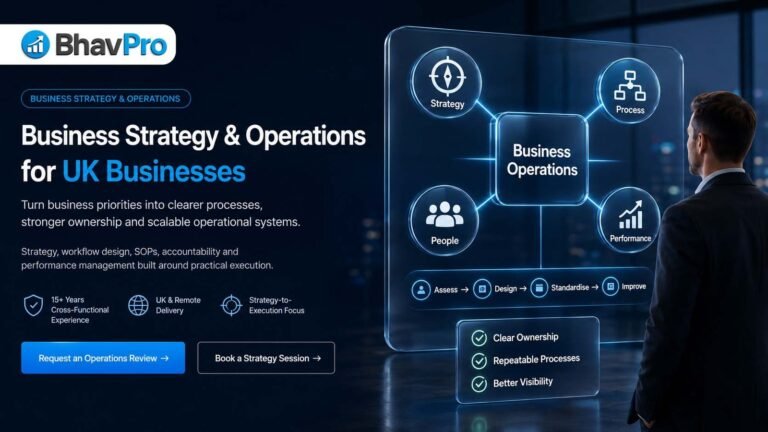
Growing businesses often reach a point where the commercial opportunity is clear but the operating model is not. BhavPro helps leadership translate priorities into processes, ownership, documentation, management routines and measurable improvement actions. The service is designed for businesses that need a clearer way to operate—not generic motivational strategy or a software implementation disguised as strategy consulting.
Business Strategy & Operations Consulting at a Glance
BhavPro helps growing businesses move from informal ways of working to a clearer operating model with explicit priorities, repeatable workflows and accountable ownership.
Strategy to execution
Translate leadership priorities into operating decisions, initiatives and management routines.
Process clarity
Map how work flows today, identify bottlenecks and define the target process.
Operating standards
Create SOPs, checklists, playbooks and role ownership around repeatable work.
Performance governance
Define KPI routines, scorecards, review cadence and improvement actions.
What This Service Is — and Is Not
Business Strategy & Operations Consulting owns the operating model and process decisions. It does not absorb every technology implementation discipline into one broad service.
Business Strategy vs Digital Transformation
These services are connected but answer different questions. Business Strategy defines how the organisation should operate; Digital Transformation defines how technology should support that model.
| Requirement | Business Strategy & Operations | Digital Transformation |
|---|---|---|
| Define priorities and operating model | Primary service | Uses as business context |
| Design SOPs and workflow ownership | Primary service | May reference as implementation input |
| Define technology target state | Supporting input | Primary service |
| Prioritise systems and architecture changes | Supporting input | Primary service |
| Define KPI/management routines | Primary service | May implement technology reporting |
| Build transformation technology roadmap | Not the main scope | Primary service |
Business Strategy vs CRM Consulting
Customer and sales processes may appear in both services, but Business Strategy owns the end-to-end operating process while CRM Consulting owns the CRM-specific system requirements.
Business Strategy
Defines lead-to-customer process, ownership, hand-offs, service model and management controls.
CRM Consulting
Defines CRM fields, stages, platform fit, governance, reporting and implementation requirements.
Used together
The operating process becomes the business input for CRM design rather than letting the CRM dictate how the company works.
Business Strategy vs AI Automation
Automation should follow a stable process rather than substitute for process design.
Business Strategy
Defines the workflow, responsibilities, exceptions, approvals and expected operating outcome.
Decision rule
Simplify first, standardise second, then automate only the parts that are sufficiently understood.
When Does a Business Need Strategy & Operations Consulting?
The service becomes valuable when growth exposes weaknesses in ownership, process consistency, documentation or management control.
Work depends on individuals
Critical knowledge sits with a few people instead of documented processes.
Teams handle the same task differently
Service quality or internal results depend too heavily on who performs the work.
Growth creates more admin
Adding customers or staff creates disproportionate coordination and manual effort.
Ownership is unclear
Tasks are visible but responsibility for the outcome is ambiguous.
Managers lack visibility
Leadership spends too much time chasing updates and reconstructing what happened.
Technology decisions come first
The business is buying tools before agreeing what the underlying process should be.
What's Included in Business Strategy & Operations Consulting
BhavPro focuses on operating clarity: how work should flow, who owns it, what should be documented, what leadership needs to measure, and which changes should happen first.
SOP Design & Process Documentation
Workflow Mapping & Bottleneck Analysis
Strategic Planning & Priority Alignment
Roles, Decision Rights & Accountability
KPI, Scorecard & Management Routine Design
Improvement Roadmaps & Implementation Handover
Playbooks for Onboarding & Scale
Business Priorities & Strategic Objectives
Operations design should be anchored to a real business priority. BhavPro helps leadership distinguish important strategic outcomes from a long list of disconnected improvement ideas.
Growth
What capabilities must improve to support more customers, services or staff?
Customer experience
Which operating problems create delay, inconsistency or avoidable friction?
Delivery quality
Where do errors, rework or unclear standards weaken service execution?
Management control
What information and routines does leadership need to run the business with less ambiguity?
Turn Goals into Strategic Initiatives
A strategy becomes operational when each priority has an owner, target outcome, dependencies and review mechanism.
| Question | Purpose |
|---|---|
| What outcome matters? | Define the business result or operating change |
| What prevents it today? | Identify the real constraint rather than the visible symptom |
| What capability is missing? | Define what the organisation must become able to do |
| What should change first? | Prioritise based on impact, dependency and readiness |
| Who owns the outcome? | Create accountability |
| How will we know? | Define evidence and review cadence |
Strategic Initiative Prioritisation
BhavPro can help leadership rank improvement initiatives so resources are not spread across too many simultaneous projects.
Business impact
How strongly does the initiative support an agreed priority?
Customer impact
Will it materially improve the customer or service journey?
Risk
Does it address a meaningful operational, compliance or resilience issue?
Readiness
Are ownership, process and information sufficiently clear to proceed?
Dependency
Must another decision or initiative happen first?
Effort & capacity
Can the organisation realistically absorb the change?
Business Operating Model Design
The operating model describes how strategy becomes day-to-day execution across people, process, information, management and supporting systems.
Customers & services
What does the organisation deliver, to whom and through which core journeys?
Processes
What repeatable workflows produce the intended outcome?
Roles & ownership
Who is accountable and who performs the work?
Management system
How are performance, exceptions and priorities reviewed?
Current-State Operating Model
Before redesigning operations, BhavPro maps how important work actually happens rather than relying only on policy documents or leadership assumptions.
- Key customer and internal workflows.
- People and teams involved at each step.
- Systems, spreadsheets and communication channels used.
- Manual hand-offs and repeated data entry.
- Approvals and decision points.
- Exceptions and common failure modes.
- Current measures and management routines.
- Existing SOPs, templates and undocumented workarounds.
Target Operating Model
The target state defines how the business should operate after the priority improvements are made.
Workflow
The desired sequence, ownership and exception handling.
Roles
Accountable owners, operators, approvers and escalation responsibilities.
Standards
SOPs, policies, checklists, templates and evidence required.
Management
KPI routines, review cadence, improvement ownership and decision rights.
Understand the Process Hierarchy
Businesses often call every activity a 'process'. A clear hierarchy helps determine what should be mapped, documented or measured.
| Level | Meaning | Example |
|---|---|---|
| Value stream | End-to-end outcome crossing several processes | Lead-to-customer |
| Process | Repeatable sequence producing a defined result | Lead qualification |
| Workflow | Operational movement of tasks/information | New enquiry → qualify → CRM hand-off |
| Task | Individual work activity | Validate contact details |
| Control | Check or decision protecting the process | Approval / exception review |
| SOP | Documented procedure for performing repeatable work | Lead qualification SOP |
Current-State Workflow Mapping
Workflow mapping makes hand-offs, delays and ownership visible. It provides a shared picture of the process before redesign begins.
- Start trigger and desired outcome.
- Activities and decision points.
- People/roles performing each step.
- Systems and information required.
- Waiting time and hand-offs.
- Approvals and exceptions.
- Failure or rework loops.
- Evidence/records produced.
BhavPro's Business Strategy & Operations Approach
A structured process moves from evidence and current-state workflows into target-state design, documented standards, accountable ownership and a prioritised improvement roadmap.
Discovery & Current-State Review
Understand business priorities, operating pain points, key workflows and existing documentation.
Process & Operating Model Mapping
Map how work flows across teams, systems, roles, hand-offs and decisions.
Target-State Design
Define the future process, ownership, controls, SOP structure and management routines.
Implementation Planning & Handover
Prioritise changes and route system, automation or training implementation to the correct specialist service.
Review & Continuous Improvement
Use agreed measures, issues and feedback to update processes rather than freezing them permanently.
Bottleneck & Friction Analysis
Not every slow step is the root problem. BhavPro reviews where workflow design creates repeated effort, delay or decision ambiguity.
Handoffs
Work waits because ownership changes unnecessarily.
Rework
Incomplete or inconsistent inputs force teams to repeat activity.
Queueing
Too much work accumulates at one role or approval point.
Duplication
The same information is entered, checked or communicated multiple times.
Exceptions
The standard process ignores common edge cases, forcing manual improvisation.
Visibility
Managers cannot see status without asking individuals for updates.
Target-State Process Design
Target-state design asks what should change before software or automation choices are made.
Remove
Eliminate steps with no useful outcome or control purpose.
Simplify
Reduce unnecessary decision points, forms or hand-offs.
Standardise
Define one normal path where teams currently improvise.
Control
Add ownership, approval or evidence where the process genuinely needs it.
Automate later
Identify repetitive stable steps suitable for later automation.
Measure
Define how the process will be monitored after the change.
Problem Framing & Root-Cause Analysis
BhavPro separates the visible symptom from the operating cause so teams do not buy tools to fix the wrong problem.
| Symptom | Possible operating cause |
|---|---|
| Leads are missed | Ownership, qualification or follow-up rules may be unclear |
| Projects run late | Scope, dependencies, capacity or decision rights may be weak |
| Customers receive inconsistent service | Standard process or quality controls may be missing |
| Managers chase updates | Status ownership and reporting routines may be poorly designed |
| Staff struggle to onboard | Knowledge, access, role expectations or SOPs may be fragmented |
SOP Design & Documentation
A useful SOP is a working operational document, not a long narrative copied from policy language.
- Purpose and intended outcome.
- Scope and boundaries.
- Process owner.
- Trigger and required inputs.
- Step-by-step activity.
- Decision points and conditions.
- Exceptions and escalation.
- Systems or templates required.
- Records/evidence created.
- Relevant controls and measures.
- Review owner and review date.
- Version history where appropriate.
Policy vs Process vs SOP vs Checklist vs Playbook
Different operating documents answer different questions. Using the right type keeps documentation easier to use and maintain.
| Document | Primary question |
|---|---|
| Policy | What rule or principle applies? |
| Process | What sequence happens to produce the outcome? |
| SOP | How should the repeatable work be performed? |
| Checklist | What must be confirmed or completed? |
| Playbook | How should the team respond to common scenarios? |
| Template | What standard structure should be reused? |
Improve Existing SOPs
Existing documentation is often valuable but may no longer match the live process. BhavPro can review SOPs against actual work.
- Remove outdated system or role references.
- Clarify ambiguous steps.
- Add missing owners and escalation routes.
- Separate normal path from exceptions.
- Reduce duplicated instructions.
- Identify where a checklist is better than prose.
- Align terminology across connected SOPs.
- Add review and version ownership.
SOP Ownership & Version Control
Documentation becomes unreliable when nobody owns maintenance. Every important SOP should have a clear lifecycle.
Owner
Accountable for keeping the procedure current.
Version
Shows which approved process the team should use.
Review date
Creates a trigger to reassess relevance.
Change record
Captures material updates where traceability is useful.
Roles, Decision Rights & Accountability
Operational scale requires more than job titles. BhavPro clarifies who owns outcomes, who performs work and who makes key decisions.
Accountable owner
Owns the result and resolves unresolved trade-offs.
Responsible operator
Performs the work or coordinates delivery.
Approver
Authorises defined decisions where approval is genuinely required.
Escalation owner
Takes responsibility when the normal workflow cannot resolve the issue.
When to Use a RACI Matrix
RACI can clarify complex cross-functional work, but it should not be forced onto every small process.
| RACI role | Meaning |
|---|---|
| Responsible | Performs the activity |
| Accountable | Owns the final outcome |
| Consulted | Provides input before a decision or action |
| Informed | Needs visibility after or during the activity |
For simpler processes, one accountable owner plus clearly named operators may be easier to maintain than a full RACI.
Process Mapping, Documentation & Collaboration Tools
Tools support the consulting method; they are not the service. BhavPro can work with common mapping, documentation, project and collaboration platforms where they fit the client’s existing environment.
Miro, Lucidchart or similar tools for process and workflow visualisation
Asana, ClickUp, Trello or similar tools for implementation actions and ownership
Google Workspace, Microsoft 365, Notion or similar environments for documentation and collaboration
Reusable SOP, policy, checklist, playbook and process templates aligned to the agreed operating model
Cross-Team Handoffs
Many scaling problems occur between teams rather than inside one team. BhavPro makes hand-off criteria explicit.
- What must be complete before hand-off.
- Who sends and receives ownership.
- Information that must accompany the work.
- Expected response/acceptance point.
- Conditions requiring rejection or rework.
- Escalation when the next team cannot proceed.
- System/status update confirming transfer.
Service Delivery Process Design
For service businesses, the core operating model often follows a set of end-to-end customer journeys that need consistent ownership.
Enquiry to qualification
Capture, qualify and route new opportunities.
Sale to onboarding
Move from commitment into clear client setup and expectations.
Onboarding to delivery
Establish access, scope, responsibilities and initial work.
Delivery to billing
Connect completed or recurring work with commercial administration.
Issue to resolution
Handle service problems with ownership and escalation.
Renewal / retention
Review value, open issues, scope and next-period decisions.
Remote & Hybrid Operating Models
Distributed work increases the importance of documentation, asynchronous hand-offs and explicit management routines.
Async documentation
Important decisions and process knowledge should not live only in calls or chat.
Meeting purpose
Use meetings for decisions and coordination rather than status reconstruction.
Ownership
Remote work needs clear task and outcome ownership.
Escalation
Teams need defined routes for blockers when managers are not physically present.
Employee Onboarding System Design
Onboarding works better when access, knowledge, expectations and manager checkpoints are part of one operating process.
- Pre-start information and responsibilities.
- System/account access.
- Role purpose and expected outcomes.
- Required SOPs and playbooks.
- First-week / first-month tasks.
- Manager checkpoints.
- Training and practical learning needs.
- Completion evidence or sign-off where appropriate.
For deeper learning delivery, see Technical Training Services.
Operational Knowledge Management
An SOP library only works when people can find the current information and know who owns it.
Source of truth
Define where approved operating documentation lives.
Naming & structure
Organise documents by process or role rather than personal folders.
Access
Give appropriate users access without exposing unnecessary information.
Maintenance
Review content after system, policy or process changes.
Management Operating Cadence
KPIs create value when they support decisions. BhavPro can design a review cadence around operational exceptions, performance trends and strategic priorities.
| Cadence | Typical focus |
|---|---|
| Daily / near-term | Exceptions, urgent blockers and operational risk |
| Weekly | Team scorecard, delivery issues, workload and committed actions |
| Monthly | Performance trends, recurring problems and improvement initiatives |
| Quarterly | Strategic priorities, resource allocation and operating-model changes |
KPI Framework Design
BhavPro helps define what should be measured, why it matters and who owns the response—not simply which chart should appear on a dashboard.
Strategic KPI
Shows progress against an important business objective.
Operational KPI
Shows whether a core process is performing as intended.
Leading indicator
Signals conditions likely to influence a future outcome.
Lagging indicator
Records an outcome after it has occurred.
Quality metric
Tracks errors, rework, complaints or conformance.
Capacity metric
Shows workload, utilisation or throughput constraints.
Define Metrics Properly
Metric names alone are not enough. Each KPI should have a definition that different managers can interpret consistently.
- Metric name.
- Business purpose.
- Calculation or counting rule.
- Data source.
- Owner.
- Reporting frequency.
- Target or expected range where supported.
- Exception or action rule.
- Known limitations in the underlying data.
What Better Operational Design Can Help Improve
Business outcomes depend on implementation and context. BhavPro focuses on practical operating improvements that can be observed and measured rather than promising fixed percentage gains.
Clearer onboarding steps, responsibilities and handover points
Fewer avoidable process gaps, repeated tasks and ownership ambiguities
More consistent service delivery, management visibility and team execution
Operational Scorecards
A compact scorecard should help a manager decide what needs attention rather than reproduce every available data point.
Outcome
What result is the team responsible for?
Health
Which measures show whether the process is working?
Exceptions
Which conditions require action?
Commitments
What actions were agreed and who owns them?
Operational Governance
Operational governance defines how standards are maintained and how changes are approved when several teams depend on the same process.
- Process owner.
- Document owner.
- Change decision rights.
- Approval threshold.
- Exception handling.
- Management review cadence.
- Improvement backlog ownership.
- Escalation route for unresolved cross-team issues.
Continuous Improvement System
A process should not be frozen after an SOP is written. BhavPro can define a lightweight cycle for learning from real operational evidence.
Observe
Collect issues, exceptions, feedback and performance evidence.
Measure
Use agreed metrics to identify where the process is not behaving as intended.
Analyse
Determine whether the problem is process, ownership, capacity, data or system related.
Improve
Make a controlled change with an owner and expected effect.
Standardise
Update SOPs, checklists or system rules where the change proves appropriate.
Review
Reassess later and retain an improvement backlog.
Capacity & Workload Planning
Scaling often fails because the process is documented but the organisation has not considered workload and bottleneck capacity.
Demand
How much work enters the process and when?
Capacity
How much work can the role/team reasonably complete?
Constraint
Which step limits throughput or creates queueing?
Response
Should the organisation simplify, redistribute, automate or add capacity?
Delegation & Management Span
Founders and managers often become operational bottlenecks when decisions have not been intentionally delegated.
- Identify decisions that genuinely require leadership.
- Define safe decisions that can move to process owners.
- Set thresholds for approval and escalation.
- Document information required before escalation.
- Use management review rather than pre-approving every routine action.
- Monitor outcomes so delegated authority remains accountable.
Who Should Use Business Strategy & Operations Consulting?
- Growing SMEs and service businesses that need repeatable operating processes
- Agencies, consultancies and professional-service firms scaling delivery across more people
- Remote or hybrid teams that need clearer ownership, documentation and management routines
- Businesses experiencing operational friction, unclear hand-offs, inconsistent delivery or weak process ownership
Operational Change Management
Process redesign changes responsibilities and habits. Implementation planning should account for people and adoption, not only documentation.
Impact
Which roles, tasks and routines change?
Communication
Why is the change happening and what is expected?
Readiness
Are documents, access, systems and managers prepared?
Reinforcement
How will adoption problems or process drift be detected?
Technology & Automation Recommendations
Business Strategy can identify where technology should support the operating model, while technical implementation remains in the relevant specialist service.
Compliance-Aware Process Design
Business processes may need approvals, records, access controls or evidence because of contractual, regulatory or policy requirements. Business Strategy can capture those operating requirements without presenting itself as legal advice.
- Identify where a process needs evidence or approvals.
- Clarify ownership for control steps.
- Document exceptions and escalation.
- Separate business operating requirements from legal interpretation.
- Route specialist readiness questions into Compliance Advisory where appropriate.
For deeper compliance-readiness work, see Compliance Advisory.
What You Receive
Deliverables depend on scope, but an engagement should leave the business with concrete operating decisions and reusable working documentation.
Current-state findings
Process maps, pain points, ownership gaps and operational constraints.
Target operating model
Defined future workflow, roles, decision rights and management routines.
SOP / document set
Agreed procedures, checklists, playbooks or responsibility matrices.
KPI framework
Metric definitions, owners and review cadence.
Improvement backlog
Prioritised actions with owners and dependencies.
Implementation roadmap
Sequence for internal delivery or hand-off into specialist technology/training services.
Business Strategy & Operations Engagement Models
BhavPro can scope work around a defined operational problem rather than forcing every business into a large transformation programme.
Operations Review
Focused current-state assessment of priority workflows and operating gaps.
SOP & Process Design
Deep work on a selected process, documentation set and ownership model.
Operating Model Engagement
Broader design across teams, workflows, KPIs and management routines.
Ongoing Improvement Advisory
Periodic review of scorecards, process issues and improvement priorities.
What Affects Consulting Cost?
Pricing depends on the number of processes, teams and decisions involved rather than one generic package.
- Number of workflows in scope.
- Number of teams and stakeholders.
- Quality of existing documentation.
- Current-state process discovery required.
- Target operating-model depth.
- Number of SOPs / playbooks / checklists required.
- KPI and governance design.
- Workshops and leadership alignment.
- Implementation-planning requirements.
How Long Does Business Strategy & Operations Consulting Take?
A focused SOP review and an organisation-wide operating-model engagement require very different levels of discovery and stakeholder input.
Evidence & Recommendation Standard
BhavPro does not promise fixed reductions in errors, doubled onboarding speed or guaranteed growth before the operating baseline and implementation evidence are understood.
Evidence-led
Recommendations connect to observed workflows, stakeholder evidence and explicit business priorities.
Assumptions stated
Where data is incomplete, BhavPro documents the limitation rather than inventing precision.
Measure after change
Operational outcomes should be compared against agreed baseline measures where reliable data exists.
No guaranteed outcome
Results depend on implementation quality, leadership follow-through, staff adoption and business conditions.
Review available project evidence in the BhavPro Portfolio and client reviews.
Related BhavPro Capabilities
Business Strategy owns the operating model. Use connected services when the requirement becomes specialist technology, implementation or capability development.
Digital Transformation
CRM Consulting
CRM Implementation
AI Automation
Technical Training
Digital Products
Related BhavPro Services
Business Strategy owns the operating model and process decisions. Once those decisions are approved, specialist implementation should move into the service that owns the technology or training work.
Digital Transformation Consulting
Connect the target operating model to systems, technology, data and transformation roadmaps.
CRM Consulting & Implementation
Translate customer-process requirements into CRM strategy, configuration, migration and reporting.
AI & Workflow Automation
Implement suitable automation opportunities after the process and exception model is defined.
Technical Training Services
Build team capability and adoption around approved processes, systems, tools and operational responsibilities.
Compliance & Risk Advisory
Support deeper compliance readiness, risk interpretation, governance and regulatory requirements beyond operating-process design.
Turn Business Priorities into Clear Operating Systems
Book a Strategy Session
Discuss the operating challenges, growth priorities and decisions leadership needs to make before committing to process or system changes.
Request an Operations Review
Share the workflows, teams and operational issues you want reviewed so BhavPro can define an appropriate consulting scope.
Email a Business Strategy Enquiry
Have a specific question about SOPs, operating models, accountability or process improvement? Email BhavPro with the current situation and desired outcome.
BhavPro can start with a focused workflow review or a broader operating-model engagement, then route approved implementation into the appropriate specialist service.
Frequently Asked Questions About Business Strategy & Operations Consulting
Answers about operating models, SOPs, process mapping, accountability, KPIs, remote teams, technology hand-off, engagement scope and implementation.
It helps leadership translate business priorities into an operating model with clearer workflows, ownership, SOPs, management routines and measurable improvement actions. BhavPro focuses on strategy-to-execution for growing businesses rather than generic corporate-strategy presentations.
It is best suited to growing SMEs, agencies, professional-service firms and operational teams dealing with inconsistent processes, unclear ownership, weak documentation, scaling friction or too many manual hand-offs.
An operating model describes how the business delivers its strategy through roles, processes, decision rights, management routines, information and supporting systems. BhavPro focuses on making that model practical enough to operate day to day.
A standard operating procedure documents how a repeatable activity should be performed, including purpose, scope, owner, steps, decisions, exceptions, controls and review responsibilities where appropriate.
Yes. BhavPro can map current workflows, identify hand-offs and bottlenecks, clarify ownership and convert agreed target processes into SOPs, checklists, playbooks or other useful operating documentation.
Yes. Existing SOPs can be reviewed for unclear steps, missing ownership, outdated system references, weak exception handling, duplication and gaps between the documented process and how work actually happens.
Yes. Remote and hybrid operating models can be reviewed for documentation, ownership, communication, meeting cadence, asynchronous hand-offs, approvals, knowledge management and escalation.
Business Strategy & Operations defines how the business should operate. Digital Transformation Consulting focuses on how technology, systems and data should support that target operating model.
Business Strategy can define customer and sales processes at operating-model level. CRM Consulting owns detailed CRM requirements, platform fit, governance and CRM-specific strategy.
Business Strategy can identify automation opportunities and define the target workflow. Technical implementation is separately scoped through services such as AI Automation or API Integration.
Yes. BhavPro can help define the management questions, KPI definitions, owners, reporting cadence and scorecard structure. Technical dashboard build can be scoped separately if a system implementation is required.
Yes. The engagement can map onboarding responsibilities, access, documents, SOPs, first-week tasks, manager checkpoints and completion evidence. Practical training delivery can be routed into Technical Training where required.
Depending on scope, deliverables may include current-state process maps, target operating model, SOPs, responsibility matrices, KPI definitions, operating cadence, improvement backlog and an implementation roadmap.
Timescale depends on the number of processes, teams, stakeholders and deliverables. BhavPro defines the discovery and delivery sequence after understanding the operating problem rather than applying one fixed timeline to every engagement.
Cost depends on scope, number of workflows, stakeholder involvement, documentation depth, workshops, operating-model design and implementation-planning requirements. BhavPro scopes the engagement around the actual business problem.
The approved operating model, SOPs and improvement priorities can be implemented internally or routed into the relevant BhavPro service for CRM, automation, digital transformation, API integration, technical training or other specialist delivery.