
3CX Phone System UK: Licensing, Hosting, SIP Trunks & Deployment
Assess whether 3CX fits your business: compare licence editions, simultaneous-call capacity, hosting choices, supported UK SIP providers, call flows, integrations, costs and migration responsibilities.
Fast answer: 3CX is a business phone-system platform that manages users, extensions and calls. UK businesses choose a 3CX licence, size its simultaneous-call capacity and arrange suitable hosting and SIP/number services. It can offer flexibility, but the full solution still needs network readiness, security, support, integrations and controlled number migration. The right choice is based on the complete operating model—not only the headline annual licence.
What Is the 3CX Phone System?
3CX is a software-based private branch exchange (PBX) that provides business calling, extensions, call routing, ring groups and other telephony functions. It connects calls to the external telephone network through a separately selected SIP trunk or VoIP provider. People can use supported desk phones, desktop clients and mobile apps, depending on the deployment and configuration.
Unlike a single fixed hosted-phone package, 3CX lets an organisation choose its hosting model and, within supported configurations, its SIP carrier. The practical decision is about the whole phone service: licence, call capacity, numbers, hosting, endpoints, integrations, security, management and support.
Choose 3CX when you need a configurable PBX and want to control how telephony is hosted, integrated and operated. Do not choose it solely because it is described as cheaper than per-user services; compare the actual total cost and internal support burden.
3CX is not a SIP trunk
The PBX manages extensions and call logic; the SIP trunk connects that PBX to public telephone numbers. A 3CX licence does not itself replace the carrier contract, numbering arrangements or number-porting requirements.
3CX is not the same as Microsoft Teams Phone
Teams Phone places calling in the Teams collaboration environment. 3CX provides a dedicated PBX model with its own web client, apps, trunk and hosting choices. Both can be viable, but user workflow, administration, telephony depth and PSTN responsibilities differ.
How Does 3CX Work in a UK Business?
A UK inbound call usually reaches a business number at the SIP provider, which delivers the call to the 3CX PBX. 3CX then applies inbound routing, schedules, queues or ring groups and sends the call to the intended user or team.
For outgoing calls, the user dials from an authorised endpoint, 3CX applies the relevant outbound rule and the SIP provider transports the call. Caller ID presentation, number format and emergency calling depend on the exact provider and trunk configuration.
Where Does 3CX Fit Best?
3CX can suit organisations that want a configurable business PBX rather than a basic call-forwarding package. Fit should be assessed against the complexity of call flows, administration and integration requirements, not only the number of employees.
Office and hybrid teams
Central business numbers, extension dialling and mobile/desktop calling for staff working across locations. Confirm endpoint and home-network support.
Reception and shared lines
Ring groups, departments, office hours and call escalation. Map the actual caller journey before copying legacy routes.
Sales and service teams
Queues, reporting and CRM integration can support customer-facing work. Verify edition-specific features and required data governance.
Multi-site businesses
Central administration can simplify some call routing. Define site dependencies, numbering, support ownership and resilience separately.
3CX Licensing: SMB Free, Basic, PRO and AI
As described by 3CX in its current licensing guidance, the product family includes SMB Free, Basic, PRO and AI. Edition names, entitlements and packaging can change. Do not rely on older editions or a historical quote when selecting a system.
| 3CX option | Indicative purpose | Check before choosing |
|---|---|---|
| SMB Free | Small-business entry option subject to its published eligibility, capacity and hosting terms. | Current limits, support model, included functionality and whether the free offering meets your continuity needs. |
| Basic | Core business telephony, apps and ordinary calling functions. | Call handling features and exclusions, integrations, recording and administration. |
| PRO | Broader call-centre, CRM/other integrations and reporting capabilities. | Exactly which queues, reports, integrations and retention functions are included. |
| AI | Higher-tier AI automation, transcripts, summaries and advanced capabilities where supported. | Licensing, availability, data handling, UK compliance and the AI tasks you genuinely need. |
Important: this is an editorial buying guide, not an authoritative price list or contractual feature matrix. Confirm the exact plan and compatibility against the current 3CX licence guide and 3CX live pricing at purchase.
How to Size 3CX Simultaneous Calls
Commercial 3CX licences are generally based on an annual system licence sized by simultaneous calls (SC), not a separate licence charged for each user. A simultaneous call is a call active at the same time as others; 3CX states that internal as well as external calls count. An idle extension does not consume SC capacity, although user or extension limits still apply to each licence size.
Practical sizing procedure
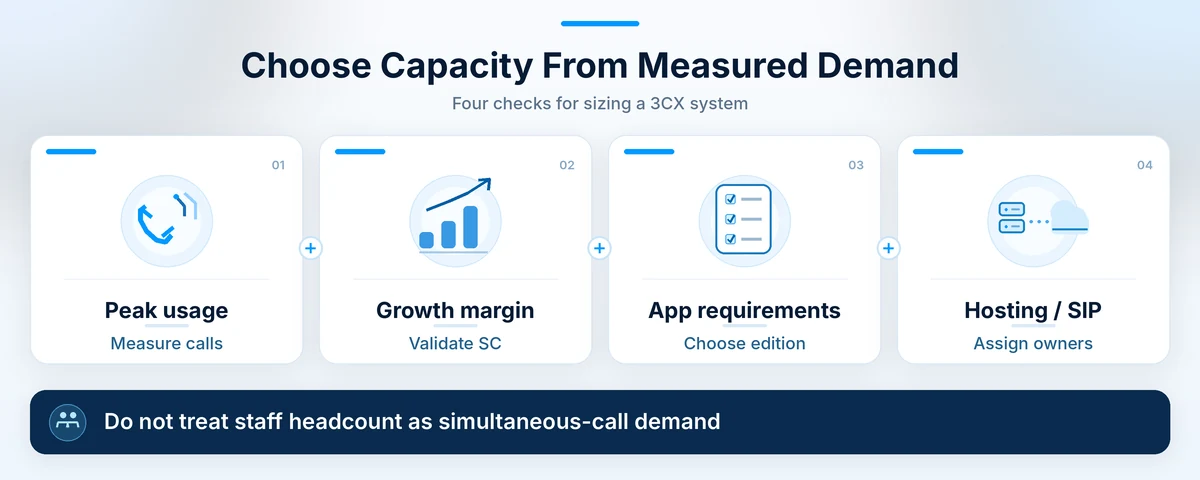
- Measure the busiest normal calling periods; use real call records if available.
- Count internal and external concurrent calls rather than estimating from staff headcount.
- Account for inbound queues, outbound sales or service activity and unusual peaks.
- Allow capacity for seasonal demand and foreseeable growth.
- Check the candidate edition’s recommended and maximum extensions, not just SC count.
- Check the effects of conferences, recording and operational scenarios in the latest product documentation.
Illustrative sizing example
Suppose historical traffic shows 12 active calls at the busiest period. Allowing 25% headroom gives an indicative requirement of 15 simultaneous calls. A 16-SC option could be a candidate for evaluation, but only if current 3CX user limits, feature behaviour and expected future peaks also fit. This is a planning illustration, not a measured BhavPro client result or a final supplier recommendation.
Thirty users do not automatically need a 30-SC licence; equally, a low user count does not guarantee low concurrency. The system must also remain usable during important call peaks.
3CX Hosting: 3CX-Hosted, Self-Hosted or On-Premises?
3CX documents three broad deployment approaches. The right one is determined by operational responsibility, control, network conditions and internal technical support—not simply by a preference for “cloud”.
| Hosting approach | Who manages core infrastructure? | Main consideration |
|---|---|---|
| Hosted by 3CX | 3CX operates the hosted system infrastructure within the service terms. | Hosting is a distinct commercial/service layer; verify support entitlement, backup and caller-side dependencies. |
| Self-hosted cloud | Customer or partner maintains the cloud environment and relevant PBX operations. | Hosting account, instance sizing, network, operating system, updates, backup and monitoring need ownership. |
| On-premises | Customer or support partner operates infrastructure at a business site. | Power, internet, firewall, physical security, backup and local resilience are central. |
3CX's installation guide explicitly separates Hosted by 3CX, self-hosted private cloud and on-premises deployment. It also distinguishes hosting from technical support. Review the exact terms of a quote rather than assuming “hosted” means every support task is included.
Choosing a UK SIP Trunk and Business Numbers for 3CX
3CX requires a route to the public telephone network for ordinary external calling. Businesses generally arrange this through a separately selected SIP trunk/VoIP provider and the appropriate telephone numbers. Number hosting, trunk charging and 3CX software licensing are distinct services.
Provider interoperability
Start with the 3CX UK supported SIP-trunk directory. Check the provider’s category and configuration guide rather than assuming all carriers have the same support status.
Inbound and outbound requirements
Document main numbers, DDI ranges, presentation numbers, call limits, international routing, emergency calling and the required inbound destinations.
Trunk registration and IP mode
Some hosted arrangements favour registration-based trunks because hosted public IPs may change. Confirm the exact mode, IP restrictions and provider compatibility.
Porting and cutover
Validate the current account, number estate and provider records before port requests. Keep the existing service active until the agreed migration and testing process permits closure.
Changing SIP provider may require new trunk configuration, number-porting paperwork, CLI rules, emergency location checks and call-route testing. A supported provider can reduce compatibility risk but does not remove commercial or migration responsibilities.
3CX Features: Extensions, Ring Groups, IVR and Call Queues
Begin with the caller journey, not the feature catalogue. Standard features may be available with different edition boundaries, limits or setup steps. Confirm the target licence and deployment before designing dependent processes.
| Capability | What it does | Practical design check |
|---|---|---|
| Extensions and user applications | Gives employees calling identities and access from eligible clients or devices. | Role, endpoint, presence, access and administration. |
| Ring groups | Offers a call to multiple extensions in parallel or sequence. | Timeouts, members, overflow and out-of-hours actions. |
| Call queues | Allows callers to wait for an available agent under configured rules. | Polling, capacity, callback, login/logout, reporting and edition availability. |
| IVR / digital receptionist | Routes callers by menu or other defined decisions. | Prompts, menu depth, accessibility, fallbacks and exception handling. |
| Business-hours routing | Changes call destinations by schedule and date. | Holidays, departmental differences and emergency overrides. |
| Call recording | Stores selected call audio when enabled and supported. | Lawful purpose, access, retention, export and storage costs. |
| Analytics / reporting | Shows selected call and agent activity. | Required metrics, exclusions, time zones, report access and exports. |
The official 3CX call queues and ring groups guide explains the operational differences. For complex service teams, validate live routing and reporting with a pilot rather than trusting the feature name alone.
3CX and CRM Integration: What Can Be Automated?
Connecting 3CX to a CRM or helpdesk can help staff identify callers and follow up enquiries, but an available integration does not guarantee the business workflow has been designed correctly.
Useful outcomes
Caller identification, click-to-call, activity records, missed-call tasks, contact matching and call-related reporting, where supported by the chosen integrations and licence.
Data and failure controls
Define duplicate contacts, consent, retention, API credentials, mismatched records, failed logging and who resolves missed calls when a connector is unavailable.
Work through one real business scenario—such as a missed sales enquiry—and test how the system creates, assigns and closes the follow-up task. That is more useful than checking only whether “CRM integration” appears on a sales page.
3CX Security, Operations and Resilience
A 3CX deployment needs business controls in addition to platform software. Relevant responsibilities change depending on whether 3CX, the business or a support partner operates the infrastructure.
Access and permissions
- Named administrators and least privilege
- Strong authentication and lifecycle controls
- Approved calling and route-change permissions
- Prompt suspension of leavers
Network and endpoints
- Supported clients and device lifecycle
- Appropriate firewall and network configuration
- Voice-quality tests on real connections
- Separate remote-user support procedure
Call fraud and data
- Destination restrictions where appropriate
- Trunk usage and unusual-call alerts
- Recording access and retention policy
- Incident and audit records
Continuity and recovery
- Backup and restoration arrangements
- Alternative connectivity/number rerouting
- Documented support and escalation
- Tested power and internet failure response
Confirm emergency services routing, location information, caller presentation and limitations with the chosen UK SIP provider and the actual user-location model. Remote users and number moves need special consideration; never assume that a PBX test call proves emergency-location accuracy.
How Much Does a 3CX Phone System Cost in the UK?
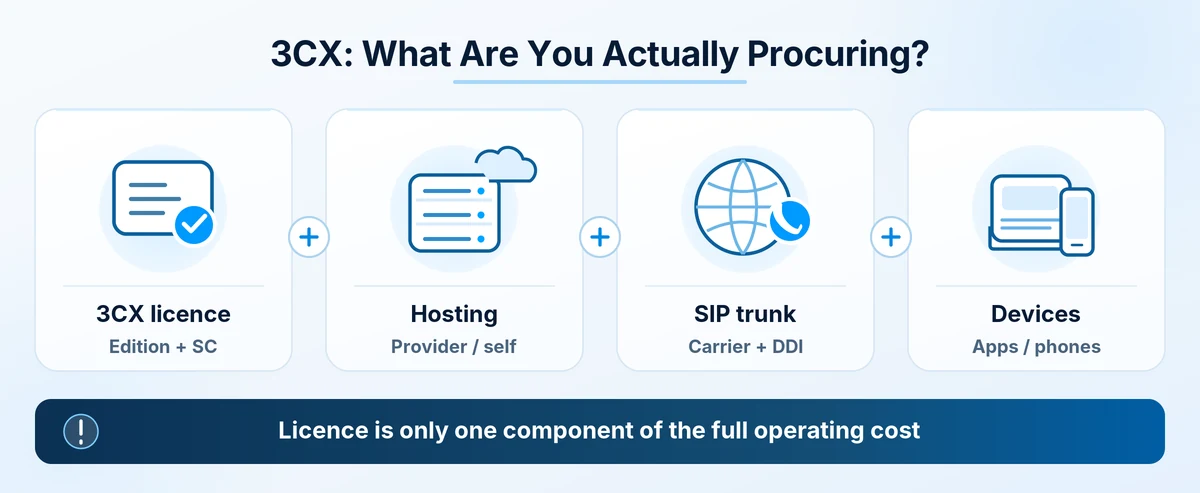
A 3CX business deployment should be budgeted as a complete service, not just a PBX licence. The commercial system licence is ordinarily annual and sized by simultaneous-call capacity and edition, but other costs depend on the chosen system.
| Cost layer | Typical scope | What to confirm |
|---|---|---|
| 3CX system licence | Edition and annual SC capacity. | Exact plan, permitted users, capacity and renewal terms. |
| Hosting / infrastructure | 3CX-hosted fee, third-party cloud or on-site compute. | Separate hosting fee, resources, backups and responsibility. |
| SIP trunk and numbers | Carrier connection, DDI numbers and calling usage. | Channels, bundles, international rates, presentation and emergency terms. |
| Endpoints / networking | Desk phones, headsets, cabling, WAN and remote work. | Compatibility, device support and network improvements. |
| Implementation / migration | Call design, deployment, testing and number transfer. | One-off setup, porting, training and integration effort. |
| Support and operations | Incident help, upgrades, monitoring and changes. | Service ownership, SLAs, out-of-hours cover and exclusions. |
Published prices can change and may be displayed in a currency other than sterling. Validate current tax/VAT, exchange rates, contractual terms and any renewal changes. No fixed UK price is stated here because it would require a dated supplier quote and a defined system.
Compare a 3CX proposal with alternatives using the same three-year scenario: calling demand, required features, platform, SIP, hosting, equipment, implementation, support and likely changes. A low system licence is not equivalent to a fully supported telephony service.
3CX vs Hosted VoIP vs Microsoft Teams Phone
These choices overlap technically, but they are not interchangeable. Compare who operates the PBX, where users work, the PSTN/carrier model, integration needs and the support arrangement.
| Decision factor | 3CX | Managed hosted VoIP | Teams Phone |
|---|---|---|---|
| Core proposition | Configurable dedicated PBX software | Provider-managed calling service | Calling integrated with Teams |
| PSTN model | Separately selected compatible SIP carrier | Usually bundled or provider-selected | Microsoft or supported partner connectivity model |
| Hosting responsibility | Choose 3CX-hosted, self-hosted or on-prem | Primarily provider-operated | Microsoft-hosted Teams platform |
| Licence logic | System edition and simultaneous calls for commercial tiers | Usually provider-defined user/service plan | Teams Phone and PSTN licences/services |
| Main buying risk | Underestimating operational support and sizing | Overlooking contract limits or routing depth | Confusing Teams Phone with PSTN connectivity |
If most employees already work in Microsoft Teams, that should influence the shortlist. If the requirement is a more independently configured PBX with dedicated call-routing or hosting choices, 3CX may deserve closer assessment. Procurement should remain provider-neutral.
3CX Implementation and Migration Plan
Build and test the new service before number cutover. A safe deployment has clear ownership and acceptance criteria for every critical call path.
1. Discover the estate
Record users, numbers, current PBX, analogue dependencies, contracts, sites and current calling patterns.
2. Design the 3CX solution
Confirm edition, simultaneous calls, hosting model, SIP provider, extensions, caller journeys and identity controls.
3. Build and secure
Configure the platform, routes, endpoints, permissions, business hours, monitoring and backups.
4. Pilot and validate
Test inbound/outbound calls, queue behaviour, transfers, caller ID, devices, CRM events and failure paths.
5. Port numbers and cut over
Agree porting ownership, supplier coordination, go-live window, rollback constraints and escalation contacts.
6. Handover and monitor
Provide admin runbooks, a user guide, escalation procedures, change approvals and an operational review.
Where a project involves several offices, departments or carriers, use a phased plan if practical. Do not assume that porting or carrier routing can be reversed instantly after a failed cutover.
3CX and the UK Digital Phone Transition
Openreach currently says traditional UK business phone lines need to move to a digital service by 31 January 2027. A 3CX PBX with suitable IP calling connectivity may be one part of a business’s migration plan, but it does not automatically replace every analogue device using an older line.
Check alarms, lift phones, door entry, payment terminals, fax, monitoring equipment and any other service that depends on a legacy connection. Those systems require their own supplier and technical assessment.
Treat the PBX migration and the traditional-line dependency audit as related but separate workstreams. Confirm equipment compatibility and service continuity with the relevant provider before ceasing legacy circuits.
Common Mistakes When Buying or Deploying 3CX
Sizing only by employee count
Count active internal and external calls at busy periods; check extension limits and reserve capacity.
Treating a licence as a complete phone service
Include carrier, numbers, hosting, implementation, devices, support and migration costs.
Choosing an unsupported carrier without evaluating risk
Check 3CX’s current UK SIP provider listing and the exact provider configuration requirements.
Skipping an end-to-end pilot
Test actual customer journeys, caller ID, CRM, recording, remote endpoints, transfers and outage procedures.
Ignoring service ownership
Name the people who change routes, renew licences, administer accounts, restore backup and handle faults.
Assuming every edition includes every feature
Verify Basic/PRO/AI entitlements and any third-party services before creating a dependency.
3CX Procurement and Readiness Checklist
Use these checks as an acceptance gate before committing to a supplier or preparing a number port.
Business requirements
- Named owner and use cases
- Peak concurrent call records
- Users, locations and remote roles
- Agreed numbers and caller journeys
Commercial requirements
- Current licence edition and SC sizing
- Hosting, SIP and calling costs separately
- Support and response boundaries
- Renewal, exit and number-porting terms
Technical readiness
- Supported SIP trunk and devices
- Firewall, connectivity and power
- Admin security, backup and recovery
- Recording and integration governance
Go-live sign-off
- Inbound/outbound and emergency calling reviewed
- Queues/IVR and office hours tested
- Call recording and CRM scenarios tested
- Handover and escalation runbook accepted
3CX Phone System FAQs
What is 3CX used for?
3CX is software-based PBX technology used to manage business calls, extensions, routes, ring groups and other phone-system functions. External calling normally uses a separately selected SIP trunk provider.
Is 3CX a cloud phone system?
It can be. 3CX can be hosted by 3CX, self-hosted in a supported cloud environment or installed on-premises. The hosting choice determines much of the infrastructure responsibility.
Does 3CX charge per user?
Commercial 3CX licensing is primarily priced per system and simultaneous-call capacity rather than a separate fee for every user. Published user and extension limits still apply to each licence size.
What is a 3CX simultaneous call?
It is a call active at the same time as other calls on the PBX. According to 3CX licensing guidance, both internal and external calls count; an idle extension does not consume concurrent-call capacity.
What is the difference between 3CX Basic, PRO and AI?
3CX describes Basic for core telephony, PRO for broader contact-centre and integration functions, and AI for advanced AI and analysis features. Confirm the current feature matrix before buying.
Does a 3CX licence include SIP trunks and numbers?
No. The SIP trunk and business telephone numbers are generally sourced separately; hosting and support may also be separate commercial elements.
Can 3CX keep our existing UK business numbers?
Often, through a suitable provider and an agreed number-porting process. Inventory the numbers and associated services before changing or ceasing the old arrangement.
Can 3CX integrate with CRM?
Integration options are available for supported platforms and suitable licence tiers. Test contact matching, activity logging, permissions and failures in the specific CRM workflow.
Can I use 3CX with Microsoft Teams?
The systems serve different core roles. Integration possibilities and product support depend on the current editions and configuration; do not assume the same features as Teams Phone without a documented design.
What happens to 3CX calls during an internet outage?
Users and SIP routes need working connectivity. A cloud PBX may remain online but local callers or agents can lose access. Plan failover, alternate connectivity and rerouting with the provider.
What should a 3CX quote include?
The system licence and simultaneous-call size, hosting, SIP/number charges, hardware, migration, integrations, support, continuity and any applicable tax or exchange-rate effects.
Is 3CX right for every small business?
No. Some organisations need a simpler provider-managed service. The right choice depends on call flow complexity, support capability, user workflow, cost and operational risk.
How This 3CX Guide Was Researched
This is an independent, business-requirements-led explanation of 3CX deployment. The guide separates phone-system licence, simultaneous-call sizing, hosting, UK SIP/carrier interoperability, numbers, workflows and operational responsibility. It does not represent a 3CX certification, supplier endorsement or an existing client case study.
Product licensing, edition names, hosting options and supported carriers are time-sensitive and should be reconfirmed before procurement. Technical recommendations are conditional on the exact version, licence, call workload, supplier contract and local compliance requirements.
Primary sources reviewed
- 3CX — Licensing, Editions and Simultaneous Calls
- 3CX — Current Pricing and Hosting Selection
- 3CX — Deployment and Installation
- 3CX — UK Supported SIP Trunk Providers
- 3CX — SIP Trunk Configuration
- 3CX — Ring Groups and Call Queues
- Openreach — Digital Phone Lines for Businesses
Editorial research date: 30 October 2026. This is an editorial staging draft, not confirmation of publication or a current supplier quotation.
Need Help Evaluating 3CX for Your Business?
BhavPro’s provider-neutral VoIP consulting approach can help structure requirements, compare call-control choices, evaluate UK SIP/number dependencies and develop a migration and acceptance-testing plan. Any implementation, supplier procurement or support commitment should be agreed separately in the project scope.
Explore VoIP Consulting Services →Discuss Your Requirements →
Executive Summary
- 3CX is a software PBX, not a complete carrier service. External telephone numbers and calling usually rely on a separately chosen SIP provider.
- Size by active calls and extension limits. Commercial licensing is system-based with simultaneous-call capacity rather than simple per-user charging.
- Choose the appropriate current edition. Check the Basic, PRO and AI feature matrix and any SMB Free terms against your needs.
- Hosting changes operational responsibility. Compare 3CX-hosted, self-hosted and on-premises deployment including support and continuity.
- Validate the UK carrier and number estate. Check supported SIP provider configuration, caller ID, porting, emergency calling and contingency.
- Model full cost and test before cutover. Include software, hosting, SIP, calling, devices, migration, integration, support and ongoing changes.
About the Author