
Telecom SaaS Consulting for VoIP & UCaaS Platforms
BhavPro provides telecom SaaS consulting for businesses building or scaling VoIP, UCaaS and cloud communications platforms. We advise on platform architecture, service provisioning, rating and billing, carrier connectivity, multi-tenant design, customer portals, APIs, operational controls and launch planning, helping teams translate commercial telecom requirements into a clear implementation-ready platform blueprint.
15+ Years Telecom & Technology Experience
UK-Based, Remote Delivery
Architecture-Led Engagement
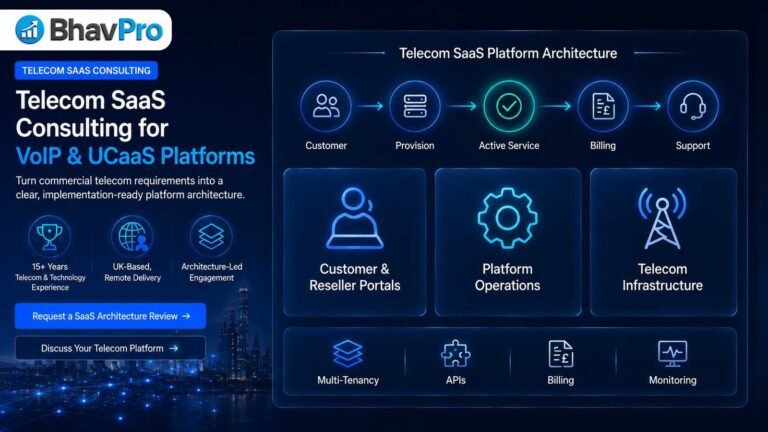
Telecom SaaS Consulting at a Glance
BhavPro helps telecom founders, service providers, MSPs and communications businesses turn a commercial service concept into a platform architecture that can be scoped, evaluated and implemented. The work connects the telecom lifecycle with billing, customer operations, carrier dependencies, portals and technical controls.
Platform architecture
Define the major modules, responsibilities, service boundaries and dependencies required to operate the telecom product.
Provisioning & lifecycle
Model how services are ordered, provisioned, changed, suspended, terminated and recovered when automated steps fail.
Rating & billing
Define usage, rate, charging, invoice and credit-control requirements before choosing or building the billing implementation.
Multi-tenant operations
Design platform-owner, reseller, customer and end-user roles with appropriate separation, branding and delegated administration.
What Is Telecom SaaS Consulting?
Telecom SaaS consulting is specialist product and platform advisory for organisations that sell or manage communications services through software. It combines telecom-domain requirements—such as numbers, SIP, provisioning, usage and billing—with SaaS concerns such as tenancy, portals, APIs, roles, subscriptions, reporting and operational controls.
Commercial model to platform model
Translate products, routes, rates, customers, resellers and service rules into platform capabilities the implementation team can actually build or configure.
Architecture before tooling
Decide what the platform must do before selecting a billing engine, PBX, CPaaS provider, CRM or custom software approach.
What This Service Is — and Is Not
Telecom SaaS Consulting is for companies operating or planning a telecom service platform. It is not the same service as configuring business telephony for one end-user organisation.
Telecom SaaS Consulting vs VoIP Consulting
Both services involve communications technology, but the buyer and platform responsibility are different. Keeping the distinction explicit prevents ordinary PBX consultancy from competing with provider-platform architecture.
| Requirement | VoIP Consulting | Telecom SaaS Consulting |
|---|---|---|
| Choose a business phone system | Primary service | Not the main scope |
| Design PBX/SIP for one organisation | Primary service | Not the main scope |
| Launch a hosted voice product | Supporting knowledge | Primary service |
| Design multi-tenant customer provisioning | Not the main scope | Primary service |
| Design telecom billing and rating requirements | Not the main scope | Primary service |
| Create reseller hierarchy and white-label controls | Not the main scope | Primary service |
| Plan carrier, number and platform-service lifecycle | Supporting knowledge | Primary service |
Telecom SaaS Consulting vs Custom Software Development
A telecom platform may include customer portals, reseller workspaces and bespoke operations software, but architecture and implementation are separate responsibilities.
Telecom SaaS Consulting owns
Telecom product requirements, modules, roles, provisioning states, rating/billing logic, carrier dependencies, portal requirements and integration blueprint.
Business Software owns
Application architecture and engineering for bespoke portals, CRM-like operations surfaces, SaaS products and custom workflows through AI Apps & Business Software.
Used together
The telecom blueprint provides implementation-ready domain requirements so software development is not forced to invent billing, tenancy or service-state rules during coding.
Telecom SaaS Consulting vs API Integration
The consulting engagement defines which systems should exchange information and where those exchanges sit in the service lifecycle. API implementation then turns the approved design into secure technical integrations.
Consulting question
Which platform owns the data, what event triggers the exchange, what must be returned, and what happens if the dependency fails?
Integration question
How should authentication, endpoints, retries, mapping, logging and technical error handling be implemented? See API Integration Services.
Architecture value
Separating the two prevents the project from building interfaces before lifecycle ownership and failure behaviour are agreed.
Who Is Telecom SaaS Consulting For?
The service is designed for organisations acting as communications providers, platform operators, resellers or product owners rather than ordinary business telephony users.
VoIP / UCaaS startups
Founders turning a service concept into a launchable hosted communications platform.
Existing communications providers
Operators modernising billing, portals, provisioning or customer operations around an established service.
MSPs entering telecom
Managed service providers adding hosted voice, SIP or communications services to an existing customer base.
Resellers & white-label providers
Businesses requiring delegated administration, pricing, branding and customer hierarchy.
Platform owners
Teams consolidating several telecom systems into a more coherent customer and operations layer.
Software teams
Development teams that need telecom-domain requirements before implementing a provider platform.
Telecom Platform Discovery
BhavPro starts with the service and operating model rather than a preferred vendor. Discovery clarifies who the platform serves, what is being sold, which suppliers are involved and which functions must be controlled internally.
- Target customers, resellers and geographic markets.
- Voice, messaging, number, trunk, seat, bundle or other service concepts in scope.
- Prepaid, postpaid, subscription or hybrid commercial model.
- Current or intended carriers, PBX/UCaaS platforms and billing dependencies.
- Existing CRM, ticketing, payment and customer-support systems.
- Manual provisioning, reconciliation and operational processes.
- Roles, approvals and support responsibilities.
- Launch, migration or scale-up constraints.
Commercial & Product Model
A telecom platform needs a clear commercial model before billing and provisioning can be designed correctly. BhavPro maps what the business intends to sell and how each product behaves through its lifecycle.
Product
What is the customer buying: seat, trunk, number, package, usage plan, add-on or another service unit?
Commercial basis
Recurring charge, setup fee, usage, allowance, bundle, credit or another pricing basis.
Customer type
Direct business customer, reseller, wholesale customer or another controlled account model.
Service dependency
Which carrier, PBX, API, inventory, billing or fulfilment component is required to activate the product?
Telecom Platform Capability Map
The capability map identifies the modules the service model requires before deciding whether they will be provided by one platform, several integrated products or bespoke software.
Catalogue & pricing
Products, plans, rate structures, bundles and effective dates.
Customer & reseller
Accounts, hierarchy, contacts, roles, service ownership and commercial status.
Provisioning
Orders, activation, changes, suspension, termination and supplier interaction.
Numbers & routing
Number inventory, assignment, porting status, CLI and route dependencies.
Usage & billing
CDRs/events, rating, balances, invoices, payments and reconciliation.
Operations
Tickets, monitoring, audit, reporting, exceptions and administrator controls.
Telecom SaaS Reference Architecture
The exact architecture varies by platform and market, but a useful reference model separates customer experience, business operations and telecom service infrastructure.
| Layer | Typical responsibilities | Examples of concerns |
|---|---|---|
| Experience | Customer/reseller/admin portals and APIs | Identity, role, branding, service visibility |
| Business operations | Orders, CRM, billing, payments, support, reporting | Ownership, states, approvals, audit |
| Service orchestration | Provisioning and lifecycle workflows | Retries, rollback, status, supplier dependencies |
| Telecom services | PBX/UCaaS, SIP, numbers, messaging | Routing, inventory, activation, policy |
| Usage & finance | CDRs/events, rating, invoicing, reconciliation | Completeness, tariffs, credit, disputes |
| Observability | Monitoring, logs, alerts and operational dashboards | Failure detection, ownership, escalation |
End-to-End Telecom Customer Lifecycle
The platform should model the full customer and service lifecycle rather than only the initial activation. This helps expose missing states, ownership gaps and billing dependencies before implementation.
Subscription & Service State Architecture
A reliable telecom SaaS product should represent service state explicitly so portals, billing, support and automation agree on whether a service is pending, active, suspended or closed.
| Example state | Meaning | Architecture consideration |
|---|---|---|
| Draft | Order/service not yet committed | Editable without creating provider-side resources |
| Pending validation | Required checks or approvals are incomplete | Do not silently provision before conditions are met |
| Provisioning | Supplier/platform work is in progress | Track steps and failure status |
| Active | Service is available for normal use | Billing and support rules become active |
| Suspended | Service is restricted without full termination | Define billing, recovery and permitted operations |
| Cancelling | Termination is requested but not fully completed | Coordinate supplier and billing cut-off |
| Terminated | Service is closed | Retain appropriate audit/history and release resources according to policy |
| Failed | Requested state could not be achieved | Provide reason, retry or manual intervention route |
Product Catalogue Architecture
The product catalogue gives sales, portals, provisioning and billing a shared definition of what can be sold. Without it, prices and service rules tend to become scattered across systems.
- Product and service identifiers.
- Recurring and one-off charges.
- Usage-rated components.
- Included allowances or bundles.
- Required add-ons and dependencies.
- Customer/reseller availability.
- Effective dates and versioning.
- Tax treatment inputs where required by the billing implementation.
- Provisioning template or fulfilment route.
Pricing, Rate Deck & Tariff Architecture
Telecom pricing may combine subscription, usage and supplier costs. BhavPro helps define the data model and operational controls required before choosing the final rating implementation.
Retail pricing
Customer-facing recurring, setup and usage charges.
Reseller pricing
Wholesale or margin structure where delegated commercial models are required.
Carrier costs
Supplier rate inputs needed for commercial analysis and selected reconciliation workflows.
Effective dating
Control when a price/rate becomes active so historical usage is not incorrectly recalculated.
Provisioning Architecture
Provisioning is the controlled process that turns an approved order into active telecom resources. A robust design tracks each dependency instead of treating activation as a single API call.
- Create customer or tenant records where required.
- Reserve or assign numbers and service identifiers.
- Create users, extensions, trunks or service credentials.
- Apply product features and entitlements.
- Configure carrier, route or PBX dependencies.
- Record supplier identifiers returned during provisioning.
- Track each provisioning step and final status.
- Define retry, rollback and manual intervention behaviour.
- Prevent duplicate provisioning when requests are repeated.
Service Changes, Upgrades & Downgrades
Telecom services continue changing after activation. The platform should define what happens when a customer changes a plan, number, user count, route, feature or billing arrangement.
Change request
Record who requested the change, required approval and intended effective date.
Dependency check
Confirm whether the change affects carrier, PBX, number inventory, billing or contract status.
Provisioning update
Apply the change through the correct supplier or internal platform workflow.
Billing alignment
Ensure recurring, prorated or usage treatment matches the approved effective date.
Telephone Number Inventory & Assignment
Number management is a core platform function for providers offering telephone numbers. Architecture should make ownership, status and service association visible.
Inventory
Track available, reserved, assigned, porting, quarantined or otherwise controlled number states.
Assignment
Connect the number to the correct customer, service, user or route.
Source
Record the carrier/provider or allocation source required for operational handling.
Audit
Keep a history of important assignment and status changes appropriate to operational and regulatory requirements.
Number Porting Workflow Considerations
Porting is not a normal number assignment. It involves external providers, validation, dates and exception handling, so the workflow should be modelled separately from ordinary provisioning.
- Port request and customer authority/evidence requirements.
- Number and losing-provider details.
- Submission and external reference identifiers.
- Validation or rejection status.
- Agreed port date and service dependencies.
- Routing and billing changes at completion.
- Failure/rejection handling.
- Customer communication and audit history.
UK number portability and provider obligations should be validated against the organisation’s role, service and current Ofcom requirements with appropriate regulatory/legal support.
SIP, Carrier & Interconnect Architecture
Carrier strategy affects coverage, routing, number availability, cost and resilience. BhavPro can help define the platform requirements and evaluation criteria without claiming that every carrier or jurisdiction will accept a specific service model.
Carrier role
Origination, termination, numbers, emergency-service support or other required functions.
Commercial inputs
Rate decks, minimum commitments, number charges and other supplier terms used by the business model.
Technical interface
SIP, API, portal or file-based interaction and the identifiers required for operations.
Operational responsibility
Who monitors incidents, route failures, number issues and supplier escalations?
Routing Policy & Failover Planning
Routing architecture should express business and resilience rules clearly enough to operate and troubleshoot. It should not become an opaque collection of vendor-specific settings.
- Primary and alternative routes.
- Destination or service-class rules.
- Caller-ID and number presentation dependencies.
- Carrier health and failover conditions.
- Emergency or restricted routing requirements where applicable.
- Fraud/credit controls affecting route availability.
- Manual override and operational escalation.
- Evidence required to diagnose routing failures.
Calling Line Identity & Number Presentation
CLI requirements should be included in the platform model because caller identity depends on number ownership, routing, provider capabilities and applicable rules.
Identity source
Define which customer/service number is permitted to be presented.
Validation
Avoid allowing arbitrary caller-ID values without appropriate controls.
Routing dependency
Ensure carrier behaviour and platform configuration agree on the expected identity.
Jurisdiction
CLI obligations vary by market and service; current provider requirements should be assessed where the platform will operate.
Emergency Calling Considerations
Emergency-calling obligations can affect number, location, routing and customer-information workflows. The architecture should identify these requirements early rather than treating them as a post-launch feature.
- Which services and users need access to emergency calling.
- How caller location or service-location information is maintained where required.
- What carrier/platform dependencies support emergency routing.
- How changes of user or site location are reflected operationally.
- What customer notices or operational processes are required.
- How emergency-service failures are monitored and escalated.
BhavPro provides compliance-aware platform planning, not legal certification. Applicable UK and international provider obligations should be confirmed for the specific service model.
CDR & Usage Event Architecture
Usage records connect the telecom service to rating, billing, support and revenue assurance. The platform should treat them as controlled operational data rather than an unstructured reporting export.
Ingestion
Receive CDRs or usage events from the relevant telecom systems and retain source identifiers.
Normalisation
Map differing supplier formats into the fields required by the rating/reporting model.
Integrity
Detect duplicates, missing data and late-arriving events where the architecture supports those controls.
Traceability
Maintain enough source context to investigate a customer billing or routing question.
Rating Architecture
Rating determines the monetary value applied to a usage event. It should be treated separately from invoicing so the platform can explain which tariff and rule produced a charge.
- Customer or reseller tariff selection.
- Destination or event classification.
- Time, duration, unit or increment rules.
- Connection or minimum charges where applicable.
- Allowance/bundle consumption.
- Effective-date control.
- Currency and rounding requirements.
- Version/audit information needed to explain historical charges.
Charging, Balance & Credit Control
Prepaid and postpaid services require different controls. BhavPro can help define the states, thresholds and operational actions that the chosen billing platform must support.
Prepaid
Available balance, reservation or near-real-time usage treatment, low-balance alerts and recharge logic where required.
Postpaid
Credit limits, invoice exposure, overdue status and service-control rules.
Reseller credit
Separate parent/reseller limits and responsibility where a channel hierarchy uses delegated credit.
Overrides
Controlled manual adjustments with reason, permission and audit requirements.
Billing & Invoicing Architecture
Billing converts the commercial account state and rated charges into customer-facing financial documents and balances. The design should make billing periods, adjustments and service ownership explicit.
- Billing account and billing-contact model.
- Invoice period and issue timing.
- Recurring charges and usage charges.
- Credits, adjustments and manual charges.
- Tax/VAT inputs supplied to the invoicing process.
- Invoice numbering and document requirements.
- Reseller/wholesale billing separation.
- Customer portal visibility and download.
- Billing status passed to credit-control or service workflows.
Payments & Account Reconciliation
Payment processors collect money; they are not the telecom rating engine. The platform architecture should keep those responsibilities distinct while connecting payment events back to the correct billing account.
Payment request
Create or present the amount and billing reference the customer is expected to pay.
Processor response
Capture successful, failed, pending or refunded payment states from the chosen payment provider.
Reconciliation
Match payment records to invoices or account balances and flag exceptions.
Security boundary
Use the payment provider's appropriate hosted/tokenised approach rather than unnecessarily storing sensitive card data.
Revenue Assurance & Usage Reconciliation
A telecom billing system should support checks that help identify missing, duplicated or incorrectly processed usage before errors become customer disputes or recurring revenue leakage.
Completeness
Did expected usage events arrive from the source systems?
Rating consistency
Was the correct tariff and effective rule applied?
Supplier comparison
Can relevant carrier/supplier usage or cost data be reconciled where the commercial model requires it?
Exception workflow
Can abnormal records be identified, reviewed and resolved without silently modifying source history?
CRM & Customer Operations Requirements
A telecom provider needs a reliable customer/account model, but the telecom platform should not silently become a generic CRM strategy project.
- Customer and organisation records.
- Contacts and authorised users.
- Services and subscriptions.
- Commercial status and account ownership.
- Support/ticket context.
- Orders and provisioning references.
- Billing-account relationship.
- Reseller or parent-account hierarchy.
For deeper customer-management strategy, use CRM Consulting; for configuration and migration, use CRM Implementation Services.
Where calling activity, telephony events and customer records need to work together, use VoIP CRM integration.
Customer Portal Architecture
The customer portal should expose the service and account functions customers genuinely need without giving access to provider-wide operational controls.
Account
Business/contact details, authorised users and selected preferences.
Services
Active services, numbers, users, plans and relevant configuration visibility.
Usage & billing
Appropriate usage, invoices, balances and payment status.
Support
Tickets, service status, requests and communication history where integrated.
Reseller Portal Architecture
A reseller portal needs additional commercial and delegated-administration controls while preserving clear separation between reseller-owned customers and the platform owner's global environment.
Customer management
Create/manage permitted customer accounts and services.
Commercial model
View or apply the reseller's agreed products, prices, margins or credit rules.
Provisioning rights
Control which services a reseller may order, activate or administer.
Reporting
Provide relevant usage, billing and customer-level information without exposing other tenants.
Admin & Operations Platform
Provider administrators need a different surface from customers and resellers. The admin platform should expose global operational controls with stronger permissions, audit and exception handling.
- Tenant/customer/reseller administration.
- Product catalogue and pricing controls.
- Number inventory.
- Provisioning jobs and failures.
- Carrier and route configuration references.
- Billing, credit and payment exceptions.
- Support and escalation queues.
- Monitoring and operational dashboards.
- Audit and privileged-action history.
Multi-Tenant Telecom SaaS Architecture
Multi-tenancy is more than adding a tenant ID to a database. The architecture needs explicit boundaries around data, configuration, pricing, branding, roles and operational actions.
Data isolation
Tenant-scoped records and queries so one customer/reseller cannot access another tenant's information.
Configuration isolation
Tenant-specific products, branding, users and selected service settings where supported.
Operational isolation
Jobs, alerts, exports and support actions must retain the correct tenant context.
Auditability
Privileged cross-tenant actions should be controlled, attributable and exceptional rather than normal application behaviour.
White-Label & Reseller Hierarchy
Provider businesses may need several levels of commercial delegation. The hierarchy should be designed deliberately rather than inferred from user roles later.
Reseller Pricing, Credit & Delegated Administration
Each level of the channel model may need different capabilities. BhavPro can help define which controls belong to the platform owner and which can be delegated safely.
| Control | Platform owner | Reseller / delegated level |
|---|---|---|
| Global catalogue | Owns master products and platform capability | May see a permitted subset |
| Pricing | Defines base/wholesale model | May apply permitted customer pricing |
| Credit | Controls upstream exposure | May receive a reseller limit or manage downstream policy |
| Branding | Owns platform defaults | May apply approved white-label settings |
| Provisioning | Controls global integrations | May trigger permitted service orders |
| Customer data | Can access according to provider operations | Limited to owned/authorised customers |
| Reporting | Global provider view | Tenant/reseller-scoped view |
Roles, Permissions & Privileged Actions
Telecom platforms contain commercially and operationally sensitive controls. Roles should be based on actual responsibilities rather than broad 'admin' access.
Customer user
Access limited to the customer's own permitted services and account functions.
Reseller operator
Access to delegated customers/services within the reseller's commercial boundary.
Support operator
Operational visibility required to investigate issues without unnecessary billing or configuration rights.
Platform administrator
Privileged controls protected by stronger access, authentication and audit expectations.
API & Integration Blueprint
A telecom SaaS platform often becomes an orchestration layer across several specialist systems. The blueprint defines ownership and failure handling before developers implement endpoints.
| Integration | Typical purpose | Key architecture question |
|---|---|---|
| PBX / UCaaS | Create tenants/users/services | What state proves provisioning actually completed? |
| Carrier / number provider | Numbers, routing, porting or service actions | Which supplier reference must be retained? |
| Billing / rating | Usage, charges, invoices, balances | Which platform is authoritative for financial state? |
| CRM | Customer, sales or account workflow | Which customer record is the system of record? |
| Payments | Collect/refund payments | How are processor events reconciled to billing accounts? |
| Support | Tickets and service context | How is tenant/customer identity preserved? |
Technical implementation can continue through API Integration Services.
Workflow Automation & Orchestration
Automation can coordinate repeatable lifecycle steps, but high-impact telecom actions need explicit state, error and approval behaviour.
Good automation candidates
Account creation, standard provisioning, notifications, routine billing jobs, reconciliation checks and operational task creation.
Approval checkpoints
Credit changes, privileged routing changes, unusual refunds, high-risk service changes or exceptions.
Idempotency
Repeated requests should not accidentally create duplicate services, numbers, invoices or payments.
Failure recovery
Workflows should expose failed steps and support controlled retry or manual recovery.
For deeper workflow implementation, use AI & Workflow Automation where appropriate.
SMS & Messaging Platform Considerations
Where the telecom product includes business messaging, the platform may need separate sender, recipient, usage, consent, routing and billing controls rather than treating SMS as a simple notification feature.
- Messaging product and allowance model.
- Sender identity and provider dependencies.
- Usage/event capture and billing treatment.
- Customer/reseller permissions.
- Delivery status and failure handling.
- Applicable consent, privacy and communications requirements.
- API and portal controls for authorised messaging use.
For business messaging implementation outside the provider-platform architecture, see SMS Integration Services.
Monitoring & Observability
A telecom SaaS platform needs visibility into both customer-facing service health and internal automation. Monitoring requirements should be defined alongside the architecture.
Provisioning
Failed, delayed or stuck service jobs and supplier responses.
Telecom services
Relevant platform, route, trunk or carrier health signals available from the chosen systems.
Billing
Delayed CDRs, failed rating/billing jobs, payment exceptions and reconciliation gaps.
Integrations
API errors, authentication failures, queue depth, retries and dependency availability.
Incident Ownership & Escalation
Monitoring is useful only when the team knows who responds. BhavPro can help define operating responsibility across platform owner, carrier, software provider, billing vendor and support team.
Audit Trail & Operational Controls
Important telecom and billing changes should be attributable so operational teams can reconstruct what happened during a dispute, incident or configuration review.
- Rate and price changes.
- Credit and balance adjustments.
- Number assignment and porting status changes.
- Provisioning and service-state transitions.
- Carrier or route changes.
- Invoice and refund adjustments.
- Role/permission changes.
- Privileged customer/reseller access.
- Manual overrides and the reason for them.
Security & Resilience Architecture
Provider platforms need controls appropriate to the commercial and operational impact of compromised access or service failure. BhavPro includes these requirements in the architecture without claiming that an advisory engagement is itself a security certification.
Identity & access
Strong authentication, least-privilege roles and controlled administrator access.
Tenant boundaries
Prevent cross-tenant data and action leakage across customer/reseller contexts.
Secrets & integrations
Protect API credentials, carrier access and payment/integration secrets.
Resilience
Design around relevant supplier, platform, data and workflow failure scenarios with monitored recovery paths.
UK Telecom Regulatory Considerations
For UK communications-provider models, regulatory requirements can affect platform data, customer workflows, numbering, porting, caller identity, emergency-service access, contracts, security and resilience. The exact obligations depend on the service and provider role.
- Applicable Ofcom General Conditions and provider responsibilities.
- Telephone-number allocation, assignment and management.
- Number portability and switching workflows where relevant.
- Calling Line Identification and number presentation controls.
- Emergency calling and location information where applicable.
- Customer-contract and communications requirements.
- Network/service security and resilience responsibilities.
- Privacy and data-protection implications across customer and usage data.
BhavPro provides compliance-aware architecture and implementation-readiness support. The page does not represent legal advice, Ofcom approval or certification. Regulatory interpretation should be confirmed for the specific product, jurisdiction and provider role.
Multi-Country & Jurisdiction Planning
A platform intended for several markets should not copy one country's telecom rules into every customer workflow. BhavPro can identify where jurisdiction-specific decisions need to be isolated.
Numbering
Number eligibility, documentation, porting and presentation rules differ by country.
Emergency services
Availability, location and provider obligations vary materially.
Identity / onboarding
Customer verification or documentation requirements may differ by service and jurisdiction.
Payments / tax
Currencies, payment providers and tax/invoice requirements need local review rather than generic assumptions.
MVP Telecom SaaS Architecture
An MVP should prove the service model with the smallest controlled set of capabilities that can operate reliably. It should not create architectural shortcuts that make billing or tenant ownership impossible to recover later.
Narrow catalogue
Start with a controlled set of products and customer types.
Clear lifecycle
Implement the essential order, provisioning, active, billing and support states.
Limited integrations
Use only the dependencies needed to prove the product and operating model.
Operational visibility
Include logs, failed-job handling, billing traceability and support ownership from the beginning.
Scale-Up Architecture
Scaling is not only about more traffic. A telecom SaaS platform may need more tenants, resellers, products, carriers, billing volume and operational staff without losing control.
- Tenant and reseller hierarchy expansion.
- More products, rate sets and commercial models.
- Multiple carrier or regional dependencies.
- Higher provisioning concurrency and workflow volume.
- Increased CDR/rating/billing workload.
- Stronger role separation and operational queues.
- Improved observability and reconciliation.
- Controlled data retention, archiving and reporting.
Existing Platform Modernisation & Migration
BhavPro can also advise on an existing telecom platform that has outgrown its billing, portal or operational model. The first step is to separate what must change from what should be retained.
Retain
Keep stable telecom components that continue to meet technical and commercial needs.
Integrate
Add a controlled customer/operations layer around specialised incumbent systems.
Replace
Migrate components that create material capability, supportability or data constraints.
Coexist
Plan a phased transition where old and new platforms must run together temporarily.
Vendor & Platform Evaluation
The objective is not to produce the longest list of telecom brands. BhavPro defines the required capabilities first, then evaluates candidate systems against those requirements and the target operating model.
| Evaluation area | Questions |
|---|---|
| Product fit | Can the platform model the required services, customers and reseller hierarchy? |
| Provisioning | Can it reliably automate and expose the required service lifecycle? |
| Billing | Can rating, charging, invoicing and credit rules represent the commercial model? |
| Integration | Are suitable APIs/events available for the required architecture? |
| Operations | Can support teams see failures, audit changes and resolve exceptions? |
| Scale | Can the platform support expected tenant, product and usage growth? |
| Commercial model | Do licensing and transaction costs fit the intended business model? |
| Exit / portability | Can important data and service ownership be recovered if the platform changes later? |
Relevant Telecom Technology Categories
Platform names should be treated as examples of technology categories and experience areas—not endorsements, certifications or a claim that every product is suitable for every architecture.
Telecom / BSS platforms
Provider platforms combining selected customer, provisioning, rating, billing or operational functions.
SIP & voice infrastructure
Technologies such as Asterisk, FreeSWITCH, OpenSIPS and related SIP/media components where appropriate.
UCaaS / PBX platforms
Hosted PBX and UCaaS systems such as 3CX, FusionPBX or other supported environments.
CPaaS / communications APIs
API-led providers such as Twilio, Plivo and other suitable communications platforms.
Rating & billing
Telecom-specific billing products such as ASTPP, JeraSoft or platform-native/custom approaches where appropriate.
CRM & payments
CRM/customer operations and processors such as Zoho, HubSpot, Stripe or PayPal where they fit the final architecture.
Architecture Documentation & Decision Records
The consulting engagement should leave the implementation team with clear decisions and assumptions rather than relying on meeting memory.
- System/context diagram.
- Capability/module map.
- Service lifecycle/state model.
- Customer/reseller hierarchy.
- Data ownership and system-of-record decisions.
- Integration inventory and responsibilities.
- Provisioning and failure-handling requirements.
- Billing/rating requirements.
- Security, tenant and audit controls.
- Open decisions, assumptions and dependencies.
What You Receive
Deliverables depend on the agreed scope, but Telecom SaaS Consulting should produce implementation-ready decisions that software, billing, carrier and operations teams can use.
Platform blueprint
Target modules, responsibilities, boundaries and major dependencies.
Lifecycle model
Order, provisioning, active-service, change, suspension, termination and exception states.
Commercial/billing requirements
Product, tariff, rating, charging, invoice and credit-control requirements.
Integration blueprint
Systems, ownership, events, data flows and failure responsibilities.
Operating controls
Roles, tenancy, monitoring, audit, support and escalation requirements.
Roadmap
MVP, migration or scale-up sequence with priorities and specialist implementation hand-offs.
BhavPro's Telecom SaaS Consulting Process
The process moves from the commercial service concept into an architecture that implementation teams can scope. Existing platforms may start with a current-state assessment rather than greenfield product discovery.
Discovery
Define service model, customers, resellers, suppliers, markets and business constraints.
Current-state review
Map existing platforms, billing, provisioning, manual processes and integration dependencies.
Capability model
Define the modules and lifecycle the target platform needs.
Architecture
Design tenancy, service states, billing, portals, integrations and operational controls.
Vendor / build decisions
Evaluate improve, integrate, buy or build options against the requirements.
Roadmap
Prioritise MVP, migration or scale-up work and key dependencies.
Implementation hand-off
Translate decisions into API, software, CRM, automation or VoIP implementation scopes.
Review
Revisit architecture as carrier, product, volume or market assumptions change.
Telecom SaaS Consulting Engagement Models
The engagement can focus on one high-value architecture decision or a wider platform blueprint. BhavPro defines scope before work begins.
Platform Architecture Review
Assess an existing or proposed architecture and identify important gaps, dependencies and decisions.
MVP Blueprint
Define the minimum product, lifecycle, provisioning, billing, portal and integration model for launch.
Billing & Provisioning Review
Focus on catalogue, rating, charging, invoicing, provisioning and operational exception flows.
Scale-Up / Modernisation Advisory
Review tenancy, reseller, carrier, observability, billing volume and migration requirements for growth.
What Affects Telecom SaaS Consulting Cost?
Pricing depends on the number of products, systems, markets and architecture decisions involved. A focused billing review is different from a complete multi-tenant provider-platform blueprint.
- Number of services/products and commercial models.
- Greenfield build versus existing platform review.
- Number of carriers, PBX/UCaaS platforms and external suppliers.
- Billing/rating complexity.
- Direct, reseller and multi-level tenant requirements.
- Number management and porting scope.
- Customer/reseller/admin portal requirements.
- API and integration landscape.
- Countries/jurisdictions in scope.
- Depth of documentation and vendor evaluation required.
Request a Telecom SaaS scope with your service model, current platform and the architecture decision you need to make.
How Long Does Telecom SaaS Consulting Take?
A targeted architecture review and a full provider-platform blueprint require different levels of discovery. BhavPro defines the expected work after understanding the service model and existing documentation.
Architecture Recommendations Without Unsupported Scale Claims
BhavPro does not promise a fixed cost reduction, uptime level, subscriber capacity or billing accuracy before the actual architecture, platforms and operating data have been assessed.
What consulting can produce
A clearer product architecture, explicit lifecycle, implementation requirements, identified risks, controlled dependencies and a prioritised technical roadmap.
What must be measured
Availability, provisioning success, billing exceptions, operational effort and commercial outcomes should be measured against the deployed platform and an agreed baseline.
Review available delivery evidence in the BhavPro Portfolio and client reviews.
Related BhavPro Services
Telecom SaaS Consulting owns the provider-platform architecture. Once the blueprint is approved, specialist work should route to the service that owns implementation.
VoIP Consulting
API Integration
AI Apps & Business Software
CRM Consulting
CRM Implementation
AI & Workflow Automation
SMS Integration
Compliance Advisory
VoIP CRM Integration
Connect business telephony activity with CRM records, workflows and customer context.
Frequently Asked Questions About Telecom SaaS Consulting
Telecom SaaS consulting helps organisations design, review or modernise software platforms used to sell and operate communications services. BhavPro can advise on product architecture, provisioning, numbers, SIP/carriers, usage, rating, billing, tenancy, portals, APIs and operational controls.
The service is intended for VoIP or UCaaS startups, communications providers, MSPs entering telecom, white-label/reseller businesses, platform owners and software teams that need telecom-domain architecture before implementation.
VoIP Consulting focuses on communications systems used by a business. Telecom SaaS Consulting focuses on platforms used to sell, provision, bill and manage telecom services for customers or resellers. See VoIP Consulting for end-user business telephony.
UCaaS means Unified Communications as a Service. It generally describes cloud-delivered business communications capabilities such as calling, messaging, meetings or collaboration. The exact product architecture varies by provider and platform.
CPaaS means Communications Platform as a Service. It generally exposes communications capabilities through APIs or programmable services. A Telecom SaaS platform may consume CPaaS services, provide its own customer layer or combine several communications suppliers.
Yes. The consulting scope can define tenant boundaries, reseller hierarchy, customer ownership, roles, branding, pricing, service visibility, provisioning authority, billing context, reporting and privileged administrator controls.
Provisioning can include account or tenant creation, number assignment, users/extensions, trunks, entitlements, PBX or carrier configuration, service activation, changes, suspension and termination. The architecture should also define status, retry, rollback and manual exception handling.
Yes. BhavPro can help define product catalogue, tariffs, usage events, rating, charging, balances, invoices, credit control, payment integration and reconciliation requirements. The final billing product or implementation is selected against those requirements.
Yes. The platform blueprint can include master-reseller/reseller/customer hierarchy, delegated administration, pricing, credit, branding, provisioning rights, reporting and tenant-level boundaries.
BhavPro can help define carrier requirements and evaluation criteria, including service coverage, numbers, routing, failover, technical interfaces and commercial inputs. Carrier acceptance, regulatory eligibility and final contract terms remain subject to the provider and jurisdiction.
Yes, at architecture and workflow level. This can include number inventory, assignment states, supplier references, port requests, validation, dates, completion and failure handling. Applicable numbering and portability obligations should be confirmed for the service and country.
APIs connect PBX/UCaaS, carriers, number providers, billing, CRM, payments, support and portals. Telecom SaaS Consulting defines ownership and lifecycle behaviour; technical API implementation can continue through API Integration Services.
Yes. BhavPro can define portal roles, service visibility, usage, billing, support, provisioning and delegated administration requirements. Bespoke portal/software engineering can be scoped separately through AI Apps & Business Software.
BhavPro provides platform strategy and architecture directly. Where the solution requires bespoke application development or specialist delivery capacity, the implementation scope, responsibilities and delivery parties should be defined explicitly before build work begins.
For UK provider models, the architecture can identify implications around applicable Ofcom requirements, numbering, portability, CLI, emergency calling, customer processes, security and resilience. BhavPro provides compliance-aware planning rather than legal advice or regulatory certification.
Yes. Existing-platform work can focus on billing, provisioning, tenancy, portals, integrations, carrier dependencies, observability or migration. The aim is to retain suitable components and identify where integration, modernisation or replacement is justified.
Timescales depend on scope. A focused architecture review is smaller than a complete MVP or multi-tenant provider-platform blueprint. BhavPro defines the discovery, documentation and decision work after reviewing the service model and current architecture.
Cost depends on the number of products, systems, carriers, billing rules, tenants/resellers, markets, integrations and deliverables in scope. BhavPro scopes the engagement around the actual architecture decision rather than applying one fixed package to every platform.
Build a Telecom Platform Blueprint Before You Build the Platform
Book a SaaS Architecture Review
Discuss your service model, current platform, carriers, billing and provisioning requirements before selecting the implementation route.
Request a Telecom SaaS Scope
Share your products, customer/reseller model, platforms and biggest architecture decision so BhavPro can define an appropriate consulting scope.
Email a Platform Enquiry
Have a specific provisioning, billing, carrier, reseller, portal or integration question? Send the current architecture and desired outcome.
BhavPro can start with a focused platform review, an MVP blueprint or an existing-platform modernisation assessment, then route approved implementation into the relevant telecom, API, CRM, software or automation service.