
AI Integration Advisory for UK Businesses
Plan how a defined AI use case should connect to your CRM, ERP, website, helpdesk, document systems or communications platform. BhavPro maps the data, APIs, identity, permissions, security controls, platform choices and implementation prerequisites needed before development begins.
15+ Years Experience
Fully Remote
Flexible Engagement
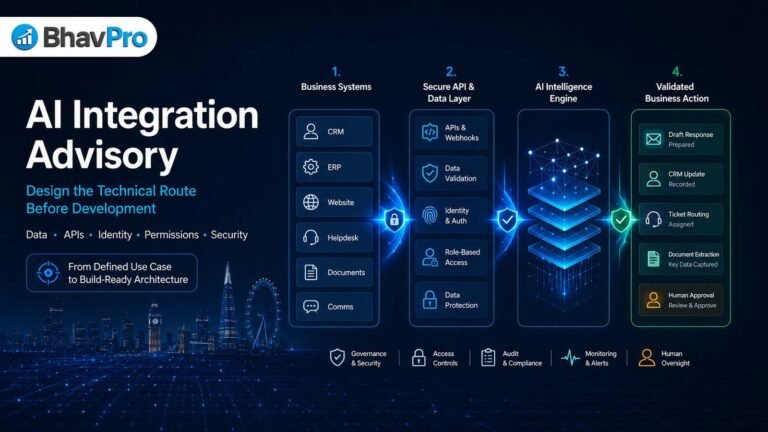
Fast answer: AI Integration Advisory helps businesses with a defined AI use case design the technical route before development. The outcome is an AI Integration Architecture Plan covering connected systems, approved data flows, APIs, identity, permissions, platform choices, security controls, failure handling, operational ownership and the prerequisites required for safe implementation planning.
A Buildable Architecture, Not a Tool List
- Trace data from source to approved destination
- Limit access to the minimum permissions required
- Define fallback, monitoring and human ownership
When AI Integration Advisory Is the Right Starting Point
This service is most useful when the business problem is already understood, but the technical route is not. It helps you avoid choosing a platform before confirming the required data, access, interfaces and operational controls.
You Have a Defined Use Case
You know the outcome you want, such as classifying support tickets, extracting document data, assisting staff with approved knowledge or preparing CRM actions.
Several Systems Must Connect
The use case depends on a CRM, website, ERP, helpdesk, telephony platform, file store, knowledge base or another business application.
Risk and Access Need Clarity
You need to understand what data can be shared, which identities may act, where approval is required and how failures should be contained.
Start with an AI Business Systems Audit. The audit identifies and prioritises opportunities. Integration advisory begins after a use case is sufficiently defined to design.
What an AI Integration Architecture Plan Covers
The plan translates a business requirement into a technical design that implementation teams can understand, estimate and test. The level of detail is matched to the complexity and consequence of the use case.
Systems and Owners
Identify the source systems, destination systems, process owners, technical owners and suppliers involved in the proposed integration.
Inputs, Transformations and Outputs
Define which records, documents, messages or fields move through the solution, how they are transformed and where outputs are stored.
APIs, Webhooks and Events
Record available interfaces, authentication methods, rate limits, payload expectations, event triggers and supplier restrictions.
Identity and Permissions
Describe which user or service identity performs each action and apply the minimum permissions needed for the approved purpose.
Validation, Approval and Recovery
Set rules for input validation, output checks, human approval, error handling, retry behaviour, logging and manual fallback.
Prerequisites and Build Sequence
Identify unresolved dependencies, recommended phases, acceptance criteria and the work required before production implementation. Where the architecture is approved and existing business platforms are ready to be connected, the next step can move into API integration implementation.
Map Data Sources Before Connecting AI
An AI integration is only as dependable as the information it receives. BhavPro examines where data originates, how current it is, who owns it, whether it is complete enough for the task and what must be excluded.
Source and Destination Mapping
- CRM records, contacts, cases and pipeline stages
- Documents, file stores and approved knowledge sources
- Helpdesk tickets, messages and conversation history
- Website forms, customer portals and application events
- Telephony, transcripts, call outcomes and operational notes
- ERP, finance, stock, order or provisioning records
Data Questions the Design Must Answer
- Which fields are necessary for the approved purpose?
- Which data is authoritative when systems disagree?
- How fresh must the information be?
- What personal, confidential or regulated data is involved?
- How will incorrect, missing or duplicated records be handled?
- What evidence must be retained for review?
The design should pass only the information required for the task rather than exposing an entire customer record, mailbox, drive or database to an AI service.
Design APIs, Webhooks and Event Flows
Integration architecture must reflect what each platform can actually support. A supplier may offer a complete API, a limited webhook, scheduled export, database access or no reliable interface at all.
Interface Review
BhavPro records the technical path available for each connection and the constraints that affect delivery. Where approved system connections are ready to be implemented, use API Integration Services.
- Authentication and token lifecycle
- Supported read and write operations
- Rate limits and usage costs
- Payload size and file restrictions
- Versioning and supplier change policy
- Sandbox or test-environment availability
Event Flow Design
The plan defines what starts the integration, what context is gathered, what the AI may do and how the result is confirmed.
Trigger
A form submission, ticket update, document arrival, call completion or scheduled check.
Context
Retrieve only the records and approved knowledge needed for the task.
Controlled Result
Validate the output before any message, status change or system update is completed.
Identity, Permissions and Least-Privilege Access
Every automated action must have an accountable identity and a defined permission boundary. The architecture should prevent an AI-assisted process from reading, changing or sending more than the approved task requires.
User Identity
Determine whether the action occurs on behalf of an individual user, a shared service account or a dedicated integration identity.
Permission Boundary
Limit access by record type, function, department, environment, customer group or approved action.
Audit Evidence
Record who initiated the process, which identity acted, what changed, whether approval occurred and how the result was verified.
Choose the Right AI Platform and Hosting Model
Model quality is only one part of the decision. The architecture also considers data handling, regional availability, identity integration, cost controls, observability, supplier terms, portability and operational support.
| Decision Area | Questions to Resolve | Why It Matters |
|---|---|---|
| Hosted AI API | What data is sent, retained or used by the provider? Which regions and controls are available? | Determines the external processing boundary and supplier dependency. |
| Cloud Platform Service | Can the AI service use existing cloud identity, networking, logging and security controls? | May simplify governance when the organisation already operates in that cloud environment. |
| Private or Self-Hosted Model | Is the additional infrastructure, model management and specialist support proportionate to the need? | Greater control can introduce significant operational responsibility. |
| Retrieval Architecture | How will approved knowledge be indexed, permission-filtered, refreshed and cited? | Prevents an assistant from treating uncontrolled or outdated content as authoritative. |
| Multi-Provider Design | Is provider portability required? Which functions are common and which are supplier-specific? | Reduces avoidable lock-in and supports a controlled fallback route. |
| Cost and Capacity | How will usage, tokens, requests, storage, latency and peak demand be monitored? | Prevents an apparently small use case from becoming operationally unpredictable. |
BhavPro compares technical fit and operating constraints rather than assuming that the most familiar AI product is automatically the right integration platform.
Separate AI Judgement from Deterministic Controls
AI is useful where language, ambiguity or unstructured information must be interpreted. Exact permissions, calculations, thresholds and status changes are usually safer as conventional rules.
Suitable AI-Assisted Tasks
- Classifying the subject or intent of a message
- Extracting structured fields from variable documents
- Summarising a call, case or customer history
- Drafting a response from approved context
- Suggesting relevant knowledge or next-step options
- Identifying anomalies for human review
Suitable Deterministic Controls
- Checking required fields and data formats
- Enforcing access and approval rules
- Calculating prices, tax or contractual thresholds
- Preventing duplicate records and repeated actions
- Confirming destination-system updates
- Stopping the process when a control fails
The architecture should give AI the smallest useful decision space, surround it with deterministic checks and escalate uncertainty when the consequence requires human judgement.
Protect Personal and Commercial Data
AI integration can create new processing paths between systems and suppliers. The architecture identifies these paths early so the organisation can decide what is lawful, necessary, proportionate and technically controlled.
Data Boundary
Define which personal, confidential or commercially sensitive information may enter the integration and what must remain excluded or redacted.
Processing Record
Document the purpose, data categories, recipients, retention expectations, supplier roles and review requirements for the proposed use.
Human Consequence
Identify whether outputs affect customers, employees, applicants or other people and whether explanation, review or additional safeguards are needed.
BhavPro can identify technical and operational considerations, but your organisation remains responsible for obtaining appropriate legal, regulatory, data-protection and security advice where required.
Plan for Failure, Recovery and Operational Ownership
A useful architecture explains not only the successful path but also what happens when the model, API, network, data or destination system does not behave as expected.
Detect the Failure
Define how the integration recognises unavailable services, invalid inputs, low-confidence results, timeouts, rejected updates and unexpected outputs.
Contain the Consequence
Prevent partial updates, duplicate messages, incorrect status changes or uncontrolled retries from creating a larger operational problem.
Route for Review
Provide the responsible person with the source record, attempted action, error context and recommended recovery route.
Restore and Verify
Retry only where safe, confirm the destination state and retain sufficient evidence to understand the final outcome.
Evaluate Vendors Without Creating Avoidable Lock-In
The integration plan makes supplier assumptions visible before they become embedded in code, data structures and operating procedures.
Evaluation Criteria
- Required functionality and supported interfaces
- Data-processing terms and available regions
- Identity, encryption, logging and administrative controls
- Model choice, quality controls and version changes
- Usage pricing, capacity and predictable cost limits
- Support model, service status and incident communication
Exit and Portability Questions
- Can prompts, configurations and evaluation data be exported?
- Can the integration call another provider through a stable internal interface?
- Which functions rely on supplier-specific features?
- How are embeddings, indexes or knowledge stores migrated?
- What happens to stored data when the service ends?
- How quickly can a manual or alternative route be activated?
Not every solution needs multi-provider complexity, but key data, permissions, decision records and operating knowledge should remain under your organisation’s control.
The BhavPro AI Integration Advisory Process
The engagement moves from a defined business requirement to a documented technical route. Work is evidence-led and proportionate to the systems, data and operational consequence involved.
Confirm the Use Case and Decision Boundary
Clarify the intended outcome, users, source information, proposed actions, unacceptable outcomes and the decisions that must remain with people.
Inspect Systems, Data and Interfaces
Review the relevant applications, available APIs, authentication methods, data quality, supplier constraints and existing security controls.
Design Architecture Options
Compare practical approaches for data flow, AI service placement, retrieval, permissions, validation, monitoring and human approval.
Review Risk, Failure and Ownership
Identify security, privacy, operational and supplier risks, then define how failures are detected, contained, escalated and resolved.
Prepare the Integration Architecture Plan
Document the recommended route, unresolved prerequisites, acceptance expectations, suggested delivery sequence and handover to implementation. Where the approved route requires business platforms to be connected through APIs or webhooks, the project can continue through BhavPro’s API Integration Services.
What You Receive from the Advisory
The exact document set depends on scope, but every engagement is designed to leave clear technical decisions and actionable next steps rather than a collection of product suggestions.
System Context Diagram
A visual map of the systems, users, suppliers and integration boundaries involved in the use case.
Data Flow and Interface Map
Sources, destinations, fields, transformations, APIs, webhooks, events and data-handling constraints.
Identity and Permission Matrix
The user or service identity responsible for each action and the minimum access it requires.
Platform Decision Record
Recommended architecture with options considered, trade-offs, supplier assumptions and portability considerations.
Control and Failure Model
Validation, approval, logging, monitoring, exception, retry, fallback and recovery requirements.
Implementation Readiness Plan
Prerequisites, dependencies, acceptance criteria, delivery sequence and the appropriate next implementation route.
The plan can support BhavPro implementation, an internal development team or another approved supplier. The objective is to make responsibilities and technical assumptions explicit before build work begins.
When Integration Becomes a Larger Business Application
If the integration requirement develops into a larger customer portal, internal business application, SaaS product or multi-system platform, the next route can continue through BhavPro's custom application development capability.
BhavPro's AI Apps & Business Software Development service covers custom portals, CRM platforms, billing and ticketing systems, SaaS applications and connected operational software where the agreed architecture now needs to become a production-ready system.
Explore AI Apps & Business SoftwareCompare Audit, Consulting, Advisory and Implementation
Each route answers a different question. Choosing the correct starting point avoids paying for architecture before the business need is clear or starting development before the technical constraints are understood.
| Your Current Position | Best Route | Main Outcome |
|---|---|---|
| You have several problems or opportunities but do not know which AI use case should come first. | AI Business Systems Audit | Current-state findings and prioritised opportunities. |
| Leadership needs an adoption direction, governance approach, roadmap or pilot portfolio. | AI Consulting | Strategy, priorities, governance and adoption plan. |
| You have a defined use case but need data, API, identity, permissions and platform architecture. | AI Integration Advisory | AI Integration Architecture Plan. |
| You need existing business platforms connected and the work does not require AI-specific model, data-governance or permission decisions. | API Integration Services | Implemented connection between approved business platforms. |
| The architecture is agreed and a cross-system operational process is ready to build. | AI Workflow Automation | Tested production workflow and operational handover. |
| The architecture is agreed and a controlled conversational system is ready to build. | AI Chatbot Development | Tested chatbot with knowledge, actions and human handoff. |
Use the AI Business Hub to compare BhavPro’s AI routes. To review the experience and methods behind the work, visit AI Automation Expertise.
Use Cases This Advisory Can Support
These examples illustrate the type of integration design the service can address. Suitability depends on the actual systems, data, permissions, suppliers and business consequences involved.
CRM-Assisted Drafting
Retrieve approved customer context, prepare a draft response and require human approval before any message is sent.
Ticket Classification and Routing
Interpret incoming requests, apply deterministic validation and route uncertain or sensitive cases for review.
Document Data Extraction
Extract defined fields from invoices, orders, forms or operational documents before controlled entry into a business system.
Internal Knowledge Assistance
Connect staff to permission-filtered policies, product information, procedures and case knowledge with source references.
Call and Conversation Summaries
Turn transcripts into structured summaries, actions or CRM notes while protecting sensitive information and verifying updates.
Controlled Customer Chat
Plan how an assistant uses approved knowledge, creates tickets, checks status and transfers complex cases to a person. Where the conversational use case is ready to build, continue through AI Chatbot Services.
These examples are not preconfigured packages. The advisory confirms whether the use case is technically viable and what must be controlled before implementation is approved. When an approved use case is ready to move into delivery, continue with AI & Workflow Automation.
Integration Advice Informed by Business Systems Experience
Technical architecture is more useful when it reflects how teams, suppliers and operational processes work in practice—not only how an API appears in documentation.
Led by Bhav Giva
BhavPro draws on more than 15 years of broader experience across telecom, CRM development, operations, websites, lead handling, customer service, connected business systems and process improvement. That experience is applied to current AI-assisted architecture without claiming 15 years in generative AI.
Learn more about BhavPro and Bhav Giva or view Bhav Giva’s LinkedIn profile.
Measurable Advisory Evidence
The engagement records the decisions, assumptions and unresolved constraints behind the recommended architecture. Evidence can include system maps, interface inventories, data flows, access matrices, platform comparisons, risk observations, acceptance requirements and implementation prerequisites.
Review BhavPro’s portfolio for broader examples of connected systems, CRM, telecom, websites and operational delivery.
Last reviewed: 18 July 2026.
Trusted AI, Security and Data-Protection Guidance
These independent resources can help business, technical and governance teams understand the wider obligations that may apply to an AI integration.
Related AI, Integration & Transformation Services
Continue into the appropriate delivery or consulting route when the advisory has clarified the architecture, implementation scope or wider business requirement.
AI & Workflow Automation
Move approved AI-assisted and cross-system workflows from architecture into controlled implementation.
AI & Workflow Automation →API Integration Services
Implement approved APIs, webhooks and system-to-system connections between business platforms.
API Integration Services →AI Chatbot Services
Build controlled conversational experiences using approved knowledge, actions and human handoff.
AI Chatbot Services →Digital Transformation Consulting
Plan broader business, technology and operating-model change when the requirement extends beyond one AI integration.
Digital Transformation Consulting →CRM Consulting
Define CRM architecture, data, lifecycle and workflow requirements that the AI integration needs to support.
CRM Consulting →AI Integration Advisory FAQs
Answers to common questions about scope, deliverables, technical access, data protection and the transition from advisory to implementation.
What is AI Integration Advisory?
AI Integration Advisory is a technical planning service for a defined AI use case. It maps the required data, systems, APIs, identity, permissions, platform architecture, security controls, failure handling and implementation prerequisites before build work begins.
When should we use this service?
Use this service when the business problem and intended outcome are already clear, but the technical route is not. If you still need to identify or prioritise use cases, begin with an AI Business Systems Audit.
How is this different from AI Consulting?
AI Consulting focuses on adoption strategy, governance, priorities, roadmaps and pilot planning. AI Integration Advisory focuses on the technical architecture for a defined use case.
How is this different from an AI Business Systems Audit?
The audit reviews the current business environment and identifies opportunities. Integration advisory begins after a use case is sufficiently defined and designs how it should connect to existing systems.
How is this different from general API Integration Services?
AI Integration Advisory designs the AI-specific technical route, including model access, data boundaries, identity, permissions, platform choices and control requirements. General API Integration Services build approved connections between business platforms after the required interfaces and implementation scope are clear.
Does the advisory include implementation?
No. The primary outcome is an AI Integration Architecture Plan. Implementation can follow through BhavPro’s workflow automation or chatbot services, an internal team or another approved delivery supplier.
Can BhavPro work with our existing CRM, ERP or helpdesk?
Potentially, subject to API availability, authentication, permissions, data quality, supplier restrictions and security requirements. These constraints are assessed during the advisory.
What happens if a system has no suitable API?
The plan can assess alternative options such as supported exports, scheduled files, approved database access, browser-based automation or process redesign. An alternative is recommended only when it is maintainable and proportionate to the risk.
How does the advisory address personal data?
The architecture identifies what personal data is involved, why it is needed, where it moves, which suppliers receive it and which technical controls may reduce exposure. Your organisation remains responsible for legal and regulatory decisions.
Can the architecture support more than one AI provider?
Yes, where portability or resilience justifies the additional complexity. The plan can separate common internal interfaces from provider-specific functions and document the trade-offs.
How long does an advisory engagement take?
The duration depends on the number of systems, interface availability, data sensitivity, supplier access and the consequence of the proposed actions. Scope, inputs and delivery expectations are agreed before work begins.
What do we receive at the end?
You receive a documented architecture plan appropriate to the scope. It may include system context, data flows, interface inventory, identity and permission matrix, platform decision record, control model and implementation readiness plan.
Discuss Your AI Integration Architecture
Share the use case, systems and technical questions you need to resolve. BhavPro will help determine whether integration advisory is the right next step or whether an audit, strategy engagement or implementation service is more appropriate.
Useful Information to Bring
- The business outcome and users involved
- The systems that may need to connect
- The data or documents the use case requires
- The actions AI may suggest or complete
- Known security, supplier or compliance constraints