
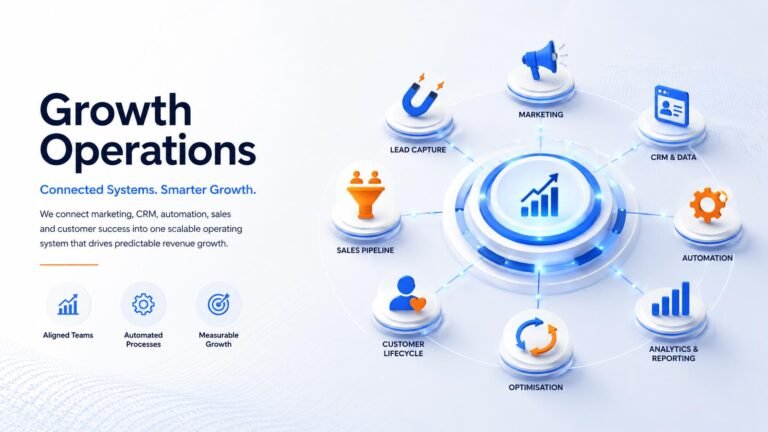

Growth Operations: Connect Marketing, CRM, Sales & AI Into One Growth System

Automate, Integrate, and Accelerate Your Business

Growth Operations connects marketing, CRM, sales, automation and customer operations into one measurable growth system. BhavPro helps UK businesses remove fragmented handoffs, improve lead follow-up, strengthen customer data, coordinate AI and automation, and connect day-to-day activity with pipeline, customer outcomes and revenue.

Growth Operations Consulting

15+ Years Experience

Fully Remote

Flexible Engagement

Growth Operating System Connected workflow
01Demand & DiscoveryAttract
02Lead CaptureRecognise
03CRM & Customer DataUnderstand
04Qualification & AutomationOrchestrate
05Sales & PipelineProgress
06Customer & RevenueMeasure
↻ Continuous optimisation & feedback
Measured implementation Clear baselines, ownership, controls, acceptance criteria and performance measures.
The Growth Constraint
More activity does not create more control.
Business performance charts and a laptop being reviewed during a Growth Operations assessment
Reviewing growth data helps identify where leads, systems and commercial outcomes become disconnected.

Your Business Does Not Have a Lead Problem If the System After the Lead Is Broken

More traffic, more campaigns and more software do not automatically produce better growth.

A business can generate enquiries and still lose revenue because the steps between marketing and a paying customer are fragmented. Forms may feed different inboxes. Sales teams may work from incomplete CRM records. Follow-up may depend on memory. Lead sources may be lost. Marketing reports may stop at clicks or form submissions. Customer information may sit across separate systems with no reliable lifecycle view.

The result is often more activity without more control.

Growth Operations addresses the system around growth. It connects the commercial journey from market demand through acquisition, conversion, CRM, sales, customer experience, retention and measurement.

01Leads enter through disconnected channels
02Follow-up quality depends on individual staff
03CRM records do not reflect the real customer journey
04Marketing activity cannot be connected reliably to pipeline or revenue
05Automation, AI and customer data operate without one end-to-end model
See the full list of warning signs
  • leads enter the business through several disconnected channels;
  • follow-up speed and quality depend on individual staff members;
  • marketing and sales use different definitions, data or priorities;
  • your CRM exists but does not reflect the real customer journey;
  • teams repeatedly copy information between applications;
  • you cannot reliably connect marketing activity to pipeline or revenue;
  • automation has been added in isolated places without an end-to-end design;
  • AI tools are being used, but there is no governance, workflow ownership or measurement;
  • customer onboarding, service and retention data are separated from acquisition data;
  • your technology stack has grown faster than the operating model around it.

Growth Operations creates the structure required to solve these problems in the right order.

Operating Model

What Is Growth Operations?

Growth Operations is the design, integration and continuous improvement of the people, processes, data, technology and measurement systems that move a business from market opportunity to sustainable customer revenue.

It sits across functions rather than inside one department. Marketing may create demand. A website or sales team may capture the enquiry. CRM manages identity and lifecycle data. Automation coordinates repeatable actions. Sales manages opportunities. Customer operations deliver the relationship. Analytics connects activity to commercial outcomes.

Growth Operations makes those parts work as one system.

It is not simply another name for digital marketing, CRM implementation or AI automation. Those are specialist capabilities. Growth Operations determines how they should connect, what each stage must achieve, which information should move between them, where people should make decisions, where automation can safely help and how performance should be measured.

If a business cannot answer those questions for the stages between first contact and retained customer, there is usually an operational growth gap.

Connected Journey

The Growth Operations Workflow: From Market Demand to Measurable Revenue

A practical Growth Operations model follows the customer and commercial journey rather than the boundaries between departments. Open any stage to inspect the operating requirement and typical failure when it becomes disconnected.

Discover & Attract
01

Market Intelligence

Who are we trying to reach and what problem are they trying to solve?

Should operate correctlyCustomer segments, demand signals, competitor context, commercial priorities.

Typical failureActivity targets the wrong market or problem.

02

Offer & Positioning

Why should the right customer choose us?

Should operate correctlyClear value proposition, offer structure, qualification criteria, commercial fit.

Typical failureTraffic arrives but does not understand the value.

03

Discovery & Demand

How will suitable prospects find us?

Should operate correctlySearch, AI discovery, content, paid acquisition, referrals, social and outbound where relevant.

Typical failureVisibility grows without useful demand.

04

Digital Experience

Can prospects understand, trust and act?

Should operate correctlyWebsite journeys, landing pages, proof, conversion paths and useful content.

Typical failureVisitors leave or take low-value actions.

Capture & Convert
05

Lead Capture

Can every meaningful enquiry enter a controlled process?

Should operate correctlyForms, calls, chat, bookings, referrals and source capture.

Typical failureEnquiries are missed, duplicated or poorly attributed.

06

Customer Data

Do we have a reliable record of the person, company and relationship?

Should operate correctlyCRM structure, identity, lifecycle stage, consent, source and history.

Typical failureTeams work from conflicting or incomplete records.

07

Qualification & Routing

Does the right opportunity reach the right person with enough context?

Should operate correctlyValidation, enrichment, scoring, routing, ownership and service-level rules.

Typical failureGood leads wait while poor-fit leads consume time.

08

Automation & Orchestration

Which repeatable steps should happen consistently?

Should operate correctlyWorkflow rules, integrations, notifications, approved AI tasks and exception handling.

Typical failureManual admin expands and processes become inconsistent.

Revenue & Learn
09

Sales & Pipeline

Can opportunities move through a defined commercial process?

Should operate correctlyStages, follow-up, tasks, proposals, forecasting and lost-reason data.

Typical failurePipeline becomes unreliable or difficult to forecast.

10

Customer Lifecycle

What happens after the sale?

Should operate correctlyOnboarding, delivery, support, communication, renewal and expansion.

Typical failureAcquisition data never improves customer retention.

11

Revenue Intelligence

Can we connect activity to commercial outcomes?

Should operate correctlyAttribution, conversion, pipeline, customer value and cost measures.

Typical failureDecisions rely on channel metrics rather than business results.

12

Continuous Optimisation

What should improve next?

Should operate correctlyReview cadence, experiments, workflow evidence, customer feedback and prioritisation.

Typical failureNew tools and campaigns are added without fixing root causes.

The goal is not to automate every stage. The goal is to make every important stage deliberate, connected and measurable.

Orchestration Layer

Growth Operations Is the Layer Between Strategy and Execution

Many businesses already have useful specialists, software and channels. The problem is often not lack of capability. It is lack of orchestration.

Business team reviewing growth strategy and operational priorities around a laptop and performance chart
Growth Operations connects strategic priorities with the workflows, data and ownership required for execution.

Strategy

  • commercial objectives
  • customer journey
  • qualification definitions
  • ownership rules
  • measurement priorities
Growth Operationsworkflow β€’ data β€’ systems β€’ controls

Execution

  • demand generation
  • CRM and lifecycle
  • automation and AI
  • sales process
  • customer operations

A marketing agency may generate demand. A CRM may store records. A sales team may manage opportunities. An automation platform may send notifications. Finance may know what was paid. Customer service may know why clients leave.

If those systems do not share a coherent lifecycle, management receives fragments of the truth.

Growth Operations provides the operating layer that defines how a prospect becomes a recognised lead; when a lead becomes qualified; what information is required before sales receives it; how ownership changes between teams; what should happen automatically and what needs human judgement; how source and campaign information survives through the customer lifecycle; how outcomes feed back into marketing decisions; which metrics are operational or commercial; how systems should integrate without fragile dependencies; and where governance, permissions and auditability are required.

Connected Capabilities

What BhavPro Growth Operations Covers

BhavPro combines business-process thinking with practical implementation across the main systems that influence growth.

Growth Strategy & Operating Model

Define how the business intends to acquire, qualify, convert, serve and retain customers before adding more technology.

View capability detail
  • growth-objective alignment
  • customer and opportunity lifecycle design
  • funnel and pipeline definitions
  • role and ownership mapping
  • handoff rules between teams
  • service-level expectations
  • process and dependency mapping
  • KPI and management-reporting design
  • prioritised improvement roadmaps
Explore business strategy and operations consulting β†’

Demand & Search Operations

Connect discovery activity to the wider revenue system instead of treating traffic as an isolated result.

View capability detail
  • organic-search demand mapping
  • AI-search and answer-engine visibility planning
  • content journeys aligned to buying stages
  • campaign and source taxonomy
  • landing-page and conversion-path alignment
  • first-touch and lifecycle source capture
  • content-to-CRM handoffs
  • campaign feedback from sales outcomes

Conversion & Lead-Capture Operations

Ensure each visitor, caller, referral or prospect can move into a controlled process without losing context.

View capability detail
  • lead-form architecture
  • call and booking capture
  • enquiry validation
  • source and intent capture
  • duplicate prevention
  • consent and preference capture
  • immediate acknowledgement
  • internal alerting
  • qualification-ready data collection
  • fallback handling when integration fails

CRM & Customer Data Operations

Design the CRM around the real commercial lifecycle rather than forcing the business into a generic template.

View capability detail
  • CRM data models
  • contact and company structures
  • lifecycle stages
  • opportunity pipelines
  • source and attribution fields
  • required-field rules
  • deduplication controls
  • task and activity models
  • permissions and ownership
  • reporting requirements
  • integration with customer-facing and back-office systems
Explore CRM consulting and integration β†’

AI, Automation & Workflow Orchestration

Use automation where consistency, speed and information movement matter, while keeping judgement and accountability with people where necessary.

View capability detail
  • lead enrichment
  • qualification support
  • routing and assignment
  • CRM record updates
  • follow-up preparation
  • reminders and escalations
  • document and data processing
  • customer-service triage
  • reporting workflows
  • cross-system synchronisation
  • bounded AI tasks
  • human approval steps
  • exception and recovery paths
Explore AI automation services β†’ Explore API and system integration β†’

Sales & Pipeline Operations

Create a sales process that produces useful operational and management information instead of becoming a passive deal list.

View capability detail
  • qualification gates
  • opportunity-entry criteria
  • pipeline-stage definitions
  • follow-up standards
  • sales-task automation
  • proposal and approval workflows
  • lost-reason capture
  • stale-opportunity rules
  • forecasting inputs
  • marketing feedback loops

Customer Lifecycle & Retention

Connect onboarding, service quality, renewal, expansion, advocacy and churn back to acquisition and CRM data.

View capability detail
  • sales-to-service handoff
  • customer onboarding
  • account ownership
  • service milestones
  • support and communication workflows
  • renewal triggers
  • retention-risk signals
  • cross-sell and expansion opportunities
  • customer feedback
  • lifecycle reporting

Revenue & Performance Intelligence

Replace disconnected dashboards with measures that explain how the commercial system is performing.

View capability detail
  • enquiry volume and quality
  • response time
  • qualified-lead rate
  • lead-to-opportunity conversion
  • opportunity-to-customer conversion
  • sales-cycle duration
  • pipeline value and movement
  • acquisition source
  • marketing contribution
  • customer acquisition cost where reliable cost data is available
  • retention and renewal indicators
  • customer value measures
  • workflow exception rates
  • automation performance
  • revenue contribution

Measurement principle: if a measure does not change what a team or manager does next, it may not deserve a prominent place in the operating dashboard.

Positioning

Growth Operations vs RevOps, Marketing Operations and Growth Marketing

These disciplines overlap, but they are not identical. The operating model matters more than the label.

Growth Operations

Main focus: end-to-end growth system.

Strategy, demand, conversion, CRM, automation, sales, customer lifecycle, data and measurement.

Revenue Operations

Main focus: revenue-process alignment.

Marketing, sales and customer-success processes, systems, data and forecasting.

Marketing Operations

Main focus: marketing execution infrastructure.

Campaign processes, marketing technology, data, automation, governance and reporting.

Growth Marketing

Main focus: acquisition and experimentation.

Channels, campaigns, conversion, testing, retention experiments and growth tactics.

BhavPro uses Growth Operations as the broader operating perspective when the problem crosses several of these areas. A business does not need to adopt new terminology internally if the real requirement is to connect marketing, CRM, sales and customer operations.

01Strategy & objectives
02Market intelligence
03Discovery & demand
04Content & experience
05Lead capture
06CRM & customer data
07Qualification & routing
08Automation & integration
09Sales operations
10Customer lifecycle
11Measurement & attribution
12AI readiness & governance
Growth Operations Audit

Start With the Customer Journey, Not the Software List

Many technology audits begin by asking which applications a company owns. That is useful, but it is not enough.

BhavPro starts with the business workflow: How does a suitable prospect discover the business, become an identifiable lead, receive follow-up, enter CRM, become qualified, move through sales, become a customer and remain visible through the rest of the relationship?

Only then should technology be assessed against the job it is expected to perform.

The result should identify where the system is already strong, where value is leaking and which changes should be prioritised before adding unnecessary complexity.

Maturity Model

From Fragmented Activity to an Adaptive System

The goal is the level of maturity that supports the organisation's current complexity and growth plans without overengineering the process.

01

Fragmented

Channels, spreadsheets, inboxes and tools operate separately.

Objective: establish visibility and ownership.

02

Managed

Core processes are defined but still depend heavily on manual coordination.

Objective: standardise lifecycle and data.

03

Connected

CRM, marketing, sales and key systems exchange reliable information.

Objective: remove handoff gaps and duplication.

04

Measured

Teams can connect activity to pipeline, customers and commercial outcomes.

Objective: improve decisions using trustworthy data.

05

Adaptive

Automation, AI and optimisation operate within controlled, measurable workflows.

Objective: continuously improve without losing governance.

The objective is not to reach the highest maturity level for its own sake. A smaller business may need a simple, well-controlled system. A more complex organisation may require deeper data governance, integration, automation and management reporting.

Operational Example

What a Connected Lead-to-Customer Workflow Can Look Like

Every important transition has ownership, information, action and measurement.

Customer service team handling enquiries as part of a connected lead-to-customer workflow
A connected customer lifecycle preserves context from enquiry and sales through onboarding, service and retention.
01

Enquiry captured

A prospect submits a form, calls, books a meeting or enters through another approved channel. Source, campaign context, consent and required enquiry details are recorded.

02

Record checked

The workflow checks whether the person or company already exists before creating unnecessary duplicates.

03

Lead enriched

Where appropriate and lawful, approved business information can be added to support qualification and routing.

04

Qualification supported

Rules and bounded AI can help identify intent, service fit, urgency or missing information while sensitive decisions remain with the appropriate person.

05

Ownership assigned

The lead is routed using agreed criteria such as service, location, account ownership, availability or business priority.

06

Response triggered

The prospect receives an appropriate acknowledgement and the responsible team member receives the context required to act.

07

Sales activity recorded

Calls, meetings, notes, tasks and opportunity stages remain connected to the customer record.

08

Outcome captured

Qualified, won and lost outcomes are recorded using consistent definitions.

09

Customer handoff completed

Relevant commercial context passes into onboarding or service delivery rather than disappearing inside the sales pipeline.

10

Performance feeds back

Marketing and management can see which sources produced meaningful opportunities and customers, not only which campaigns produced clicks or submissions.

Technology Decision
You may not need another platform.

Do You Need More Technologyβ€”or Better Use of What You Already Have?

Growth Operations should not begin with a software shopping list.

Many businesses already have enough technology to make a meaningful improvement. The immediate opportunity may be to simplify the stack, correct the CRM structure, remove duplicate tools, fix integrations, improve data quality or define the workflow that existing systems are supposed to support.

1
Capability

What business capability does the platform support?

2
Ownership

Who owns it and who is accountable for the workflow?

3
Data

Which data does it create or consume, and which system is authoritative?

4
Failure handling

What happens when an integration or automated step fails?

5
Overlap

Does another tool duplicate the same function?

6
Utilisation

Is the platform being used sufficiently to justify its cost and complexity?

7
Migration risk

Would replacing it create more risk than value?

A connected system does not mean forcing every application into one platform. It means establishing clear boundaries, reliable data movement and accountable ownership.

Understand the modern marketing growth stack β†’
Controlled AI

Where AI Fits Into Growth Operations

AI can improve Growth Operations, but it should sit inside a defined process rather than become the process.

Useful AI Applications

AI can support bounded, reviewable work across the customer and operational lifecycle.

  • summarising inbound enquiries
  • extracting structured information
  • preparing lead research
  • supporting qualification
  • suggesting next actions
  • drafting approved follow-up communications
  • classifying support or service requests
  • identifying missing CRM information
  • summarising calls and meetings
  • detecting anomalies
  • assisting content and campaign operations
  • preparing management summaries

Lower Risk

Repeatable internal tasks with clear validation rules may be suitable for greater automation.

Control: clear data boundary, deterministic validation and exception route.

Medium Risk

AI may prepare, classify or recommend while a person reviews the result before action.

Control: human approval before external or consequential action.

Higher Risk

Commercial commitments, sensitive customer decisions, legal or regulated communications and high-impact external actions normally require stronger approval, access and audit controls.

BhavPro approach: define the workflow, data, permissions, validation, exception handling and human responsibility before increasing autonomy.

Explore AI automation services β†’
Operating Principles

What We Do Not Recommend

Growth Operations is as much about avoiding unnecessary complexity as it is about adding capability.

Avoid
Automating a broken process
Replacing useful systems without a business reason
Using AI without ownership
Measuring marketing separately from commercial outcomes
Building dashboards before fixing the data
Adding software to compensate for unclear responsibilities
Prefer
Clarify and stabilise the process before automation
Change platforms only to solve a defined limitation or create measurable value
Give every AI workflow a purpose, boundary, validation method and accountable owner
Connect activity to opportunity quality, conversion and customer outcomes
Create trustworthy lifecycle and source data before polishing dashboards
Use technology to support ownershipβ€”not replace it
Engagement Models

How BhavPro Delivers Growth Operations

Growth Operations can begin as a focused diagnostic or develop into a broader transformation programme depending on the organisation's needs.

01 β€’ DIAGNOSE

Audit & Roadmap

Best for: businesses that know something is disconnected but need an evidence-based view of what to fix first.

Typical activities & outputs
  • stakeholder discovery
  • customer-journey mapping
  • lead and opportunity lifecycle review
  • CRM assessment
  • marketing and sales handoff review
  • technology and integration mapping
  • automation review
  • data-quality and ownership review
  • measurement and reporting assessment
  • AI-readiness review
  • risk and dependency identification
  • current-state growth-system map
  • priority gap analysis
  • target workflow recommendations
  • system and data recommendations
  • automation opportunity backlog
  • measurement framework
  • phased implementation roadmap
02 β€’ BUILD

Build & Integration

Best for: organisations that need implementation rather than a strategy document alone.

Typical implementation scope
  • CRM structures and lifecycle stages
  • lead-capture workflows
  • qualification and routing logic
  • system integrations
  • automation workflows
  • AI-assisted processes
  • sales-pipeline controls
  • onboarding handoffs
  • reporting and management dashboards
  • operating documentation
  • user acceptance criteria
  • training and rollout support

Implementation is prioritised around business value, dependencies and operational risk rather than attempting to transform every process at once.

03 β€’ OPTIMISE

Managed Growth Operations

Best for: businesses that need ongoing coordination, optimisation and cross-functional improvement after the core system is established.

Ongoing focus
  • workflow performance
  • CRM quality
  • automation reliability
  • lead and pipeline performance
  • marketing-to-sales feedback
  • new integration requirements
  • reporting improvements
  • customer-lifecycle opportunities
  • AI use-case evaluation
  • operating documentation
  • prioritised continuous improvement

The purpose is to keep the growth system aligned as the business, customer behaviour and technology environment change.

Delivery Process

A Practical Delivery Process

A controlled loop from discovery through implementation, adoption and evidence-led optimisation.

01

Discover

Understand commercial objectives, journey, teams, technology, constraints and known problems.

Establish the context before proposing system changes.

02

Map

Document the current lifecycle and identify ownership, data, handoffs, manual work and failure points.

Make the real operating model visible.

03

Prioritise

Separate high-value operational gaps from lower-value optimisation.

Fix foundations before advanced automation.

04

Design

Define target workflow, system responsibilities, data movement, controls, KPIs and exception paths.

Create an implementable future-state model.

05

Implement

Configure or build agreed CRM, automation, integration, reporting and process changes.

Deliver in controlled, testable increments.

06

Validate

Test normal journeys, edge cases, permissions, failure scenarios and reporting.

Do not rely on a workflow before its failure modes are understood.

07

Adopt

Document the process, clarify ownership and support the people who will operate it.

A technically correct workflow still needs operational adoption.

08

Optimise

Use real evidence to decide what should be simplified, automated, expanded or changed next.

Close the loop with continuous improvement.

Measurement

What Should Growth Operations Measure?

A useful framework normally covers four levels. The business should establish a small set of trusted measures that explain whether the growth system is working and where management should intervene.

Business professional presenting performance analytics used to measure Growth Operations and revenue outcomes
Useful Growth Operations reporting connects demand and workflow performance with pipeline, customers and revenue outcomes.

Demand Indicators

  • relevant search and campaign visibility
  • suitable website traffic
  • enquiry volume
  • source and campaign coverage
  • conversion-path performance

Operational Indicators

  • lead response time
  • record completeness
  • duplicate rate
  • qualification speed
  • routing accuracy
  • workflow failures
  • overdue follow-up
  • automation exceptions

Commercial Indicators

  • qualified-lead rate
  • opportunity creation
  • pipeline movement
  • win rate
  • sales-cycle duration
  • average commercial value where relevant
  • source-to-customer conversion
  • revenue contribution

Customer Indicators

  • onboarding completion
  • service engagement
  • renewal
  • retention
  • expansion
  • customer feedback
  • churn reasons where applicable
Best-Fit Organisations

Who Is Growth Operations For?

Growth Operations is particularly useful when business complexity has increased faster than the systems used to manage it.

Growing SMEs

You may have moved beyond spreadsheets and individual inboxes but still depend heavily on manual coordination between marketing, sales and service.

Professional & B2B Services

Fewer but higher-value opportunities make qualification, follow-up, pipeline visibility and relationship history particularly important.

Agencies & Digital Businesses

Several acquisition channels, software platforms and client workflows may exist without reliable commercial reporting.

SaaS & Technology

You may need stronger lifecycle definitions, CRM architecture, product or service handoffs, automation and expansion signals.

Telecom, IT & Communications

Complex quote, provisioning, billing, support and renewal processes need to connect with acquisition and CRM data.

Established Organisations

Capable teams and enterprise software may still need better integration, governance, process ownership or AI readiness.

The engagement should fit the operating reality of the organisation. Growth Operations is not limited to businesses of a particular size, but the design should remain proportionate to the complexity it needs to manage.

Delivery Experience
Cross-functional problems need cross-functional experience.
Business team collaborating on strategy, analytics and cross-functional Growth Operations
Cross-functional Growth Operations work brings business strategy, customer data, digital growth and operational systems together.

Relevant BhavPro Delivery Experience

BhavPro's Growth Operations approach is supported by practical experience across business systems, customer operations, digital acquisition and automation rather than marketing theory alone.

CRMDesigning CRM environments around lead pipelines, customer accounts, workflow automation, operational visibility and connected business processes.
Lead ManagementBuilding structured intake, enrichment, qualification support, routing, CRM updates and follow-up processes.
Business PortalsDeveloping multi-role operational environments where access, workflows, customer data and business processes coexist securely.
AI WorkflowsApplying bounded AI to repeatable business tasks with approvals, exception handling and human accountability where necessary.
Digital GrowthConnecting SEO, content, conversion and lead generation with the systems that receive and manage demand.
IntegrationConnecting applications so information can move between marketing, CRM, communications and operations without unnecessary manual re-entry.

This cross-functional perspective is important because Growth Operations problems rarely belong to only one platform or department.

Explore BhavPro experience and credentials β†’
Why BhavPro

Why Work With BhavPro on Growth Operations?

Business Workflow Before Software

The engagement starts with how the business needs to work rather than beginning with a preferred platform.

Founder-Led Accountability

Strategic discovery and solution design remain closely connected to delivery rather than being separated through multiple account layers.

Strategy Connected to Implementation

Recommendations are designed with implementation realities, data, integration, adoption and ongoing ownership in mind.

Cross-Functional Perspective

BhavPro works across business strategy, CRM, AI automation, integrations, digital growth and operational systems, helping identify problems that sit between traditional service boundaries.

Controlled Automation + Measurable Outcomes

Automation and AI are introduced with attention to ownership, validation, permissions, human review and exception handling. The operating model defines what should be measured before optimisation begins, helping teams distinguish useful activity from commercial progress.

What does a Growth Operations consultant do?
A Growth Operations consultant examines how a business generates demand, captures leads, manages customer data, qualifies opportunities, coordinates sales, serves customers and measures commercial outcomes. The role is to identify gaps between those stages and design the processes, systems, integrations, automation and reporting required to make the overall journey more reliable.
Is Growth Operations the same as Revenue Operations?
No, although the disciplines overlap. Revenue Operations usually focuses on aligning marketing, sales and customer-success functions around revenue processes, systems and data. Growth Operations can take a broader view that begins earlier with market demand, digital discovery and conversion and continues through CRM, sales, customer lifecycle, revenue intelligence and optimisation.
Is Growth Operations the same as marketing operations?
No. Marketing Operations focuses primarily on the processes, technology, data and execution infrastructure used by marketing. Growth Operations looks across the wider commercial system, including the transitions between marketing, CRM, sales, customer operations and revenue measurement.
Is Growth Operations just another name for growth marketing?
No. Growth marketing typically focuses on acquiring, converting and retaining customers through channel strategy, experimentation and optimisation. Growth Operations focuses on the operating infrastructure that allows those activities and the wider customer lifecycle to work consistently across teams and systems.
Do we need a new CRM before starting Growth Operations work?
Not necessarily. The existing CRM may be suitable but poorly structured, inconsistently used or disconnected from other systems. A Growth Operations assessment should establish the required workflow and data model before deciding whether the current CRM should be improved, integrated or replaced.
Can BhavPro work with our existing marketing agency or internal marketing team?
Yes. Growth Operations can complement existing specialists by improving the systems and handoffs around their work. A marketing team may continue to own acquisition while Growth Operations ensures leads, source data, CRM processes, sales feedback and commercial measurement are connected correctly.
Can Growth Operations improve lead follow-up?
Yes. Lead follow-up is a common cross-functional problem. Improvements can include better capture, duplicate checking, enrichment, qualification, routing, ownership, response triggers, reminders, escalation and CRM activity tracking. Automation can support these steps where appropriate, but the process and accountability should be defined first.
Can AI be included in a Growth Operations system?
Yes. AI can support tasks such as enquiry classification, research, data extraction, qualification support, summaries, recommended next actions and workflow assistance. The appropriate use depends on the quality of the underlying data, consequence of error, privacy requirements and level of human oversight required.
Do you replace all of our existing software?
No. Replacing systems without a clear business case can add cost, migration risk and disruption. BhavPro can assess the role of existing platforms, identify duplication or gaps and recommend where configuration, integration, consolidation or replacement is justified.
Can Growth Operations help us understand which marketing channels create revenue?
It can improve the data and lifecycle architecture required to make attribution more reliable. This may involve consistent source capture, CRM lifecycle stages, opportunity data, customer outcomes and reporting. Attribution has practical limitations, especially across long or multi-touch buying journeys, so the objective is trustworthy decision support rather than false precision.
Is Growth Operations suitable for small businesses?
Yes, when the design is proportionate. A small business may benefit from a simple CRM, clear lead ownership, consistent follow-up, a few reliable automations and basic commercial reporting. Growth Operations should reduce unnecessary complexity, not create enterprise bureaucracy for a smaller team.
Is Growth Operations only for B2B companies?
No. The exact lifecycle differs by business model, but the underlying principlesβ€”clear customer journeys, reliable data, controlled handoffs, appropriate automation and measurable outcomesβ€”can apply to B2B, B2C and mixed models.
How does a Growth Operations engagement start?
The most useful starting point is usually an audit or discovery engagement. This establishes the current customer journey, systems, data, ownership, known problems and commercial priorities before recommending implementation work.
How long does Growth Operations implementation take?
The timescale depends on the number of systems, quality of existing data, workflow complexity, integration requirements and organisational change involved. A focused workflow can be improved incrementally, while a wider CRM and operating-model transformation may require phased delivery. BhavPro prioritises the highest-value dependencies first rather than forcing every change into one release.
How do we know whether Growth Operations is working?
Success should be defined before implementation. Depending on the problem, measures may include response time, CRM completeness, qualification rate, handoff reliability, opportunity conversion, pipeline visibility, workflow exceptions, attribution coverage, customer retention or revenue contribution. The measures should reflect the specific operating problem being solved.
Start With the Constraint

Start With the Part of Your Growth System That Is Creating the Most Friction

You do not need to redesign the entire business to improve Growth Operations.

The right starting point may be lead follow-up, CRM structure, attribution, sales handoffs, marketing automation, customer onboarding or a disconnected technology stack. The important step is to understand how that problem affects the wider customer and revenue journey before applying another isolated fix.

BhavPro can assess the current state, identify the highest-priority gaps and create a practical roadmap for connecting the systems, workflows and data that support growth.

Where is the friction?Find the constraint
ALead follow-upSpeed
BCRM structureData
CAttributionEvidence
DSales handoffsOwnership
EAutomation & onboardingWorkflow
FTechnology stackArchitecture
Assess β†’ prioritise β†’ connect β†’ measure