Featured
Check SEO, technical health and AI-search readiness with the free BhavPro SEO Analyzer.

Free Local SEO Audit Tool for UK Businesses

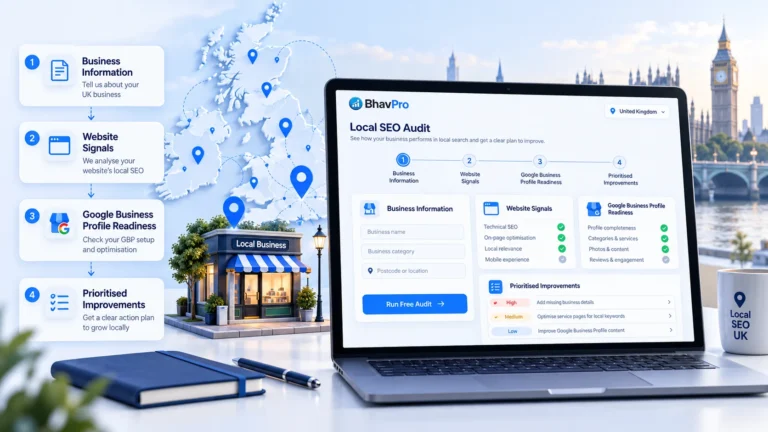
Find out whether your business website supports local customer discovery, whether your Google Business Profile is ready to represent your services accurately, and where enquiries could be slipping through the gaps. BhavPro's free local SEO audit tool combines public website checks with your own business information to produce a practical, prioritised local visibility action plan.

Local SEO Audit Tool UK

Website Signals

Google Business Profile Readiness

Prioritised Next Steps

BHAVPRO BUSINESS GROWTH TOOLSFree local review

Are local customers finding โ€” and contacting โ€” your business?

Review real website signals, tell us about your business profile, and receive an evidence-led plan to improve local customer journeys. No Google login required.

Public-page checksGBP readiness7/30/90-day plan
01 Your business02 Local presence03 Finish

What business are we reviewing?

Where permitted, we inspect initial HTML from up to two public pages, owner-reported profile and enquiry answers, and optional dated performance totals. This is not a live Maps ranking or enquiry-performance measurement.

Service-area businesses: do not enter a private/home address. We assess genuine coverage rather than recommending public address disclosure.

Audit coverage

What Does This Local SEO Audit Tool Check?

Understand exactly which signals are inspected and which details come from your own information.

A useful local SEO audit looks beyond whether a business has a website or a Google Business Profile. It checks whether a genuine local customer can understand what you do, where you operate and how to contact you, while identifying gaps that may need a more detailed investigation.

The BhavPro assessment brings together two different kinds of evidence: public website signals that the tool can inspect and information you provide about your business, Google Business Profile and enquiry process. The report keeps these sources distinct rather than presenting your answers as independently verified facts.

Audit areaWhat is reviewedWhat you can learn
Business identityTrading name, primary service, business type and genuine town or service areaWhether the assessment reflects the location and service customers actually need
Public websiteInitial HTML signals from up to two eligible public pages, where retrieval succeedsWhich visible website signals warrant attention or further verification
Local service relevanceYour primary service, local landing page and the areas you genuinely serveWhether your local customer journey has a clearly defined destination
Google Business Profile readinessYour reported verification, category, opening hours, services and photosWhich owner-controlled profile details you may need to check or update
Reviews and trustYour reported process for requesting genuine customer reviewsWhether customer-feedback handling needs attention
Enquiry journeyYour reported form testing, response ownership and attribution arrangementsWhether a customer enquiry is likely to have a clear next step
Optional performance contextDated, owner-entered Search Console, Business Profile and enquiry totalsHow available reporting figures can inform follow-up questions without claiming live verification
Four simple steps

How to Run Your Free Local Visibility Assessment

Use accurate business information and leave unknown metrics blank instead of guessing.

1

Describe your real business and service area

Enter your public website address, trading name, primary service, business type and main town or area. A shopfront, a business that travels to customers and a business operating both ways can have different local visibility needs. Additional areas should be places you genuinely serve, not a list of towns added solely to attract search traffic.

2

Review your website and Google Business Profile readiness

Provide a relevant service page if you have one. You can also supply a public Google Maps or Business Profile reference. Then answer the checklist covering profile verification, category, hours, services, photos and genuine review requests. Your answers help identify potential action areas; supplying a profile reference does not give the tool access to your private Google data.

3

Add enquiry and performance information if available

Where you have reliable records, add dated totals for search impressions and clicks, Business Profile activity or enquiries. Keep each source's dates, property or location, and reporting scope consistent. You can leave these figures blank rather than guessing.

4

Read your prioritised action plan

Use the report to distinguish findings supported by a public-page check from owner-reported details and matters requiring direct verification. Start with the actions most relevant to getting found, being trusted and receiving enquiries.

How visibility works

How Local Search Visibility Works

Googleโ€™s local systems consider several factors. Focus on genuine signals you can verify and improve.

1 Relevance
2 Distance
3 Prominence

Google explains that local results are influenced primarily by relevance, distance and prominence. These factors are not all under a business owner's control. A good audit should therefore focus on useful, verifiable improvements rather than promising a guaranteed Google Maps position.

Local factorWhat it means for your businessPractical action
RelevanceHow closely your business information matches the customer's searchKeep the primary category, real services and website content accurate
DistanceHow far your business is from the searcher or location being consideredRepresent your genuine location and service area correctly; do not fabricate an address
ProminenceHow established and recognisable the business appears online and offlineBuild a trustworthy reputation, accurate references and legitimate local relationships
Enquiry experienceWhat happens after someone discovers your businessMake contact options clear and check that enquiries arrive and receive a response

Local visibility can vary by query, device, searcher location and competition. An improvement to your website or profile does not translate into one universal ranking position.

Find what needs attention

Common Local SEO Problems Worth Checking

These issues can create customer friction even when a business already appears in local search.

01

Business details that do not match customer expectations

An outdated opening time, unsuitable profile category, incorrect telephone number or missing service detail can create friction before someone even reaches your website. Review the actual information customers see rather than trying to increase profile completeness for its own sake.

02

Service pages that are too vague

A homepage that merely states โ€œwe cover the UKโ€ may not answer a customer's specific local need. Relevant service pages should explain the work provided, who it suits, the area genuinely served and the next action. A dedicated local page is useful only when it supplies distinct, practical information, not copied text with a changed town name.

03

Unclear calls to action

Customers should not need to search for a telephone number, contact form or next step. Check that the principal contact method works on mobile and that a real test enquiry is delivered to the right person.

04

Reviews without a consistent process

Genuine feedback can help prospective customers assess a business. Ask customers fairly, avoid incentives or selective solicitation that breaches platform policies, and ensure someone is responsible for responding appropriately.

05

Reports without comparable dates or scope

A Search Console figure for an entire domain cannot be assumed to describe one Google Business Profile. Equally, profile interactions are not automatically confirmed sales leads. Use matching date ranges, label the source and avoid adding unrelated totals together.

Evidence matters

How to Interpret Your Local SEO Results

Know the difference between a detected website signal, an owner-reported answer and an unverified data point.

A local SEO audit is most useful when you understand what each kind of finding can and cannot prove.

Report findingInterpretationAppropriate next step
A website signal is detectedA particular characteristic was observed in retrieved public-page contentCheck the live page and decide whether a change improves usability or search clarity
A public page could not be retrievedThe inspection was incomplete, not proof that the website lacks contentCheck access, redirects, server responses and the page directly
Your profile answer is โ€œNoโ€You reported a potential readiness gapConfirm the detail in your own Google Business Profile before changing it
Your profile answer is โ€œNot sureโ€The assessment does not have sufficient evidenceVerify the relevant setting or practice rather than treating it as a failure
Enquiry delivery is untestedThere is no confirmed end-to-end test in the information suppliedSubmit a test enquiry and confirm assignment and receipt
Optional traffic figures are suppliedYou provided dated historical totalsAnalyse them in their original reporting tools before drawing conclusions
A phased plan

A Practical 7, 30 and 90-Day Local Improvement Plan

Prioritise fundamental accuracy, meaningful local relevance and consistent measurement.

First 7 days

Correct customer-facing fundamentals

Confirm the business's real identity, primary services, contact details and opening information. Test the main website enquiry route. Review profile ownership and the most important customer-facing fields. Fix factual inaccuracies before investing in additional content.

First 30 days

Strengthen local relevance and trust

Improve the primary service page, clarify actual coverage, add helpful answers to customer questions and review genuine citations where important. Establish a fair review-request and response process. Give each incoming enquiry a clear owner and response procedure.

First 90 days

Measure, refine and expand selectively

Review Search Console and Business Profile performance using comparable periods. Examine which enquiries were actually received and qualified. Improve pages that solve real customer problems and pursue legitimate partnerships or mentions. Add new service-area content only where there is a distinct user need.

The right sequence depends on the condition of your website and profile; these are planning horizons, not promises of results within a fixed period.

From visibility to value

From Local Visibility to Customer Enquiries

A clear local search journey continues beyond the ranking or click.

Being discovered is only the start. A local customer may see your business on Google Maps, read a service page, call, submit a form or leave without contacting you. A reliable local acquisition process makes those transitions measurable wherever appropriate.

A practical review asks four questions: Can the right customer find us? Does the information describe what we genuinely offer? Can they contact us easily? Can our team identify and follow up on their enquiry? Answering all four is more useful than treating a single visibility score as a business outcome.

DiscoverLocal search or Maps
EvaluateService information and trust
EnquireCalls, messages and forms
Follow UpAssign, respond and measure

Real-World Delivery Experience Behind BhavPro

BhavPro draws on experience in local search, digital marketing, website development, lead-generation workflows and CRM reporting. That combination matters because improving a page's local relevance is only commercially useful when the resulting enquiries reach a dependable sales or service process.

Explore BhavPro's SEO and digital marketing expertise to understand the broader approach to websites, search visibility and customer acquisition.

When to go further

When Do You Need a Professional Local SEO Review?

Know when a self-service check is sufficient and when implementation needs closer investigation.

Start with a self-service assessment

Identify basic readiness gaps, check factual accuracy and establish which observations need verification.

Use the report to organise fixes to your business information, service pages and enquiry journey.

Move to a structured professional review

Assess complex location coverage, Business Profile restrictions, competing local results and attribution issues against your commercial priorities.

A self-service tool is a sensible first step when you want to identify basic gaps and organise an improvement list. A deeper review is appropriate when visibility differs sharply between areas, your Business Profile has restrictions, competitors dominate valuable searches, multiple locations need governance or the relationship between local search activity and enquiries remains unclear.

BhavPro's Local SEO services for UK businesses cover the wider work: Google Business Profile optimisation, local service-page relevance, citation accuracy, legitimate review processes, local performance measurement and implementation. The free tool is an initial assessment, not a substitute for that ongoing work.

Request a Local SEO review if you want the findings assessed against your commercial priorities and actual service territory.

Frequently asked questions

Local SEO Audit Tool FAQs

Straight answers about what the assessment can and cannot verify.

Is the BhavPro local SEO audit tool free?

Yes. You can use the assessment to review public website signals and provide information about your local business presence. Contact information can be optional depending on the tool's published settings.

Does the tool check my Google Maps ranking?

No. It does not measure live Google Maps positions or run a location-based ranking grid. Local rankings vary by search term and searcher location, and require separate measurement.

Does it connect directly to my Google Business Profile?

No. A public profile link is a reference, not an authenticated integration. Profile verification, category, hours, services, photos and review-process answers are supplied by you.

Can a service-area business use the audit without publishing a home address?

Yes. Describe your actual service area and business type. You should not expose a private home address simply to complete a local SEO assessment.

Can I audit more than one location?

The assessment centres on a primary genuine area and permits a small number of additional areas. Organisations with materially different locations, profiles or service models should evaluate those locations separately.

Will the audit find every citation or directory inconsistency?

No. It is not a comprehensive directory crawler. Important listings and conflicting business references may need a dedicated citation audit and manual verification.

What are Google Business Profile views, website clicks and call clicks?

They are different interaction or visibility metrics reported by Google. A click on a call action is not automatically a completed conversation or qualified lead. Compare metrics only when their source, business location and reporting period are clear.

Can the tool guarantee better local rankings?

No. The assessment helps identify controllable improvements. Google determines local results, including factors outside a business's control such as distance and competition.

What should I do after receiving the report?

Check the evidence for each action, correct customer-facing inaccuracies, test your enquiry flow and prioritise the issues that affect real prospective customers. If the work requires deeper investigation or implementation, arrange a professional review.

Your next step

Turn Your Local Audit into an Improvement Plan

Use your report to identify what can be corrected now and what needs proper verification. BhavPro can help connect local search visibility with clearer service pages, trustworthy business information and dependable customer-enquiry handling.

Prepared by BhavPro โ€” UK business technology, SEO and digital growth consultancy. This assessment identifies potential improvement areas; it does not certify Google Business Profile compliance or guarantee search rankings.