
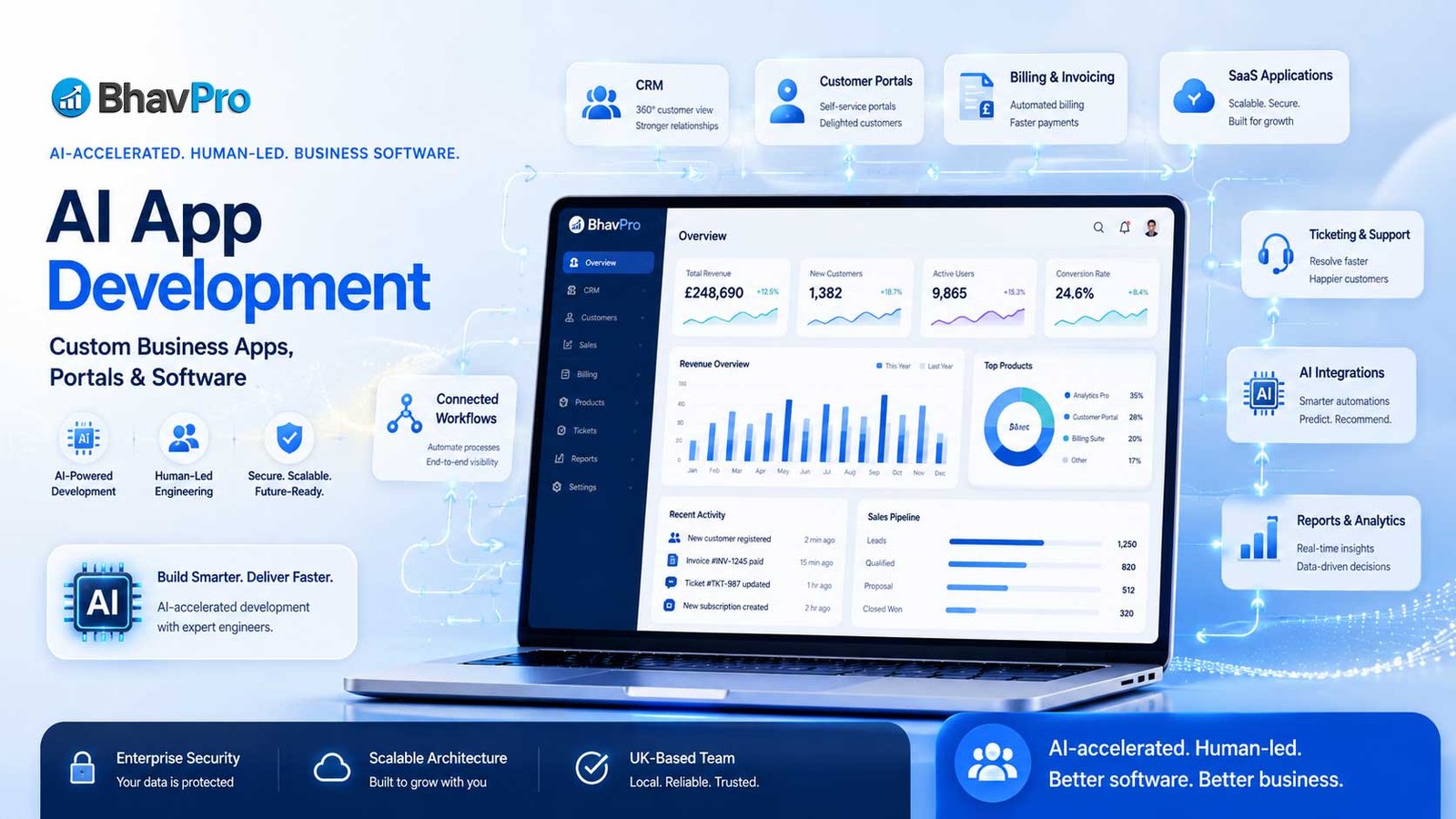
AI App Development UK β Custom Business Apps, Portals & Software
Turn manual processes, disconnected tools or a new software idea into a secure, practical business application. BhavPro combines AI-accelerated development with human-led architecture, testing and business-process expertise to build portals, CRM platforms, billing systems, SaaS products and custom applications.

Build the Missing System β Not Software for Softwareβs Sake
BhavPro helps businesses determine when a custom app is the right route and then turns the requirement into structured, maintainable software.
BhavPro designs and develops custom business applications using AI-accelerated development and human-led engineering. We build customer portals, CRM platforms, internal tools, SaaS applications, billing systems, dashboards, browser extensions and connected operational software designed around your workflows, users, data, security requirements and commercial goals.
Where Are You Starting From?
You do not need a technical specification before speaking to BhavPro. Start with the situation that best describes your business.
Start with the business problem. BhavPro can help determine whether the better answer is to build, buy, configure, integrate or automate.
What Can BhavPro Build?
From a focused internal tool to a multi-user business platform, the application is designed around the workflow rather than a generic template.
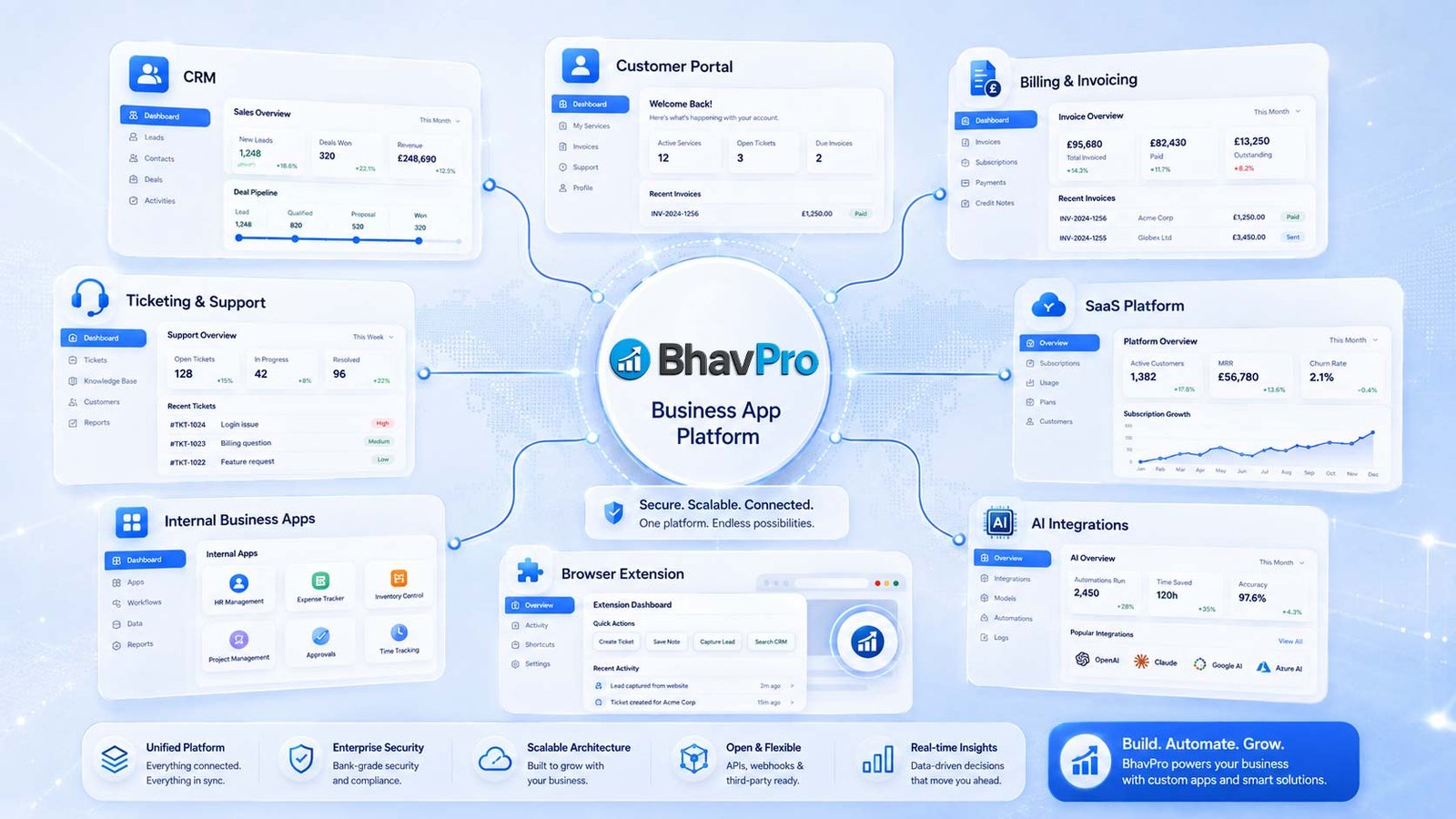
Customer & Business Portals
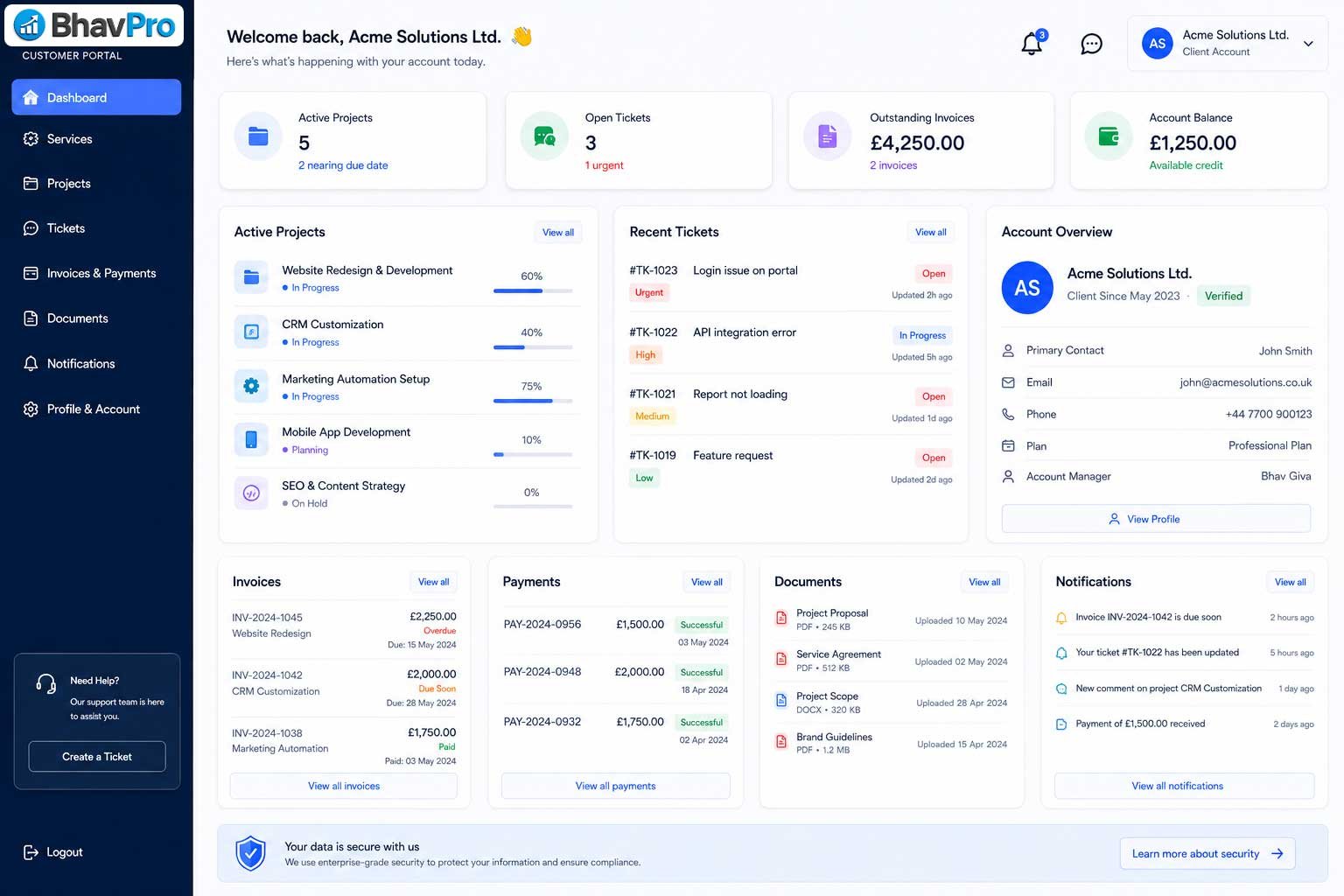
Client, customer, partner, supplier and employee portals with role-based access and self-service workflows.
- Projects and service tracking
- Tickets, documents and knowledge
- Invoices, receipts and requests
CRM & Operations Systems
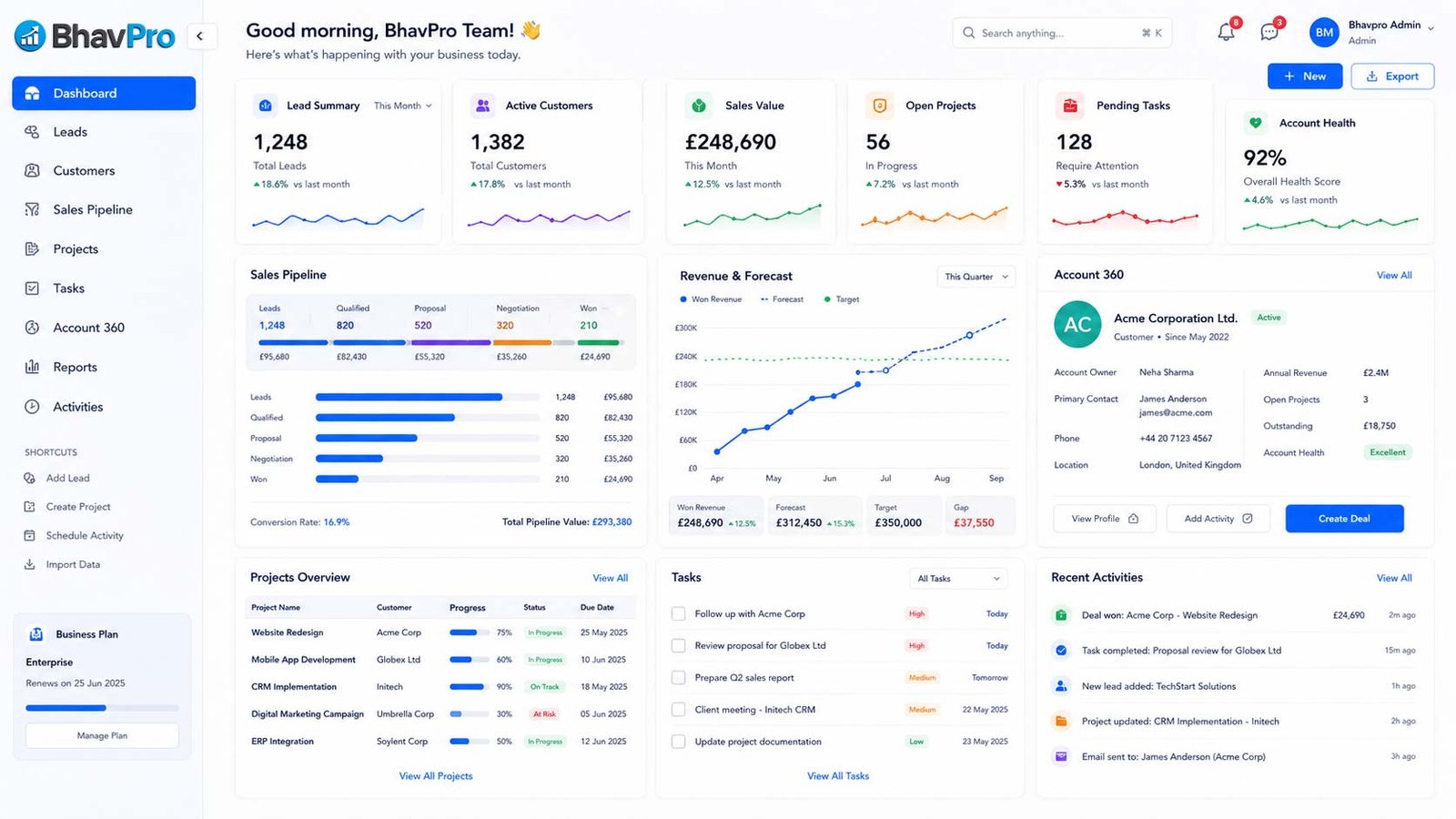
Purpose-built CRM and operational workflows spanning lead, account, sales, service and retention activity.
- Leads and pipelines
- Account 360 and activities
- Tasks, automation and reporting
Billing & Commercial Systems
Connect products, pricing, quotations, orders, invoices, payments, receipts, subscriptions and renewals.
- Quote-to-invoice lifecycle
- Payment status and webhooks
- Customer billing views
Ticketing & Support Platforms
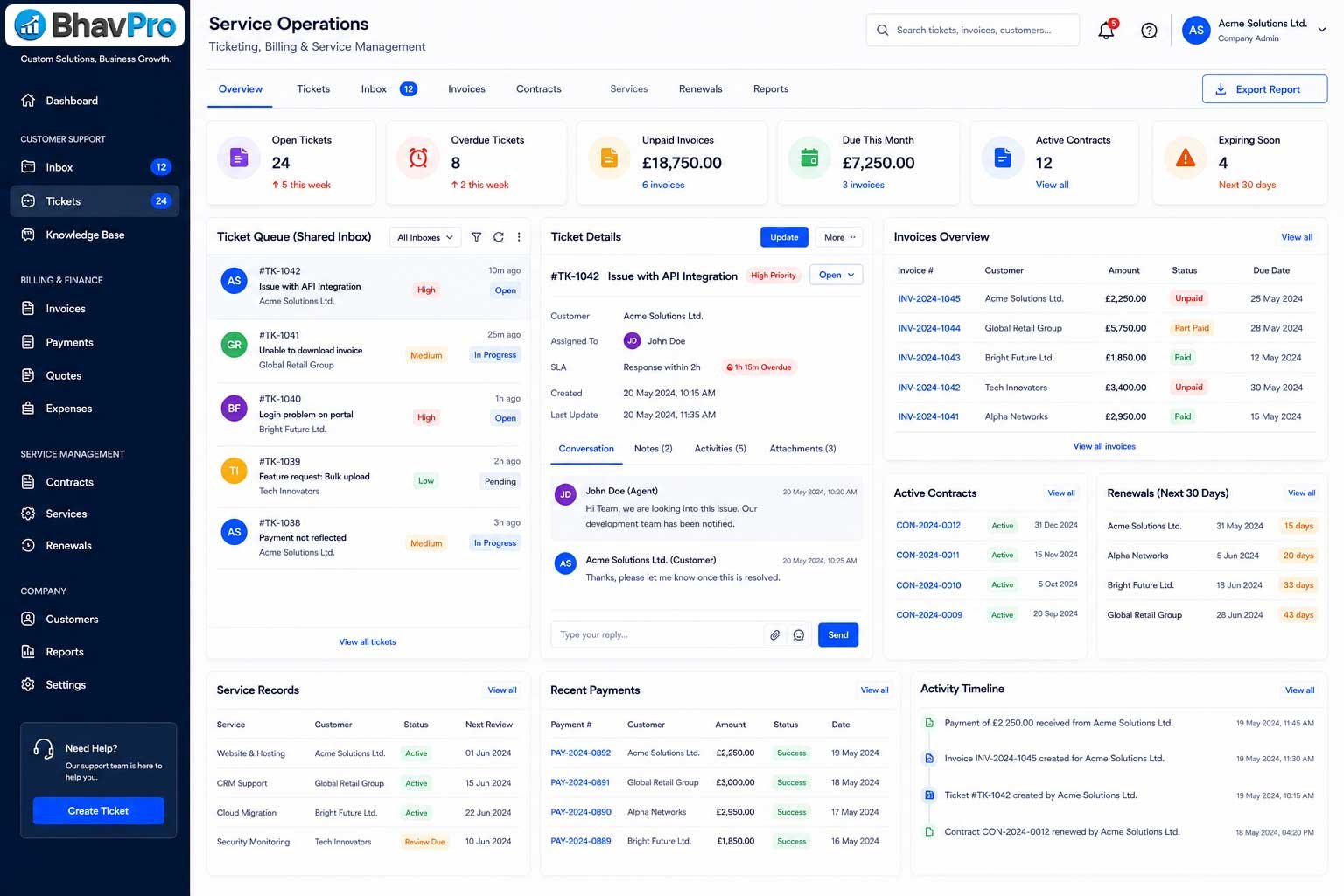
Bring inboxes, tickets, SLAs, customer history, knowledge and service workflows into one structured support environment.
- Queues and priorities
- Assignment and escalation
- Customer self-service
Internal Business Applications
Replace uncontrolled spreadsheets and repetitive administration with focused applications for internal operations.
- Approvals and requests
- Projects, tasks and assets
- Compliance and workflow tracking
SaaS & Digital Platforms
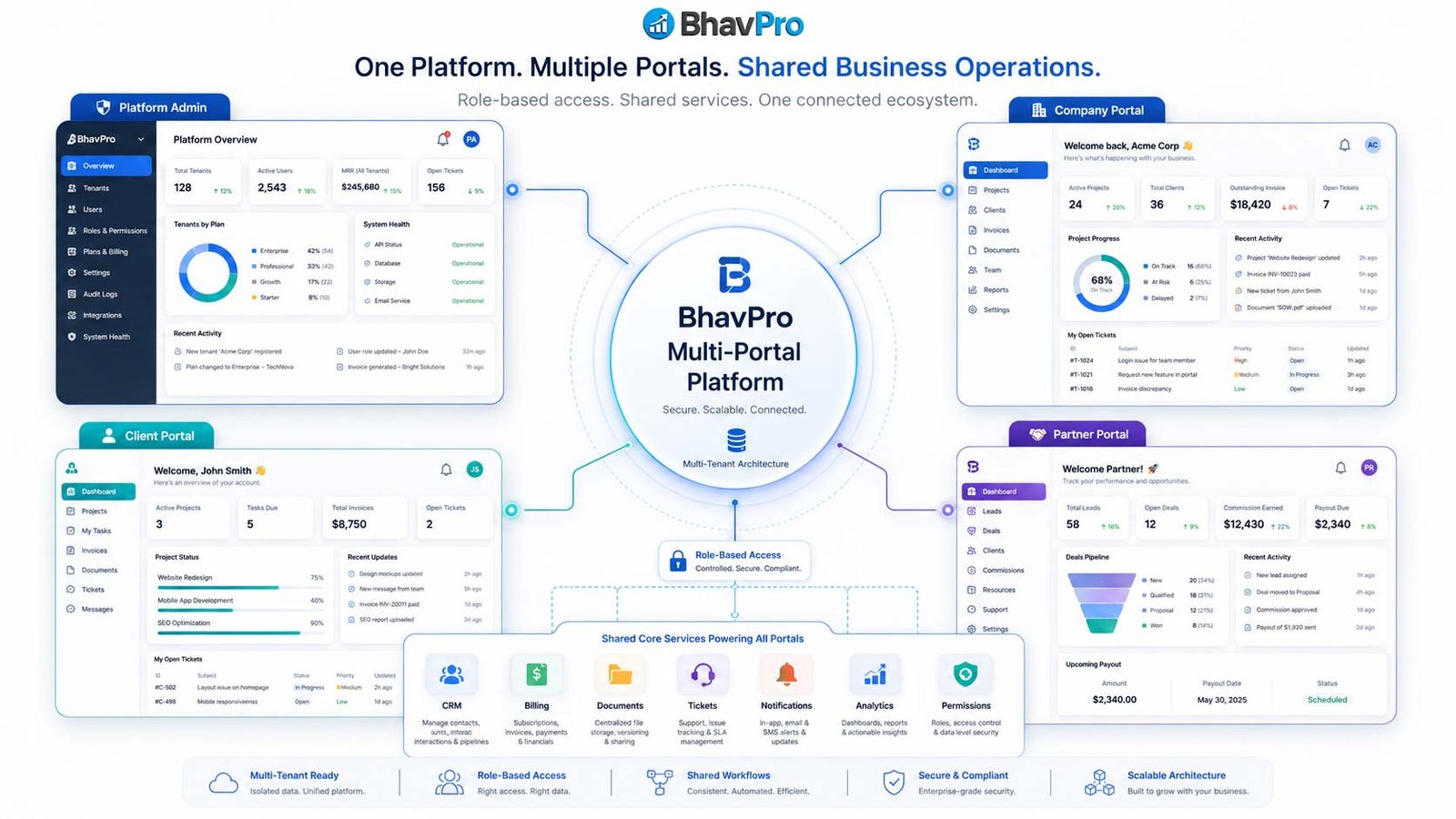
Build an MVP or full SaaS platform with organisations, users, plans, permissions, billing, dashboards and administration.
- Multi-tenant architecture
- Subscriptions and entitlements
- White-label capabilities
Directories, Marketplaces & Comparison
Commercial platforms for listings, search, providers, memberships, lead routing, quote requests and analytics.
- Provider accounts
- Comparison and enquiry flows
- Membership and referral models
Web Apps, WordPress & Extensions
Focused web applications, Chrome extensions, WordPress plugins, CRM functionality, dashboards and API-connected tools.
- Browser productivity tools
- WordPress business applications
- Custom calculators and dashboards
Examples include internal copilots, intelligent search, RAG knowledge tools, document extraction, summarisation, routing, reporting assistance and controlled workflow agents. AI is not added simply to make the project sound modern.
AI App Scope Estimator
Use this lightweight estimator to see the likely project route. It is not a quotation and does not replace discovery.
Describe the Shape of the Application
The result changes as scope, integrations and operational complexity increase.
A multi-role business application with several modules normally benefits from a structured App Blueprint before development starts.
This tool provides a project-routing indication only. Real scope depends on workflows, security, data, integrations, acceptance criteria, migration, testing and production requirements.
What a Connected Business Application Can Look Like
The strongest operational systems connect the customer lifecycle instead of leaving each department to maintain separate records.
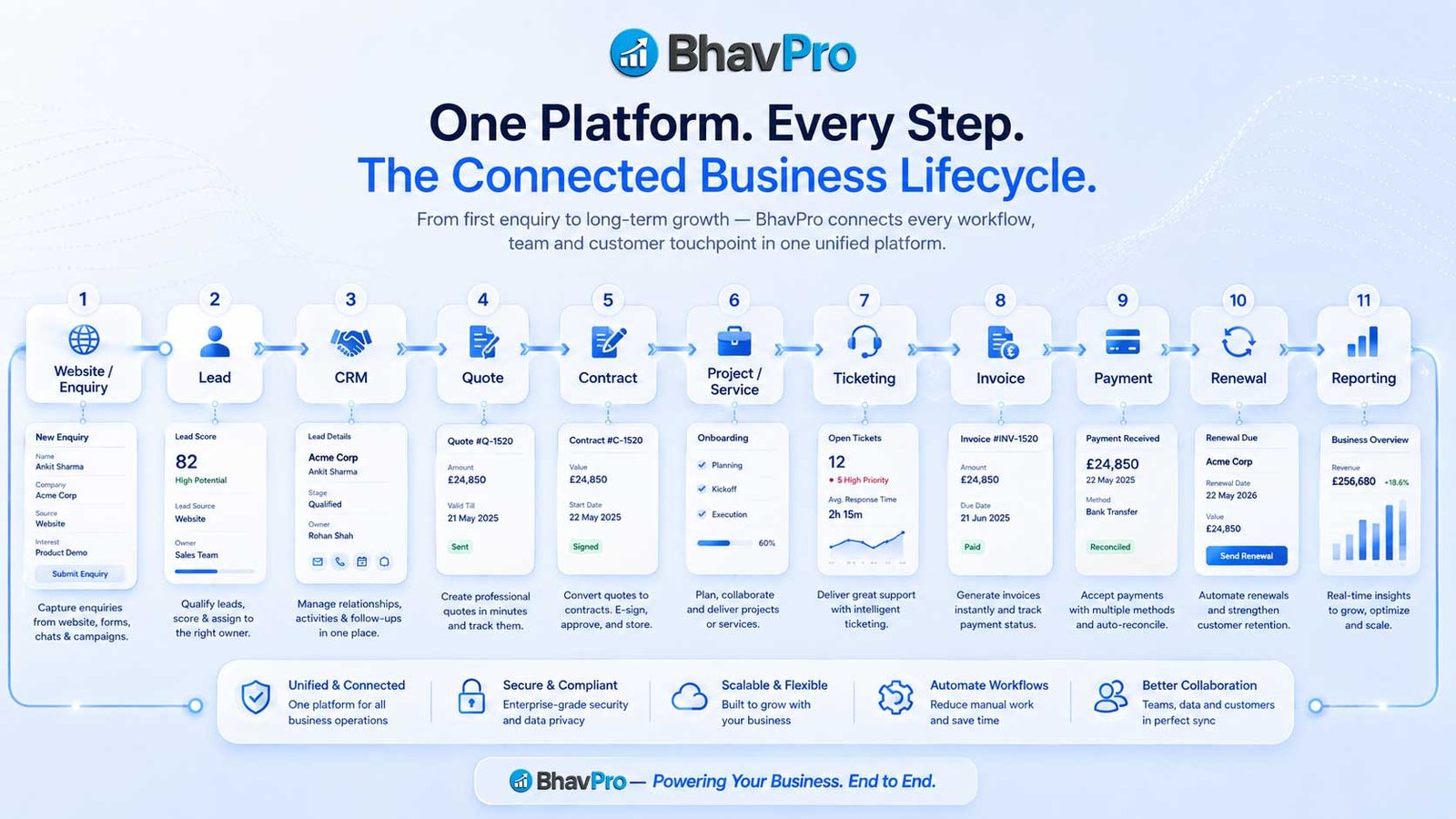
One Customer Record
Sales, service, billing and support can work from connected customer information rather than maintaining separate versions.
Controlled Workflow
Status, approvals, responsibilities and hand-offs can be designed into the process instead of relying on memory.
Customer Self-Service
Selected information and actions can be exposed through a portal without exposing internal administration.
Operational Visibility
Management reporting becomes more useful when the workflow records consistent events and outcomes.
BhavPro maps the stages that matter to your organisation and avoids building modules simply because another system has them.
Should You Build, Buy, Integrate or Automate?
Custom software is powerful, but it is not always the most commercially sensible answer.
| Situation | Usually Consider | Why |
|---|---|---|
| An existing SaaS product already covers most requirements | Buy / Configure | Avoid rebuilding mature commodity capability. |
| Two strong systems need to exchange information | Integrate | Keep what already works and remove duplicated handling. |
| Staff repeat predictable tasks across current tools | Automate | Reduce manual work without replacing the entire stack. |
| The current CRM can support the process with better configuration | Improve CRM | Configuration may deliver value faster than custom development. |
| A unique workflow is blocked by off-the-shelf limitations | Custom App | Purpose-built software can fit the actual operating model. |
| The software itself will become a product or commercial differentiator | SaaS / Platform Build | The application becomes part of the business proposition and IP. |
| An AI prototype works but has not been production engineered | Production Review | Architecture, permissions, data, security and release controls need validation. |
| The requirement is still unclear | Systems Audit | Define the problem before committing to a build. |
Build only where custom software creates meaningful operational or commercial value. Buying, configuring or integrating an existing platform can be the better decision when it already meets the requirement well.
AI-Accelerated Development. Human-Governed Engineering.
AI can shorten parts of the development cycle. The important engineering and business decisions still require accountable human control.
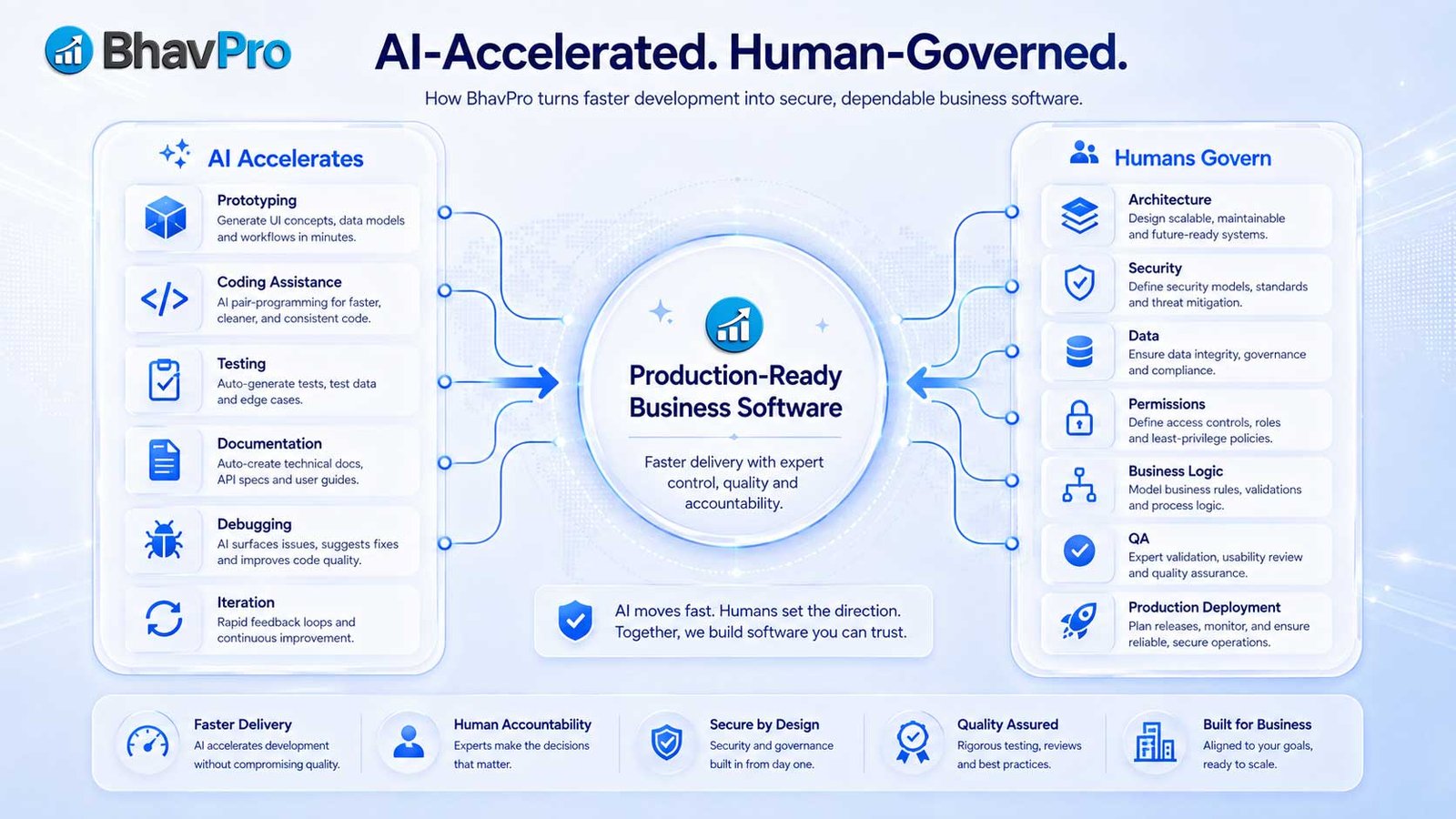
Where AI Helps the Engineering Process
- Requirements analysis and research
- Rapid prototyping and interface iteration
- Repetitive implementation code
- Test-case generation
- Documentation assistance
- Debugging and refactoring support
- Data transformation and API scaffolding
- Code-review assistance
Where Accountability Must Remain Clear
- Business requirements and acceptance criteria
- Architecture and data models
- Authentication and permissions
- Security boundaries
- Business rules and financial logic
- Integration design
- Production acceptance and deployment
- Handover and ongoing ownership
A business application needs to behave correctly across user roles, failure conditions, sensitive data, integrations and real operational workflowsβnot only inside a successful demo path.
Already Built an App with AI? Make It Production Ready
An AI-generated prototype can be a valuable starting point. Before customers, staff, payments or sensitive data depend on it, the application may need deeper engineering review.
Code & Application Structure
Review module boundaries, duplicated logic, environment configuration, technical debt and whether the system can be extended safely.
Authentication & Permissions
Check login flows, sessions, account recovery, user roles, admin controls and whether one user can access another userβs data.
Database & Integrity
Review relationships, validation, indexing, migration handling, sensitive information and backup requirements.
Testing, Deployment & Operations
Verify critical journeys, failure paths, integrations, monitoring, error logging, backups, documentation and recovery planning.
A production review focuses on what happens outside the happy path: bad input, failed payments, expired sessions, unavailable APIs, permission boundaries, duplicate requests, partial workflows and recovery.
Core Application Capabilities
Different applications combine different capabilities. The goal is to build the smallest coherent system that supports the required lifecycle.
User & Access Management
Accounts, organisations, roles, permissions, profiles, account activation, password recovery, optional MFA and access logging.
Workflow & Automation
Status flows, approvals, assignments, triggers, reminders, notifications, scheduled actions, escalations and cross-module rules.
Communication
Email, SMS, notifications, support messages, internal notes, activity timelines, templates and optional VoIP integration.
Documents & Records
Uploads, contracts, quotes, invoices, receipts, knowledge, attachments, customer-accessible records and internal files.
Billing & Payments
Products, pricing, quotations, invoices, subscriptions, payment status, receipts, credits, renewals and commercial history.
Reporting & Analytics
Operational dashboards, sales performance, revenue, service metrics, project progress, customer lifecycle and custom KPIs.
Administration
Company settings, users, services, pricing, templates, workflows, permissions, notifications, integrations and audit controls.
AI Assistance
Knowledge assistants, document intelligence, summarisation, intelligent search, routing, reporting assistance and controlled agents.
Practical AI Features for Business Applications
AI can add genuine value when it helps users find information, understand records, reduce repetitive work or make better decisions. Each feature should have a defined purpose, controlled data access and appropriate human oversight.
Internal Knowledge Assistants
Allow authorised staff to ask natural-language questions across approved documents, policies, procedures or knowledge articles without exposing unrelated information.
- RAG-based knowledge retrieval
- Source-aware answers
- Role-aware access controls
Document Intelligence
Extract, classify, summarise or route information from invoices, forms, contracts, support files or other business documents.
- Data extraction
- Classification
- Summaries and routing
Support Assistance
Help service teams understand long histories, locate relevant knowledge and prepare response drafts while keeping the agent responsible for the final action.
- Conversation summaries
- Suggested knowledge
- Draft response support
CRM Assistance
Summarise account history, prepare follow-ups, surface relevant context or assist users in finding information across customer records.
- Account summaries
- Follow-up assistance
- Natural-language record search
Intelligent Classification & Routing
Assist with categorising leads, tickets, requests, documents or messages and routing them into defined operational workflows.
- Lead categorisation
- Ticket classification
- Document routing
Reporting Assistance
Translate operational data into clearer management summaries, surface unusual patterns or help users interrogate approved reporting data.
- Management summaries
- Natural-language questions
- Trend explanation
Controlled Workflow Agents
Perform tightly scoped tasks under defined permissions and rules, with clear boundaries around what the agent can read, change or trigger.
- Defined tool access
- Permission boundaries
- Human checkpoints where needed
Communication Assistance
Generate drafts for messages, documentation, knowledge articles or internal communications where faster preparation is useful.
- Email and message drafts
- Knowledge drafts
- Template assistance
Intelligent Search
Help users find relevant information across complex records and approved content without needing to know exactly where it is stored.
- Semantic search
- Contextual retrieval
- Cross-module discovery
Where an AI feature can affect customers, finances, permissions, regulated information or important operational decisions, the workflow should define clear controls, review points and fallback behaviour.
Integrate the Software You Already Use
A custom application rarely needs to replace everything. Where an existing platform performs a function well, integration can be safer and more economical than rebuilding it.
Commercial
Payment providers, accounting software, billing platforms, eCommerce and product systems.
Customer Operations
CRM, helpdesk, ticketing, marketing platforms, calendars and customer-data services.
Communication
Email, SMS, VoIP, telephony, notifications and collaboration platforms.
Digital & Data
WordPress, cloud storage, identity providers, analytics, AI providers, supplier APIs and data services.
If an existing service already handles payments, accounting, communications or another specialist capability reliably, the custom application can focus on the workflow that differentiates your business.
Security, Privacy & Ownership Are Part of the Design
Software that handles customers, staff, billing or operational data needs clear controls and clear ownership arrangements from the beginning.
Security-Conscious Development
- Secure authentication and sessions
- Role-based access and least privilege
- Input and API validation
- Secrets and environment controls
- Logging and audit trails
- Dependency and configuration review
- Backups and recovery planning
Data Protection by Workflow
- What information is collected
- Who can access it
- Where it is stored
- Third-party processors
- AI-provider data exposure
- Retention and deletion
- Export and account closure
Clear Handover Terms
- Source-code access
- IP and licensing
- Third-party components
- Hosting and accounts
- Database and data ownership
- Documentation
- Maintenance responsibilities
The exact security and regulatory controls depend on the application, data, users, integrations and risk profile. Requirements should be assessed against the real project rather than implied by generic marketing language.
Problem β Process β Architecture β Build β Verify β Launch β Improve
A repeatable delivery model keeps attention on the business outcome while giving the software enough structure to remain maintainable.
Discover
Define the problem, users, current workflow, existing tools and the outcome that would make the project worthwhile.
Model
Map user journeys, workflow stages, business rules, approvals, records, exceptions and reporting requirements.
Architect
Define modules, data, permissions, integrations, security, environments, hosting approach and MVP boundaries.
Build
Develop against agreed workflows and acceptance criteria, using AI assistance where it safely accelerates implementation.
Verify
Test critical journeys, validation, permissions, integrations, billing, notifications, mobile behaviour and admin controls.
Launch
Configure production, migrate agreed data, prepare users, complete go-live checks and provide the defined handover.
Evolve
Improve workflows, performance, integrations, reporting, automation and AI functionality as the business learns from use.
Depending on scope, completion can include defined requirements, working software, verified critical journeys, roles and permissions, deployment, administration guidance, known limitations, documentation and agreed support arrangements.
AI App Development Engagement Routes
Not every enquiry should begin with a large development commitment. The route should match how clear the problem and solution already are.
AI Business Systems Audit
For businesses that know something needs to improve but are unsure whether the right route is build, integration, configuration or automation.
App Blueprint
Define users, workflow, feature priorities, data, integrations, risk areas, MVP boundaries and a practical delivery roadmap.
Prototype / Proof of Concept
Validate the highest-risk assumption or workflow before committing to the complete product.
MVP Development
Deliver the smallest usable version of a new app or SaaS product that can support real users and learning.
Custom Business System
Build a significant operational application spanning modules such as CRM, portal, ticketing, projects, billing and reporting.
Integrated Platform Build
Support multiple portals, shared data, complex permissions, integrations and cross-functional workflows in one platform.
AI Prototype Production Review
Assess an existing AI-built application for architecture, permissions, data integrity, security, testing and production readiness.
Managed App Evolution
Continue improving the application after launch through enhancements, integrations, automation, AI features and support.
Business Use Cases
The application should be designed around how the organisation makes money, delivers services and manages usersβnot around a generic industry template.
Professional Services
Client portals, onboarding, projects, documents, billing, CRM and service tracking.
Telecom & Communications
CRM, provisioning, support, billing, service management, partner portals and communications integration.
Agencies
Client portals, leads, projects, campaign reporting, billing and partner workflows.
SaaS & Technology
MVPs, subscriptions, customer portals, admin panels, usage management, billing and knowledge systems.
Recruitment
Candidate workflows, client areas, vacancies, onboarding, communication and reporting.
Field & Service Businesses
Jobs, scheduling, customer portals, service history, billing and notifications.
Directories & Membership
Listings, search, subscriptions, provider portals, lead generation, reviews and memberships.
Comparison & Lead Generation
Comparison journeys, provider management, lead routing, partner portals, quotes and commercial analytics.
Selected Build Capabilities Behind the BhavPro Offer
BhavPro's AI Apps proposition is informed by practical work across CRM, customer operations, billing, ticketing, portals, communications, workflow automation, web development and business-process improvement.
Customer Lifecycle Systems
Experience spans lead capture, pipelines, customer records, activities, account management, user access, reporting, automation and customer-retention workflows.
Operational Modules
Business-system work has included projects, tasks, order management, service provisioning, stock, internal tools, staff workflows and operational reporting.
Ticketing & Communication
Experience includes ticketing, multiple inboxes, customer histories, SMS, templates, activity records and communication workflows connected with CRM operations.
Billing & Commercial Processes
Operational experience includes billing administration, quotations, order processes, rate calculators, service records and integration of commercial platforms.
Portals & Access
Client, company, partner and role-based access patterns can be designed so each user sees the correct workspace and actions.
Comparison Platforms
Comparison, provider, partner and lead-routing workflows can support businesses built around enquiries, referrals or service matching.
Telecom Operations
Deep telecom and VoIP experience provides additional context for provisioning, services, billing, support and communications-heavy workflows.
WordPress & Web Systems
Custom web applications, WordPress functionality, integrations, dashboards and customer-facing journeys can form part of a broader system.
BhavPro can present proprietary builds, demonstration systems, internal platforms and client work according to what each project genuinely represents. The page does not depend on invented client names, fabricated testimonials or unsupported performance figures.
Why Businesses Choose Custom Software
Custom development should have a clear operational or commercial reason. The strongest projects solve a problem that existing tools cannot solve cleanly.
Fit the Actual Workflow
Design the application around how your organisation sells, delivers, supports and bills instead of forcing teams into a generic software model.
Reduce Repetitive Work
Remove unnecessary re-keying, manual hand-offs, duplicate records and administrative steps that consume staff time.
Connect Departments
Allow sales, service, operations and finance to work from connected information and clearer lifecycle states.
Improve Customer Experience
Give customers useful self-service, clearer updates, structured requests and faster access to records or support.
Improve Visibility
Build reporting around consistent operational events so management can see what is happening and where work is getting stuck.
Control Access
Provide different permissions and interfaces for employees, customers, partners, suppliers or administrators.
Build Commercial IP
For SaaS, marketplaces and digital products, the software can become part of the company's own commercial proposition and value.
Reduce Tool Fragmentation
Consolidate overlapping workflows while retaining specialist third-party systems that continue to add value.
A strong application architecture can keep existing accounting, payment, communications or CRM services where they work well and add only the custom layer needed to make the overall process coherent.
AI App Project Readiness
You do not need every answer before contacting BhavPro, but thinking through these areas helps expose the decisions that will shape scope, risk and delivery.
Business Problem
- What problem should the application solve?
- Who owns the project internally?
- What improves if the project succeeds?
- Is the process stable enough to automate?
Users & Roles
- Who will use the system?
- What different roles are required?
- Do customers, partners or suppliers need access?
- Who will administer the system?
Data & Migration
- What information is involved?
- Where does it live today?
- Does historical data need migration?
- Is any information sensitive?
Workflow & Exceptions
- What are the main stages?
- Where are approvals required?
- What happens when something fails?
- Which events need an audit trail?
Existing Systems
- Which platforms must remain?
- Are APIs or webhooks available?
- Which system should own each record?
- Are there supplier dependencies?
Commercial Model
- Is the app internal or customer-facing?
- Is the software itself a product?
- Are billing or subscriptions required?
- Are there partner or referral flows?
Security & Risk
- What access controls are required?
- Does the app process regulated information?
- Are payments involved?
- What happens if the system is unavailable?
After Launch
- Who supports users?
- Who manages configuration?
- What reporting is required?
- What documentation is needed?
Acceptance & Outcomes
- What must work on day one?
- What can wait for a later phase?
- How will success be measured?
- What would make the project commercially worthwhile?
Discovery exists to turn uncertainty into a structured requirement. The important thing is to start with the real problem rather than guessing the technical solution.
Scope, Timing, Ownership & Readiness
A good project starts with clarity about the business problem, decision-maker, users, data and operating responsibility.
How Is Scope Determined?
Scope is driven by workflows, user roles, modules, integrations, migration, billing, AI functionality, reporting, security, testing and documentationβnot simply by the number of screens.
How Long Does Development Take?
Timescales depend on complexity and feedback cycles. A focused prototype can move quickly; a multi-portal business platform needs more discovery, testing and release control.
How Is Pricing Determined?
Pricing is scoped against the actual delivery route and responsibilities. Discovery, integrations, data migration, permissions, payments and production requirements can materially change complexity.
Who Owns and Operates the System?
Source-code access, licensing, hosting, data ownership, third-party accounts, documentation, maintenance and handover should be defined in the project agreement.
BhavPro may recommend against a build when an existing platform already fits well, the workflow is not defined, the project has no internal owner, a simple integration solves the problem, or the business value does not justify custom software.
Useful starting information includes who uses the process, what happens today, which systems are involved, what data matters, what should improve and whether the new application is internal, customer-facing or a commercial product.
AI App Development FAQs
Clear answers to the questions businesses commonly need to resolve before commissioning custom software.
What is AI app development?
AI app development can describe software that uses AI as part of its functionality or a development process that uses AI assistance to accelerate research, prototyping, implementation and testing. BhavPro uses AI where it creates practical value while keeping architecture, security, testing and production decisions under human control.
Does every application BhavPro builds use AI?
No. Some projects are better solved through conventional software, workflow automation, integration or configuration. AI should be included because it improves the outcome, not because the project needs an AI label.
Can BhavPro build a complete business portal?
Yes. Depending on scope, a portal can include customer accounts, projects, service status, tickets, invoices, payments, documents, notifications, requests, knowledge and role-based access.
Can you build a CRM?
Yes. BhavPro can develop CRM and customer-operations functionality around the required workflow. CRM-specific requirements can also be routed through BhavPro CRM Development & Integration.
Can you build billing and invoicing into an application?
Yes. A custom system can include products, quotations, invoices, payment tracking, subscriptions, receipts, renewals and customer billing views where required.
Can you build a ticketing system?
Yes. Ticketing can include queues, assignment, priorities, SLA logic, customer history, messaging, attachments, escalation, reporting and customer self-service.
Can you build SaaS software?
Yes. BhavPro can help define and develop SaaS MVPs and larger platforms including organisations, users, permissions, subscriptions, billing, dashboards, administration and integrations.
Can you build Chrome extensions and WordPress applications?
Potentially, yes. BhavPro can develop browser extensions, WordPress plugins, portal functionality, CRM-related features, custom administration workflows and API-connected tools where those platforms are appropriate.
Can you integrate payment providers?
Yes, where supported and appropriate. A complete payment integration may also need webhook handling, invoice logic, failed-payment states, subscription state, receipts and audit history.
Can you connect the app to our existing CRM or software?
Yes, where suitable APIs, webhooks or supported integration methods are available. Existing systems should be retained when they continue to perform a useful role.
Can you improve an application we built with AI?
Yes. BhavPro can review AI-generated prototypes for architecture, authentication, permissions, data integrity, security, testing, deployment, maintainability and operational readiness.
Is AI-generated code reviewed?
BhavPro uses a human-governed approach. AI-assisted output is not treated as production-ready simply because it compiles or appears to work in a demo.
How do you handle application security?
Security requirements are considered during discovery and architecture. Appropriate controls depend on the application's users, data, integrations, payments, hosting environment and risk profile.
Who owns the software?
Ownership, licensing, third-party components, hosting, infrastructure and handover arrangements are defined in the project agreement. The exact position depends on the project and should be clear before development begins.
Can another developer maintain the application later?
That depends on the agreed architecture, source-code access, licensing and handover scope. Maintainability and documentation should be considered from the beginning for systems intended to remain in use long term.
How much does custom AI app development cost?
Pricing depends on scope rather than a simple per-page rate. User roles, modules, integrations, payments, AI functionality, migration, security, testing and support can materially change project complexity.
Should we build custom software or buy an existing platform?
If an existing product already meets most of the requirement, buying or configuring it may be the better option. Custom development is most valuable where your workflow, commercial model or integration requirement creates a meaningful gap.
Can BhavPro replace several SaaS tools with one platform?
Potentially. The first step is to identify what each current tool does well, what is duplicated, what needs to remain and whether consolidation creates a genuine operational or commercial benefit.
What happens after launch?
Depending on the engagement, BhavPro can provide maintenance, enhancements, integration support, workflow changes, automation, reporting and ongoing application development.
What if we are not sure what we need?
Start with the business problem or the AI Business Systems Audit. The objective is to determine whether your requirement is best solved through custom software, automation, integration, configuration or another route.
Related BhavPro Solutions
If a full custom application is not the right starting point, these specialist services may be more appropriate.
Not sure whether to build?
Start with the AI Business Systems Audit to identify the most sensible route.
AI & Automation
Automate existing workflows and introduce practical AI capabilities.
CRM Development
Design CRM and customer-management systems around your operational lifecycle.
API Integration
Connect CRM, communications, billing, SaaS and other platforms through supported APIs.
Web Development
Build high-performance websites and WordPress solutions when a full custom application is unnecessary.
Ready to Scope Your AI App or Business System?
You do not need to arrive with a complete technical specification. Tell BhavPro what is not working today, who needs to use the system, which tools you already use and what the new workflow needs to achieve.
We can then help determine whether the right route is to build, integrate, automate, configure or improve.
Request an AI App Scope Review
Tell us what you want to improve or build. BhavPro can review the business problem, likely application route and the most important scope questions before recommending the next step.
By submitting the form, you are asking BhavPro to respond to your enquiry. Read the Privacy Policy.
