
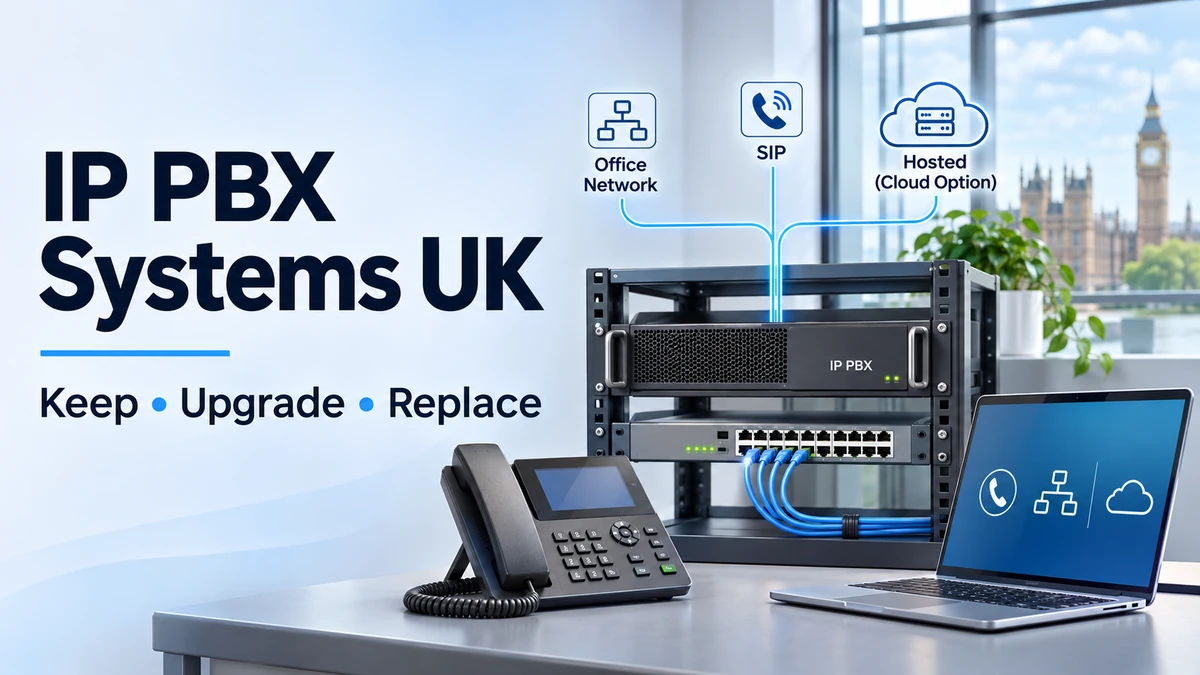
Make the Right IP PBX Decision for Your Business
A buyer-focused IP PBX assessment for UK businesses. Test whether your existing system deserves another investment, compare operating responsibilities and costs, and produce a supplier-ready specification before committing to migration.
Keep & Modernise
Retain a supported PBX where business workflows, SIP connectivity and operating controls can be proven.
Upgrade the IP PBX
Move to a supported, maintainable IP platform when local control is useful and the organisation can operate it.
Replace With Hosted
Assess managed calling when lifecycle support, remote users or supplier accountability favour a hosted model.
Should you replace an existing PBX? Not automatically. Keep it if the platform is supported, meets current call workflows and can use an appropriate digital network service. Upgrade it if essential functions or security maintenance are no longer viable. Consider hosted calling when the organisation wants less direct PBX administration. The right choice depends on technical acceptance tests and comparable lifetime costs—not a single per-user price.
Should You Keep, Upgrade or Replace Your PBX?
Direct answer: Start with the current system's support status, call-flow fit, interoperability and resilience. If those are sound, retaining the PBX with updated connectivity may be sensible. If the system is unsupported, cannot meet operational needs or creates unacceptable security risks, compare a supported IP PBX upgrade with managed hosted calling. Do not decide on headline licence price alone.
A documented vendor support path, working call flows, proven SIP service and affordable maintenance.
Current infrastructure needs a new supported platform, but local or private-cloud control and in-house/partner expertise still make sense.
New work patterns, support coverage or operating constraints make a managed platform worth evaluating.
These are decision paths, not product rankings. An upgraded IP PBX can itself be hosted; the key distinction is who controls its software, how it is supported and who is accountable when calls fail.
For a wider comparison across all business calling technologies, start with the Business Phone Systems UK selection guide. This page concentrates on businesses assessing IP PBX ownership, upgrade and replacement.
Interactive PBX Decision Assessment
Answer the questions as you would during a supplier discovery call. The tool provides conditional planning guidance and a list of outstanding evidence—not a guaranteed recommendation or a technical certification.
PBX Keep / Upgrade / Replace Assessment
The assessment is calculated in this browser; this tool does not submit answers to BhavPro. Normal website analytics and browser extensions may operate separately.
Assessment Not Yet Completed
Select the known facts, then choose Assess PBX Options.
When the output recommends comparison, collect competing quotes against the same technical inventory and acceptance tests before awarding the contract.
What Is an IP PBX—and Where Does It Run?
An IP PBX is a private telephone system that controls call routing and extensions using IP networks. It is a technology architecture, not a synonym for an on-premise box. The software may run on dedicated hardware, a local virtual machine, a private-cloud server or a managed hosting platform. Hosted PBX describes a deployment and support model, not a different telephone protocol.
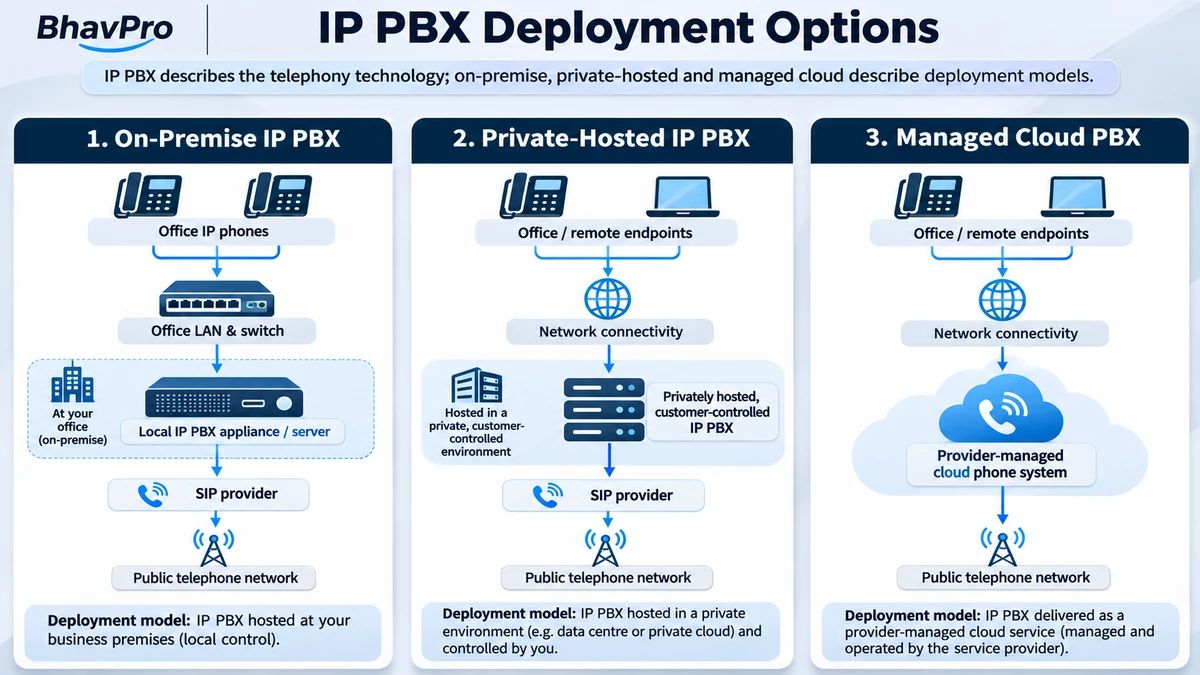
| Model | Where Call Control Runs | Who Typically Manages It | Main Buyer Question |
|---|---|---|---|
| Traditional or analogue PBX | Local legacy platform | Business or maintenance contractor | Can the dependent circuits be migrated without losing critical functions? |
| On-premise IP PBX | Local appliance or server | In-house IT / contracted PBX partner | Can we secure, patch, back up and recover it? |
| Virtual / private-cloud IP PBX | Virtual infrastructure on-site or in a private cloud | Business IT / integrator | Who owns the virtual host, hypervisor and PBX lifecycle? |
| Provider-hosted PBX | Supplier-hosted infrastructure | Managed provider, subject to contract | What administration, restoration and porting rights remain ours? |
| Hybrid PBX environment | Mixed legacy, IP and/or hosted components | Shared responsibility | What must interoperate during the transition? |
These categories overlap. A virtual IP PBX may be hosted privately; a platform such as 3CX may be deployed in different hosting arrangements. Check the service boundary in writing rather than classifying a solution by its marketing label.
The NCSC PBX security guidance also distinguishes traditional, IP, hosted, virtual and hybrid models.
Build Your PBX and Telephone Estate Inventory
A reliable buying decision starts with an asset register. Ask your IT administrator, telecom partner and business operations lead to complete these fields before requesting a replacement quote.
| Evidence to Record | Why It Changes the Decision | Acceptable Proof |
|---|---|---|
| PBX make, model, firmware and support end date | Determines patch support and spare-part risk | Vendor support confirmation, contract and version export |
| User extensions, sites, departments and queues | Maps real workflows, not only total headcount | Live extension export and call-flow documentation |
| Busy-hour concurrent external calls | Sets trunk/call capacity and contention risk | Time-stamped CDR, SIP or PBX busy-period reporting |
| SIP trunk credentials, IP authentication, codec and DTMF | Determines carrier interoperability | Carrier interop statement plus witnessed test |
| Desk handsets, DECT, paging and headsets | Shows reuse or replacement costs | Device model inventory and firmware compatibility |
| Analogue devices, alarms, lifts, payment terminals | May require separate migration paths | Device supplier compatibility and test record |
| CRM, call recording, reporting, API integrations | Prevents losing essential capabilities | Workflow owner approval and integration test |
| WAN/ISP, VLANs, QoS, PoE, UPS, firewalls | Exposes network and power dependencies | Network diagram, switch/UPS data and fault test |
| Number ranges, emergency location, porting contacts | Protects inbound reachability and 999/112 obligations | Carrier account details and signed number schedule |
| Backup and recovery evidence, roles, licence portability | Shows maintainability and exit rights | Restoration drill, contract and offboarding conditions |
How Should You Size an IP PBX and Its Calls?
Do not size an IP PBX by headcount alone. Count active user extensions and devices, then measure simultaneous external calls during your busiest representative periods. Validate the carrier's channel limits, the PBX platform's licensed concurrency, internal call needs and expected growth separately.
Worked illustration: a business has 45 extensions but its busiest observed period contains 9 simultaneous external calls. An illustrative 25% capacity allowance gives ceil(9 × 1.25) = 12 external-call channels for initial discussion. This is not a carrier order quantity: busy-hour evidence, feature traffic, inbound peaks, call treatment and resilience requirements may change the specification.
Also check SIP session/channel semantics, codec and transcoding load, call recording storage, IVR/queue concurrency and how users connect across sites. For detailed channel rental and calling charges, use BhavPro's specialist SIP Trunking UK guide and channel calculator rather than duplicating carrier comparisons here.
When Does On-Premise IP PBX Still Make Sense?
On-premise IP PBX can still be appropriate where a business requires local control, has supported infrastructure, can fund maintenance and needs integrations that are difficult to reproduce in managed hosted calling. Hosted PBX can suit organisations that prioritise easier provisioning and contracted platform operations. Neither architecture removes the need for resilient connectivity, clear accountability or user testing.
| Decision Factor | Retain / Self-Manage IP PBX | Managed Hosted Calling |
|---|---|---|
| Platform lifecycle | Buyer or named partner owns updates, infrastructure and refresh | Contracted provider normally runs core PBX platform; confirm exact scope |
| Connectivity dependencies | Local calling may survive some WAN faults, depending on design; external calls need carrier access | Remote provider access, local network and endpoints still depend on connectivity |
| Custom integrations | Potentially deeper control over supported local APIs and interfaces | May be simpler or more limited, depending on provider capability |
| Day-to-day administration | Requires skills, access control, change management and backup discipline | Vendor portal and contracted service; clarify who configures complex flows |
| Capital expenditure | May reuse equipment or require refresh/UPS/server spend | Often lower upfront platform spend, but recurring per-user and add-on charges |
| Resilience obligation | On-prem recovery and tested backup sit with assigned owner | Provider SLA is not a guarantee of end-to-end office reachability |
| Exit/migration | Export and device reuse depend on licensing and support status | Numbers, recordings, configuration and terms require an exit plan |
To evaluate the hosted architecture itself, use the existing Cloud Phone Systems UK guide. This resource focuses on the customer's decision to preserve, modernise or replace the current PBX investment.
IP PBX Costs: Compare the Same Business Requirement
Which is cheaper—on-premise IP PBX or hosted PBX? Neither is always cheaper. Use the same number of users, measured call capacity, features, devices, support cover and resilience standard for each option, then compare the total cost over three and five years. Include both recurring charges and one-off implementation, refresh and internal administration costs.
Two offers labelled “£X per user” may exclude different items. Your comparison must account for licences, SIP/carrier charges, handsets, server or hosting, cloud services, security/patching, monitoring, engineering hours, support SLAs, testing, number porting, UPS, backups and future replacements.
| Cost Layer | Items to Ask Suppliers to Disclose | Common Omission |
|---|---|---|
| Platform and user licensing | PBX licences, user tiers, simultaneous-call rights, annual renewal, feature add-ons | Feature tier changes as more queues or integrations are required |
| Carrier calling and numbers | SIP trunks/channels, bundles, out-of-bundle charges, DID ranges and emergency calling | Carrier rental quoted separately from the PBX |
| Hardware and endpoints | Appliance/virtual host, handsets, DECT, PoE switches, UPS and spares | Reuse is assumed but compatibility is untested |
| Implementation and migration | Discovery, number porting, call-flow rebuild, training, parallel running and contingency | One-off effort and downtime planning |
| Operations and security | Maintenance, patching, monitoring, recovery testing and administrator hours | Internal staff time or outsourced support |
| Future changes | Growth users, licence uplift, hardware refresh and exit/port charges | Year-four or year-five replacement risk |
How the lifetime costs are calculated: annual internal administration cost is hours × loaded hourly rate. Monthly equivalent cost combines platform rental, per-user licences, carrier charges, rented devices, and one-twelfth of annual support and administration. Add one-off costs to both three- and five-year totals; add a separately entered year-four refresh only to the five-year total. The optional VAT illustration applies to assumed taxable supplier charges, not internal labour.
Fictional worked illustration, excluding VAT: suppose supplier costs are £150 per month, internal support takes 10 hours per year at £30 per hour (equivalent to £25 per month), one-off implementation is £800 and the year-four refresh is £1,000. Three-year TCO is £7,100 (36 × £175 + £800); five-year TCO is £12,300 (60 × £175 + £800 + £1,000). These are invented mathematics inputs, not UK supplier prices.
All actual prices must come from supplier quotations or documented internal budgets. The calculator below deliberately starts with blank prices; zeros must be entered consciously where costs are genuinely included elsewhere. A demonstration is available but uses fictional amounts, not market rates.
Interactive IP PBX Total Cost Calculator
The model compares three scenarios using consistent user requirements. Enter all cost lines for each scenario; use 0 only when the item is truly not charged or already included in another entered figure. The tool does not recommend a vendor, calculate net present value, estimate downtime losses or make tax assumptions.
Three- and Five-Year PBX Total Cost Calculator
Keep & Modernise
Existing PBX supported; carrier and control upgrades only
Upgrade IP PBX
New supported self/partner-managed IP PBX
Replace With Hosted
Managed cloud calling that meets the same workflows
Waiting for Comparable Supplier Inputs
All nine cost inputs per scenario are required for a complete comparison. Enter zero deliberately for genuinely absent charges.
| Scenario | Monthly Equivalent | Three-Year TCO | Five-Year TCO |
|---|---|---|---|
| Keep & Modernise | Price Not Supplied | Price Not Supplied | Price Not Supplied |
| Upgrade IP PBX | Price Not Supplied | Price Not Supplied | Price Not Supplied |
| Replace With Hosted | Price Not Supplied | Price Not Supplied | Price Not Supplied |
Formula (before any illustrative VAT): monthly supplier costs = platform + (licence × costed users) + carrier/calls + rented devices + annual supplier support ÷ 12; monthly internal staff cost = annual administrator hours × loaded hourly rate ÷ 12. Three-year TCO = 36 × monthly total + one-offs; five-year TCO = 60 × monthly total + one-offs + year-four refresh/exit. Optional VAT applies only to assumed taxable supplier amounts, not internal labour. No inflation, future price increases, discount rate or financing is assumed. Verify every supplier charge and tax treatment.
Does the UK 2027 Phone Transition Force You to Replace Your PBX?
No—not necessarily. The UK PSTN and legacy ISDN transition requires affected services to move to digital alternatives by 31 January 2027. A supported PBX that can be connected through an appropriate digital service may remain in use, subject to carrier compatibility, configuration and testing. Unsupported analogue/ISDN dependencies and specialist devices need their own migration plan.
Openreach identifies alarms, payment terminals, lift emergency phones, CCTV and door entry as examples of connected services that may need assessment. Do not assume a generic voice-over-broadband adapter will preserve every critical feature. Confirm replacement or approved digital routes with each equipment supplier. See Openreach guidance for businesses and BhavPro's PSTN switch-off migration guide.
SIP Interoperability, Number Porting and Calling Routes
Can you keep your existing UK business numbers? Usually, eligible landline numbers can be retained when changing providers through number porting, subject to provider processes and any technical restrictions. Confirm the complete number inventory, porting eligibility, lead times, emergency-location details and fallback arrangements before cancelling the old service. Ofcom sets number-porting rules under General Condition B3 and switching rules under C7. Check Ofcom’s number portability guidance.
SIP compatibility must be demonstrated, not assumed. Confirm that the selected carrier and PBX support the required authentication mode, network addressing, codecs, DTMF, inbound/outbound number presentation, call forwarding and failover. Record test outcomes for ordinary calls, reception routing, voicemail and 999/112 handling.
Document the complete number inventory before submitting a port: main published numbers, direct-dial ranges, legacy extensions, fax numbers, emergency-service addresses and any third-party numbers used by alarms. Porting should be timed against tested fallback routing; a temporary diversion is not an excuse to omit the cutover checklist.
For detailed carrier and channel choices, refer to SIP Trunking UK: PBX Compatibility and Costs. For preserving number ranges specifically, use VoIP Number Porting in the UK.
Who Secures an IP PBX—and What Must Be Controlled?
The PBX owner and contracted supplier must agree responsibility for security before go-live. The minimum discussion should cover supported software, admin MFA, unique accounts, call-destination restrictions, network access controls, monitoring, incident response, patching, encrypted signalling/media where supported and independently usable backups. A provider's fraud alerts do not remove the need to manage exposure or contract terms.
| Control Area | Buyer Acceptance Question | Proof to Request |
|---|---|---|
| Access and identity | Who owns admin access and removes dormant accounts? | MFA demonstration and role review |
| Toll fraud protection | Can international/premium and out-of-hours calling be constrained? | Dial-plan rules, fraud alerts and contracted liability |
| Network isolation | Is the PBX isolated from unnecessary public exposure? | Diagram, firewall/allowlist and SIP/SBC configuration review |
| Patching | Who updates PBX, server, phones and firmware? | Named owner, supported versions and change log |
| Encryption | Which calls actually use TLS/SRTP and what are the exceptions? | End-to-end signalling/media configuration test |
| Monitoring | How are unusual destinations, volume and failed logins detected? | Escalation path, thresholds and alert trial |
| Backup and recovery | Can configuration and essential data be restored away from the live server? | Dated successful restore test and encrypted off-site backups |
The NCSC's PBX best practice provides a strong external checklist for on-premise and hosted models. BhavPro also maintains a specific guide to toll fraud and SIP account abuse.
What Happens When Power, Internet, PBX or Carrier Fails?
A second SIP trunk or backup broadband link does not guarantee telephone continuity. Test the actual call path: handset → LAN/PoE → PBX or cloud access → carrier → public network. Any component may fail independently. Document which calls still work, who changes routing and how inbound customers can reach the business during each fault.
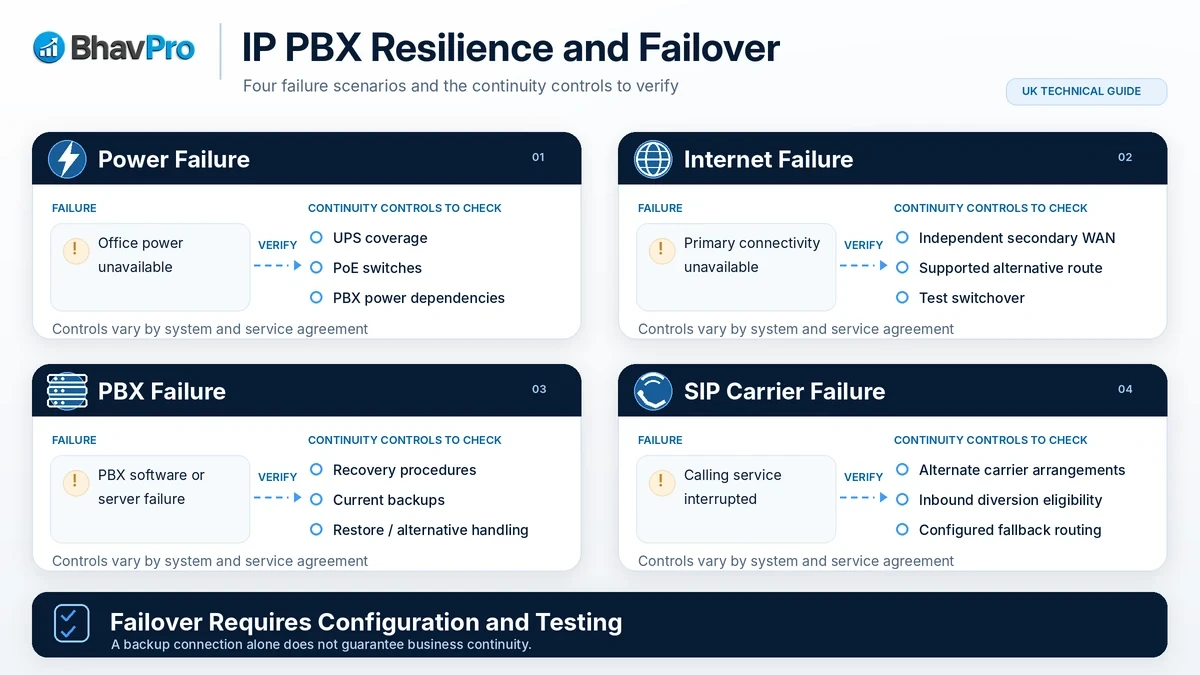
Ofcom requires regulated voice providers to maintain access to emergency organisations and reliable caller-location information where technically feasible. Work with the provider on the specific service design rather than assuming that an office UPS alone satisfies all obligations. See Ofcom General Condition A3 and BhavPro's VoIP Power Cuts and Emergency Planning.
Call Recording, Retention and Privacy Checks
Recording availability is not permission to record every call. Decide why calls are recorded, who can access them, how long they are retained, how people are informed and how recordings can be exported or deleted. Apply data protection obligations to staff, customers and callers, including access requests and appropriate security controls.
For call recording, contract and technical design should specify lawful purpose, privacy notices, access permissions, storage jurisdiction if relevant, backup retention, policy exceptions, payment-data handling and any sector-specific rules. The ICO's monitoring-workers guidance explains why indiscriminate monitoring may be disproportionate and why affected people should be told when calls are recorded. Consult your compliance adviser where the legal basis is unclear.
Acceptance Tests Every PBX Supplier Should Demonstrate
A specification is only useful when measurable. Assign each test an owner, evidence, pass/fail result and remediation date, and do not accept “supported in principle” where a critical workflow has not been demonstrated.
| Acceptance Test | Pass Evidence | Failure That Blocks Go-Live |
|---|---|---|
| Inbound to main number, reception and out-of-hours | Recorded calls across peak, closed and diverted states | Published number cannot consistently reach intended team |
| Outbound UK and authorised international numbers | Correct presentation, routing and restriction policy | Unauthorised premium/international dialling available |
| Emergency 999/112 and location | Provider-confirmed configuration and safe test approach | Emergency access/location requirements unresolved |
| Desk phones, DECT, softphones and remote users | Actual supported devices complete core workflows | Critical staff unable to place/receive calls |
| CRM, queues, call recording and reporting | Named business owner signs tested outcomes | Compliance or operationally mandatory capability missing |
| Concurrent-call and capacity limit | Peak or controlled load test with monitoring | Busy-hour calls blocked or unacceptable quality |
| WAN, power, carrier and PBX outages | Witnessed fault-test report and recovery evidence | No workable continuity route for critical calls |
| Backup restore and admin handover | Fresh restore, credentials and runbook witnessed | Only supplier can recover service without agreed access |
| Number porting and roll-back | Signed number inventory, route tests and fallbacks | Numbers or specialist devices cannot be recovered |
The Business Phone System Replacement Checklist covers the wider migration process. This checklist is specifically the acceptance gate for an owned or managed IP PBX decision.
Generate a Quote-Ready IP PBX Requirements Brief
Different PBX quotations are rarely comparable unless suppliers answer the same questions. This tool combines your known requirements, assessment findings and entered cost models into a copyable brief. Edit it before sharing with vendors; it is a starting specification, not a formal tender or SLA.
Supplier Brief Builder
Consistency: the current/planned user count and the number priced are recorded separately. If they differ, the brief raises a reconciliation warning. Changing inputs marks the previous brief out of date; generate again before sending. Copy and Print refresh an outdated brief automatically, but retain manual edits while inputs remain unchanged.
This tool generates the brief locally; it does not submit its contents. Check all figures, licensing, portability, emergency calling and service responsibilities before sharing. Do not enter credentials or sensitive personal data.
Three Illustrative PBX Buying Scenarios
Supported 20-User Office PBX
A supported system already delivers call routing and the carrier offers tested digital connectivity. Retention may be economical if the security, power and operational checks pass. Price the SIP move and future support; do not buy an entirely new PBX merely because of the PSTN transition.
Multi-Site Business With an Unsupported PBX
An unsupported platform creates patch, recovery and parts risk. Compare supported private-cloud/on-site IP PBX against hosted calling. The recommendation depends on feature compatibility, site resilience, lifecycle costs and staffing for administration.
Organisation With Complex Legacy Devices
Door entry, lifts, alarms or proprietary extensions make a fast “all-cloud” decision risky. Map each device and its responsible supplier, then specify replacement interfaces and witnessed acceptance before moving the public numbers.
These are illustrative procurement patterns, not client case studies or evidence of successful past projects. No costs or performance savings are claimed.
A Practical Five-Step PBX Procurement Process
The best proposal is not necessarily the cheapest. It is the most suitable supported architecture that can be validated against the business's operational requirements and commercial constraints.
Which PBX Option Should You Shortlist?
Decision summary: shortlist retention when the existing PBX is supported and passes calling, SIP, security and recovery checks; shortlist a new IP PBX when local control or integration matters but the old platform needs replacement; and shortlist managed hosted calling when the business wants contracted platform operations and the required workflows are demonstrably supported. Unknown requirements should become pre-contract tests, not assumptions.
The assessment tool above gives an initial conditional result. Compare your final shortlisted solution against the actual functions and costs you can verify. A platform may be technically elegant but commercially unsuitable; a low-cost hosted package may be insufficient for complex call treatment; and a working on-premise system can still carry unacceptable support or security risk.
IP PBX Systems UK — Buyer FAQs
Is an IP PBX the Same as an On-Premise PBX?
No. IP PBX describes IP-based call control. It can run on local hardware, a virtual machine or hosted infrastructure. On-premise describes location and who operates the platform.
Can We Keep Our Existing PBX After January 2027?
Possibly. If a supported PBX can use an appropriate digital calling service and all dependent devices are tested, it may not need replacement solely because the UK legacy PSTN/ISDN services are changing.
How Many SIP Channels Does an IP PBX Need?
Measure busiest simultaneous external calls, then add evidenced capacity allowance. User count and external channel count are different. Confirm the PBX licence, provider limits and resilience route.
Is a Cloud PBX Always More Secure Than an On-Premise PBX?
No. Security depends on effective controls, patching, access management, monitoring, contracts and incident response. Hosting changes the shared responsibility model; it does not remove it.
Is a New IP PBX Cheaper Than Hosted Calling?
There is no universal price answer. Compare the same users, capacity, features, support, devices, migration work and operational costs over three and five years using quotations.
Can We Reuse Our Existing IP Desk Phones?
Sometimes. Check model and firmware support, provisioning, licensing, power requirements, advanced feature compatibility and lifecycle. Physical Ethernet compatibility is not proof of PBX feature support.
What Happens to Calls When the Office Internet Goes Down?
It depends on the call path. Local extensions may continue in some configurations, while external calling normally needs carrier reachability. Test failover, forwarding, mobile diversion and emergency access.
What Should We Ask About Number Porting?
Confirm number ownership, the full number list, lead times, restrictions, the losing/gaining provider process, cutover timing, emergency address updates and rollback routes.
Do We Need Our Own PBX Engineer?
A self-managed platform needs a clearly accountable skilled operator, either internal or contracted. In a managed deployment, check which tasks the supplier actually handles and the agreed response and recovery times.
Should We Replace the PBX Before Fixing Legacy Alarms or Lift Phones?
Not without checking dependencies. Safety and specialist devices may need separate replacement or approved connectivity; agree the migration and tests with the appropriate equipment supplier.
Sources, Methodology and Verification Limits
Review method: This resource is organised around the supplier decisions a UK business must make: asset suitability, software lifecycle, operational ownership, costs, security, migration and acceptance. The interactive scoring is an editorial decision aid, not a standardised engineering certification. No case-study figures, provider savings or benchmark prices have been invented.
- UK NCSC — Private Branch Exchange (PBX) Best Practice. PBX types, fraud prevention, access controls, segmentation, updates and backups.
- Openreach — Switching Your Business Phone Line to Digital. 31 January 2027 transition and connected-device considerations.
- Ofcom — General Conditions of Entitlement, Section A3. Provider obligations for emergency calling, service availability and caller location.
- Ofcom — Number Portability. General Condition B3 and provider switching responsibilities.
- ICO — Monitoring Workers Guidance. Telephone monitoring, call recording and transparency.
Need a Second Opinion on Your PBX Decision?
Make the decision from an evidence-based brief
BhavPro's VoIP consulting services can help frame requirements, compare platform and supplier responsibilities, and define a migration acceptance plan. The first step is a documented current-state discussion—not an assumption that your existing PBX must be replaced.
Discuss Your PBX RequirementsAbout the Author