
SIP Trunking UK: Costs, PBX Compatibility & Migration
Decide whether to retain your existing PBX, modernise SIP connectivity or move to a hosted phone system. Review interoperability, channels, numbers, fraud controls and failover before cutover.
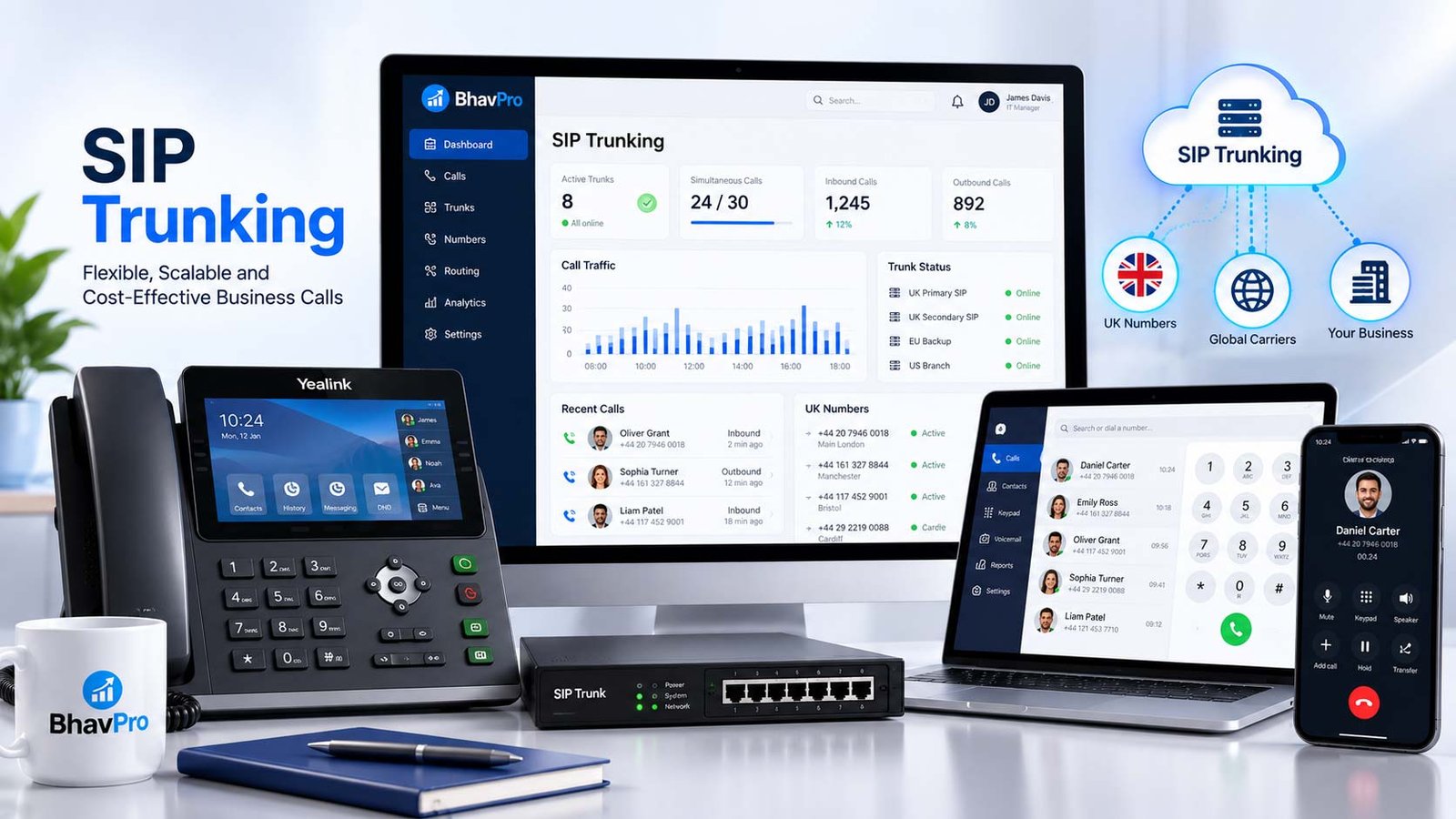
Fast answer: SIP trunking connects a compatible business PBX to an external calling provider over IP. It can retain an existing phone system while replacing legacy voice connectivity, but does not itself upgrade unsupported PBX software, guarantee call resilience or remove number-porting and network dependencies.
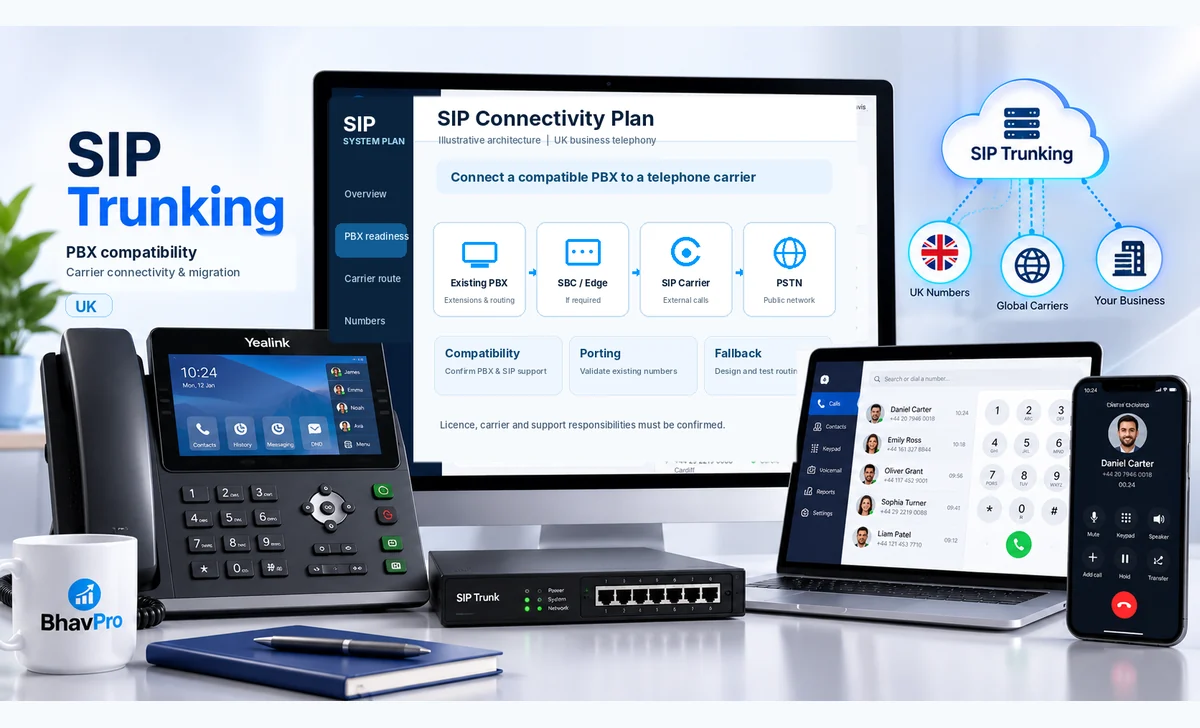
SIP Trunking UK: Should You Keep Your Existing PBX?
SIP trunking connects a compatible PBX to external telephone services over IP. It can let a UK business retain its existing telephone system while replacing older voice connectivity—but retaining the PBX is not automatically the lowest-risk or lowest-cost decision. That depends on vendor support, security, current call routing, connectivity and the cost of continuing to manage the system.
When is SIP trunking suitable? It is a strong option for a supported, SIP-compatible PBX when you want to retain call routing, handsets or integrations while modernising carrier connectivity. If the PBX is unsupported or expensive to maintain, compare a hosted replacement on full three-year cost and operational risk rather than channel price alone.
A practical decision begins with the assets already installed. Identify the exact PBX model and software version, all connected devices, numbers, call queues and any analogue lines supporting alarms, lifts, payment terminals or other critical equipment. Then compare three options: keep the PBX with SIP, upgrade the PBX first, or replace the entire phone system.
Good Reason to Retain a PBX
It remains supported, SIP-compatible, appropriately secured and valuable because of established workflows or integrations.
Good Reason to Assess Replacement
The PBX is unsupported, expensive to maintain, lacks required capabilities or depends on an operational failure point without acceptable recovery.
The business phone system categories guide explains wider deployment models; this article addresses the narrower existing-PBX connectivity decision.
How SIP Trunks Connect a PBX to the Public Telephone Network
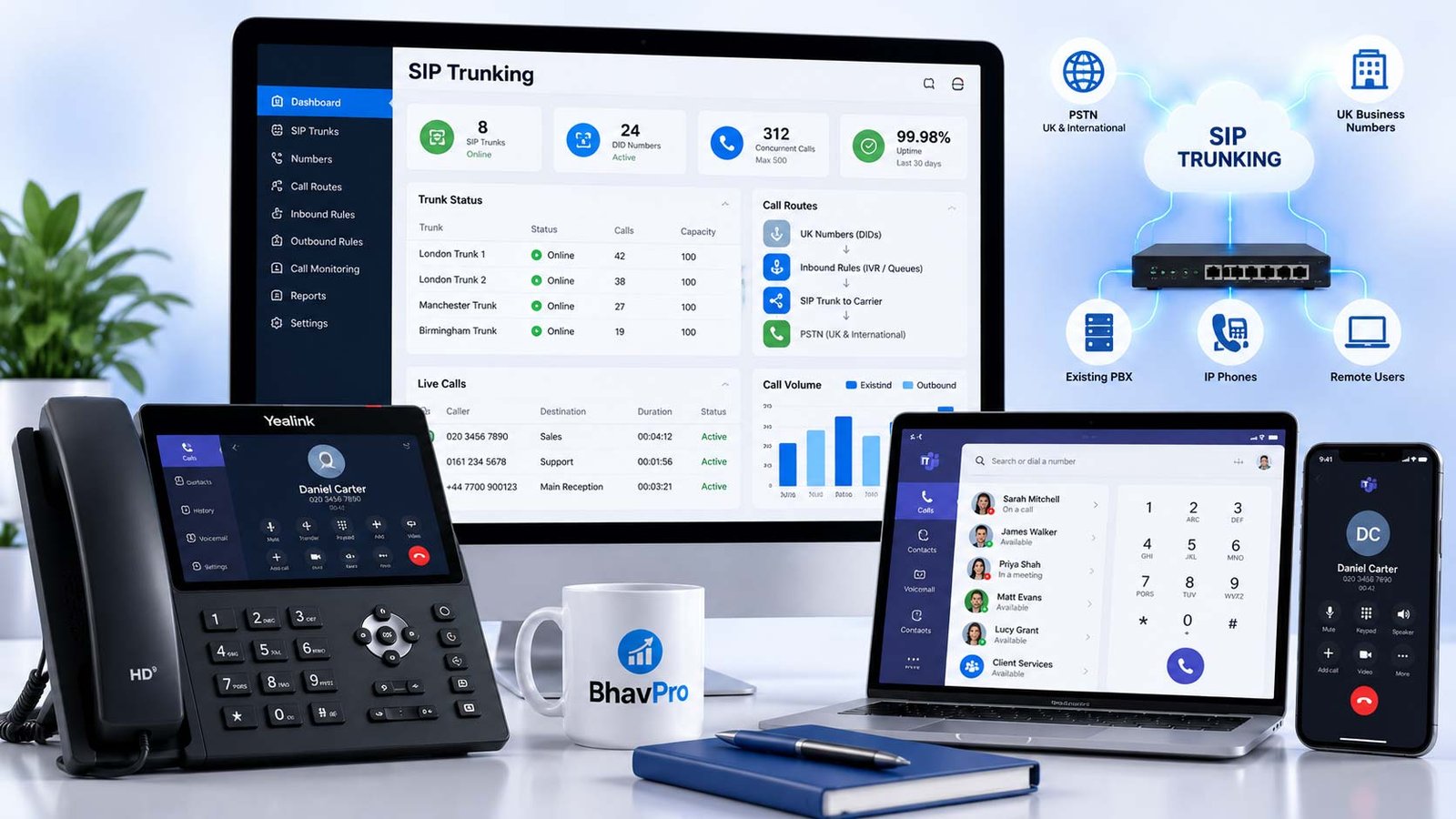
A SIP trunk carries signalling and media between a compatible telephone system and a telecoms provider. In practical terms, the PBX continues to manage extensions, queues and internal routing, while the SIP provider carries external calls and may provide numbers and other carrier functions. An SBC or appropriate network edge may be required depending on the topology and provider.
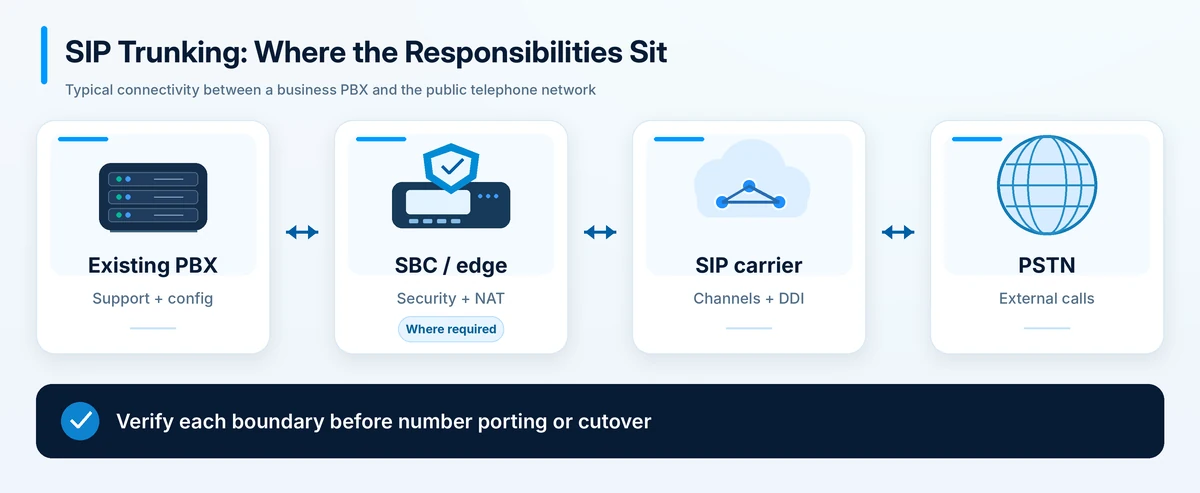
Do not mistake the trunk for the PBX itself. SIP trunking does not automatically add new contact-centre features, replace unsupported system firmware or protect a site from losing mains power. Carrier-grade connectivity and local business continuity need to be designed and tested separately.
The BhavPro Retain, Upgrade or Replace Decision
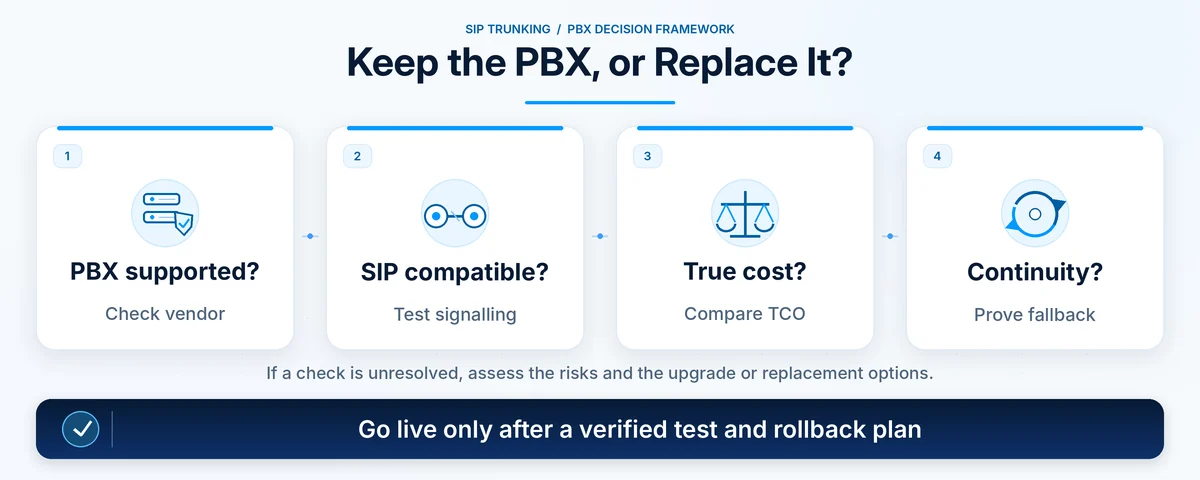
When should you retain an existing PBX with SIP trunking? Retaining it is worth evaluating when the PBX remains supported, compatibility with the proposed SIP provider can be demonstrated and ongoing costs are reasonable. If its software is unsupported, critical features are missing or maintenance and security risks are excessive, compare a supported upgrade or hosted replacement before signing a SIP contract.
Assess the existing PBX alongside the alternative operating models, including maintenance, cyber security, service levels, call workflows, integration requirements and disruption. The table below sets out the main decision conditions.
| Existing situation | Next step | Why |
|---|---|---|
| Supported, SIP-compatible PBX; important integrations | Investigate a SIP trunk and a planned cutover. | May preserve useful investment and familiar workflows. |
| Supported system but no proven SIP interoperability | Demand a documented compatibility pilot first. | A successful carrier sales discussion is not proof of signalling compatibility. |
| Unsupported or out-of-support PBX | Cost replacement or supported upgrade before trunk commitment. | A cheaper link does not remove unsupported-platform risks. |
| Multi-site business with separate old PBXs | Assess centralisation, phased SIP and managed cloud alternatives. | Operational cost and continuity may outweigh short-term savings. |
| Analogue dependencies remain | Inventory and validate specialist equipment separately. | Certain devices may require a supported adapter, dedicated service or replacement. |
For a complete replacement process, see the existing business telephone replacement checklist.
PBX Compatibility Checks Before Ordering SIP
Confirm more than the words “SIP supported” on a sales specification. Two SIP-compliant systems can still behave differently under registration, caller-ID, number formatting, codec negotiation, transfers, redirects or DTMF. Obtain a current supported configuration and document who will troubleshoot interoperability faults.
Compatibility answer: A PBX should be called SIP-ready only when the specific software version, supported trunk model and tested inbound/outbound call flows work together. Registration/IP authentication, DTMF, codec negotiation, caller-ID presentation, emergency calling and the firewall/SBC arrangement must all be confirmed—not inferred from “SIP supported” marketing.
- Record PBX make, version, licences, SIP capacity and current maintenance status.
- Confirm carrier support for the precise PBX or SBC and authentication method.
- Check public IP/FQDN, allowed provider addresses, NAT/firewall and SIP ALG handling.
- Validate DDI/E.164 formatting, presentation number and outbound caller-ID requirements.
- Verify expected codecs, RFC2833/telephone-event DTMF, media path and any fax needs.
- Test simultaneous inbound/outbound calls, transfers, forwarded calls and unexpected error handling.
- Confirm security controls, international dial restrictions, logs and incident contacts.
3CX publishes technical SIP trunk interoperability requirements, which illustrate why support includes signalling and routing details—not simply carrier availability. Avaya, 3CX and other PBX families must each be checked against their own software release and supported trunk configurations.
SIP Trunking Costs in the UK: Beyond Channel Rental
How much does SIP trunking cost in the UK? There is no standard monthly rate. A provider may charge per concurrent call channel, per number, by call usage or through a bundle. Request an itemised quote covering the carrier service, calling, numbers, retained PBX licences, connectivity, security, support and one-off migration work.
Published UK price reference (checked 31 October 2026): Spitfire advertises SIP trunking from £4 per month, but its publicly displayed headline does not specify a £4-per-channel tariff. Andrews & Arnold describes a different number-and-usage-based approach. These are examples of supplier charging models, not guaranteed prices or BhavPro quotations. The calculator therefore starts with the channel rental unspecified; enter an actual rate from a written quote.
| Cost item | What to clarify |
|---|---|
| Channels / concurrent capacity | Definition of a chargeable concurrent call; inbound/outbound limits and burst options. |
| DDI ranges and number rental | Monthly number charges, geographic restrictions, minimum volumes and porting fees. |
| Call usage | UK mobile, national, international, premium and emergency-call handling; fair-use conditions. |
| Installation and PBX changes | SBC, licence, firewall, configuration, testing and project fees. |
| Service contract | Minimum term, renewal uplift, call-data reports, cancellation/port-out rules. |
| Continuity and support | Carrier redundancy, failover costs, support response and customer operational duties. |
One useful method is to calculate total cost of ownership over the expected PBX lifetime, not just compare monthly trunk costs. If a legacy PBX needs expensive security work, hardware replacement and specialist maintenance, a hosted alternative may be better value even when its monthly subscription is higher.
SIP Trunking UK: Channel Plans and PBX Licence Selection
Which SIP trunk package should you choose? Start with the peak simultaneous external-call requirement and the exact PBX compatibility record. Compare per-channel rental with bundled-minute and usage-based arrangements, then check the PBX's own SIP licences, support and any SBC requirements. There is no single UK-wide SIP licence or standard per-user fee.
Separate SIP Service From PBX Licensing
A SIP trunk is the carrier connection. Your telephone platform may separately charge for SIP trunk modules, session limits, proprietary hardware, maintenance or a 3CX-style system licence. Check both ceilings. A trunk with eight channels is not automatically usable if the PBX only permits four external or system calls.
| Commercial Model | When to Consider It | Questions to Ask |
|---|---|---|
| Per-Channel / Concurrent-Call Rental | Clear predictable external call capacity | Does one channel carry one concurrent inbound or outbound call? Are burst calls available and chargeable? |
| Bundled Minutes | Steady UK landline/mobile demand | Which calls count, what fair-use terms apply, and what happens above allowance? |
| Metered / Usage-Based | Low or irregular call volumes | Number rental, incoming calls, destination tariffs, minimum charges and concurrency restrictions? |
| Dedicated / Resilient Carrier Model | Higher-risk multi-site or business-critical voice | Dual connectivity, PBX/SBC resilience, alternate carriers, monitoring and escalation ownership? |
Supplier price example: Spitfire's published entry-level SIP offer starts from £4 per month. This figure is provided as evidence that some UK channels have an advertised entry price, not as an average, guaranteed future rate or assumption about contract inclusions. Check Spitfire's current product page and obtain an itemised written quote.
Verify the PBX's SIP Rights
Confirm the exact PBX make, firmware, SIP entitlement, simultaneous-call cap and any SBC or gateway licence. This must match the intended provider's tested configuration; check the 3CX interoperability specification as one example of the technical checks.
Verify the Service Contract
Record rental units, included minutes, chargeable destinations, DDI rental, support hours, minimum term, price changes, porting, spend caps and exit terms. Distinguish a quoted service from the total operating cost of the retained PBX.
Selection output: a short, documented comparison showing the chosen commercial model, number of external call channels, current PBX support status and total costs. The calculator below is a planning tool, not an eligibility test or tariff engine.
How Many SIP Channels Does Your Business Need?
How many SIP channels does a UK business need? Start with the busiest measured number of simultaneous external calls (inbound and outbound combined), not its employee or extension count. As an illustration, six concurrent external calls with a 25% planning allowance require eight channels after rounding up; the allowance is not an industry standard. Confirm peak demand, the supplier's concurrency rules and the PBX's own capacity before ordering.
Traffic peaks may change with transfers, queues and seasonal demand. Internal extension-to-extension calls ordinarily do not use external SIP trunk channels, but they can still consume PBX processing or system-licence capacity. For example, a 3CX PBX system-call entitlement and a carrier's external SIP channel limit are two different constraints.
Ask the provider whether inbound and outbound calls share the same capacity pool, whether extra bursts are available, what happens when the limit is reached and whether caller experience degrades gracefully. The capacity requirement may differ from a 3CX licence tier: one describes a carrier connection, while the other describes how many system calls a PBX licence handles.
Capacity planning is a reason to request actual call data and test results; it is not a substitute for a supplier capacity commitment.
SIP Trunking UK Cost and Channel Calculator
How do you calculate SIP trunking costs? Measure peak simultaneous external calls, apply a justified planning allowance and compare the suggested channel count with your supplier's quoted capacity. Then enter the actual channel price, number rental, chargeable minutes, PBX costs, resilience and one-off migration expenses. The tool estimates monthly, first-year and three-year costs only after a channel price has been provided.
Planning tool — not a quotation. Channel rental starts blank because the publicly advertised £4/month SIP starting price does not establish a price per channel. Enter the monthly channel price from your written supplier quotation, or enter 0 only if your quote explicitly includes capacity under a different charging model. Until a price is supplied, the monthly and multi-year totals are marked Price Not Supplied, not £0.
How to use this result: Compare the estimate with a written SIP quotation for the same concurrent-call requirement and with a separately costed hosted-PBX alternative. Review the original VoIP Cost UK guide for broader telephony pricing; this tool measures the cost of retaining a PBX with SIP connectivity.
SIP Security, Fraud Protection and Control Boundaries
What security controls does SIP trunking need? Restrict PBX and SBC access to trusted sources, secure credentials and administration, block unnecessary high-cost calling destinations, monitor anomalies, maintain supported software and assign incident-response ownership. A SIP carrier does not automatically secure an exposed or unsupported PBX. The UK National Cyber Security Centre's PBX guidance describes the risks of dial-through fraud and practical mitigations.
- Limit administrative and SIP-trunk access using documented identities and provider source restrictions.
- Protect registration credentials, configure appropriate IP allowlists and avoid exposing management interfaces publicly.
- Implement international/premium call barring appropriate to business requirements.
- Alert on unexpected traffic, repeated failed registrations and out-of-hours calling anomalies.
- Agree TLS/SRTP support where relevant and compatible; do not describe encryption as automatic.
- Patch supported PBX/SBC software, retain logs and test backup restoration.
- Identify the provider, PBX owner and network owner responsible for each fault scenario.
Use BhavPro’s specialist SIP security and toll-fraud guidance for the detailed operational controls.
UK Phone Numbers, Porting and the 2027 Transition
Can you keep your existing UK business phone numbers when moving to SIP? Often, yes. Ofcom regulates number portability, but an actual port must be confirmed with the gaining provider against number types, account records, existing service dependencies and the receiving carrier's capabilities. Do not cancel the original service before the port sequence is agreed.
Before ordering, inventory the main numbers, DDIs, non-geographic numbers and any linked fax, alarm, payment or lift services. Document where each number currently terminates, then obtain a written port plan with a cutover window, test calls, fallback and named escalation owners.
Openreach states that the transition away from traditional PSTN services is scheduled for 31 January 2027. However, the exact path for your business depends on current services and provider-specific availability. It is important not to assume that an old alarm, payment terminal or lift line can simply be moved onto a SIP trunk.
| Dependency | Pre-migration evidence |
|---|---|
| Public numbers and caller ID | Number inventory, port eligibility, route test and caller-ID approval. |
| Analogue line-dependent services | Written compatibility plan from the relevant equipment/provider vendor. |
| Legacy circuit withdrawal | Actual contract/service dates and the provider migration path. |
| Cutover | Booked window, fallback numbers and named decision maker. |
Read the UK PSTN switchover guide and number-porting guide for the detail behind this summary.
SIP Trunk Resilience: What Failover Must Prove
Does SIP trunking guarantee automatic failover? No. Carrier redundancy alone cannot protect against a failed PBX, SBC, broadband connection or local power supply. Agree the alternative destination for business-critical numbers, define who can reroute calls and prove the recovery path during an actual test.
Distinguish carrier-route redundancy, secondary site connectivity, PBX/SBC recovery and calls diverted to another site or mobile destination. Each addresses a different failure scenario, and each needs a named support owner.
Ask the supplier to demonstrate the specific failure case you care about. Examples include a terminated primary circuit, a failed SBC, an unreachable PBX, a DDI porting delay and a closed office. Retest the contingency after material routing or provider changes.
See VoIP power-cut and emergency communications planning for local-continuity considerations.
| Failure to simulate | Evidence to record | Accountable party |
|---|---|---|
| Primary carrier route unavailable | Whether incoming numbers continue to reach the approved destination, including caller experience. | Carrier and PBX maintainer |
| Site broadband or power unavailable | Actual reachability of critical inbound numbers, outbound calling alternatives and local device limitations. | Business/network owner |
| PBX or SBC unavailable | Supported alternative routing, access to recovery controls and restoration times observed in a pilot. | PBX/SBC operator |
| Porting or rollback problem | Approved escalation, fall-back number routes, decision authority and recorded customer-call test. | Losing and gaining provider |
Buyer output: a signed cutover test record showing what was actually proven. An advertised SIP failover feature does not establish resilience of the PBX, local access or power supply.
SIP Trunking Migration Acceptance Checklist
Do not treat a confirmed order as proof the migration is ready. The acceptance record should identify both required outcomes and how each was tested, with owners from the business, PBX maintainer and SIP provider.
- Confirm PBX software support, SIP signalling compatibility and approved deployment design.
- Agree complete inventory of numbers, carriers, ports, contracts and old voice-dependent equipment.
- Validate security, caller-ID presentation, international call restrictions and emergency-call treatment.
- Load-test the required concurrent calls and verify queue and transfer scenarios.
- Test correct inbound routing for each critical DDI and business-hour/out-of-hours rule.
- Validate resilience for carrier, internet, power and PBX failure; record the fallback owner.
- Book cutover/porting, establish escalation contacts and document a rollback decision.
- Sign off business-user tests, update documentation and schedule post-migration review.
A successful transition has measured evidence of the original call flows working. “Calls connected once” is too weak to verify a business telephone network.
Final Decision: SIP Trunk, Hybrid Transition or Replacement?
Keep the PBX and investigate SIP when its software is supported, interoperability can be proven and the total retained-system cost is reasonable. Plan an upgrade or replacement where unsupported software, unserviceable equipment or unmanageable operational risk outweigh the value of keeping the system.
A sensible recommendation should include a compatibility finding, channel sizing rationale, documented first-year and renewal cost, porting plan and failure-recovery demonstration. The cheapest stated SIP channel is not necessarily the most reliable or suitable phone-system decision.
SIP Trunking UK FAQs
Is SIP trunking the same as hosted VoIP?
No. SIP trunking typically connects a compatible PBX to a carrier, while a hosted VoIP supplier generally operates the core PBX platform. Support and responsibility boundaries differ.
Can we keep an Avaya or 3CX PBX and add SIP trunks?
Possibly. Confirm the exact PBX version, SIP feature licensing, compatibility with the intended carrier and any SBC or gateway requirements.
How many SIP channels do 20 employees need?
Headcount alone is insufficient. Use measured concurrent external calls, including peaks and growth, and validate the supplier capacity model.
Does SIP trunking automatically make our phone system resilient?
No. SIP carrier redundancy, PBX availability, local power and internet access are separate dependencies that require designed and tested contingencies.
Can we transfer our existing business telephone numbers?
Many numbers can be ported subject to range, current operator, destination supplier and porting procedures. Confirm eligibility before cancelling the existing service.
Is SIP trunking always cheaper than cloud PBX?
No. Compare the retained PBX’s support and upgrade costs against a complete hosted replacement over the same period, with equivalent call handling and support.
How much is a SIP trunk per month in the UK?
Costs depend on concurrent channels, bundled or metered calls, telephone numbers, contract term, PBX support and connectivity. Spitfire advertises an entry-level SIP offer from £4 per month, but that does not represent a universal UK rate. Use the editable SIP cost calculator with your supplier quote.
Is a SIP channel the same as a 3CX simultaneous-call licence?
No. A SIP channel usually limits simultaneous external calls on the carrier trunk. A 3CX system licence can also count internal system calls against its capacity. Confirm both limits, and check the actual provider's definition before purchasing.
Will SIP trunking solve every 2027 PSTN replacement problem?
No. SIP can modernise external calling for a compatible PBX, but traditional-line-dependent alarms, lift equipment, payment terminals and other specialist devices need separate assessment and may require different solutions before the 31 January 2027 transition.
Sources and Further Verification
The UK transition, SIP interoperability and sample supplier prices were checked against the original sources on 31 October 2026. Confirm current prices and contract terms before publication or procurement.
- NCSC — PBX security best practice
- 3CX — SIP trunk technical interoperability requirements
- 3CX — SIP trunk configuration guidance
- Openreach — PSTN transition
- Ofcom — landline digital migration information
- Spitfire — SIP Trunks (Public Starting Price)
- Andrews & Arnold — SIP Number and Usage Pricing Model
- Ofcom — Number Portability Information
- 3CX — SIP Trunk Simultaneous-Call Options
- 3CX — System Licensing and Simultaneous Calls
- GOV.UK — Standard VAT Rates
This is a SIP trunking decision guide, not an interoperability certification, a carrier offer or a completed site survey. All suggested failure tests and business scenarios are illustrative, not BhavPro client outcomes.
Need Help Assessing the Right Calling Approach?
About the Author