
Free B2B Lead Scoring Calculator
Build an explainable lead-priority score from criteria your sales and marketing teams can review, challenge and improve. The calculator uses visible weighted rules rather than claiming to predict conversion probability.
15+ Years Experience
Fully Remote
Flexible Engagement
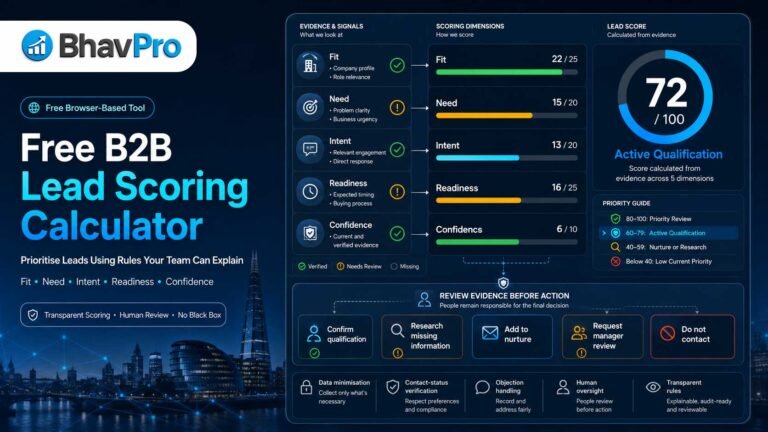
BhavPro’s free B2B lead scoring calculator applies transparent fit, intent, engagement and readiness rules to produce an explainable priority score. It does not train a predictive model, connect to your CRM or make automated sales decisions. Use the result to review qualification criteria and decide which leads need human follow-up.
One score, five visible dimensions
See whether the score comes from fit, need, intent, buying readiness or data confidence—not from an unexplained black box.
Score a Lead Using Criteria You Can Explain
Select the closest evidence for each dimension. The calculator does not ask for a person’s name, email address or other identifying details.
Complete the scorecard
Your result will explain the current priority band and the most appropriate human next step.
A high score means the selected evidence fits your current rules. It does not prove that a person will buy, justify intrusive profiling or override a recorded objection.
How the Calculator Scores a Lead
The 100-point model separates evidence into five dimensions so teams can see why a score changed.
| Dimension | Maximum | What it measures | What it must not assume |
|---|---|---|---|
| Fit | 25 | Account profile and the contact’s relevance to the stated problem. | That company size, job title or location alone proves buying intent. |
| Need | 20 | Clarity and urgency of the business problem. | That every website visitor has an active requirement. |
| Intent | 20 | Relevant engagement and direct responses. | That passive activity guarantees commercial interest. |
| Readiness | 25 | Timing, stakeholders, requirements and buying process. | That a high score means a contract is likely. |
| Confidence | 10 | How current and verified the underlying evidence is. | That assumptions deserve the same weight as confirmed facts. |
What Your Lead Score Means
The bands describe the strength of the selected evidence. They do not predict a purchase or replace professional judgement.
Priority Review
Strong evidence across several dimensions. Confirm the facts and agree a proportionate next step.
Active Qualification
Promising signals with important gaps. Clarify need, timing, stakeholders or process.
Nurture or Research
Some relevance is present, but current buying readiness is limited or uncertain.
Low Current Priority
Insufficient evidence for active pursuit. Record what is missing and reassess later.
Use Scores to Prioritise, Not Reject People
A lead score should organise work, identify missing evidence and support consistent follow-up. It should not automatically exclude a person, override an objection or create an irreversible decision.
Review the Evidence
Check whether the selected criteria are current, accurate and relevant to the next action.
Allow Exceptions
Give sales teams a documented way to challenge a score when new information changes the context.
Measure Outcomes
Compare scores with qualified opportunities, disqualifications and outcomes before changing the weights.
Fit, Need, Intent and Readiness Are Different Signals
Combining every activity into one undifferentiated score can hide why a lead appears important.
Fit and Need
- The organisation matches the customers you can serve.
- The contact is relevant to the stated business problem.
- The problem is specific enough to investigate.
- A genuine operational or commercial consequence exists.
Intent and Readiness
- Engagement relates to the actual problem, not generic activity.
- The person has responded or requested a next step.
- Timing is stated rather than assumed.
- Stakeholders, requirements or procurement steps are becoming clear.
Choose Evidence-Based Lead Scoring Criteria
A useful scorecard reflects the buying process your team can observe and support.
Define a Qualified Opportunity
Agree what must be true before a lead becomes an opportunity, including need, responsibility, timing and next action.
Identify Observable Evidence
Use direct answers, verified account data and meaningful engagement rather than assumptions or vanity events.
Set Initial Weights
Give greater weight to evidence that is closer to a real buying decision, while keeping the model understandable.
Review False Positives and Missed Leads
Check where the score created the wrong priority and adjust the criteria with documented reasons.
Keep Lead Scoring Transparent and Reviewable
Every score should be traceable to named criteria, source evidence, weights and a review date.
Visible Rules
Document what adds points, what removes priority and why each signal matters.
Source Evidence
Record whether a value came from a form, conversation, CRM field, observed action or manual research.
Review Ownership
Assign an owner to test the model, handle exceptions and approve changes to weights.
Protect Personal Data and Avoid Sensitive Attributes
Lead scoring may involve profiling when personal data is used to evaluate or predict behaviour. Use only data that is necessary, relevant and supported by a documented purpose.
Prefer Business-Relevant Evidence
- Stated business need and project timing
- Role in the buying or operational process
- Verified account characteristics
- Direct enquiries and relevant engagement
- Current CRM information with a known source
Avoid Inappropriate Inputs
- Protected or special-category characteristics
- Unverified inferences about a person
- Irrelevant browsing behaviour
- Data collected for an incompatible purpose
- Scores that override objections or suppression records
Review the ICO’s guidance on data minimisation, profiling and automated decision-making, and the right to object. Obtain appropriate legal or data-protection advice for your circumstances.
When Predictive AI Lead Scoring Is Justified
A predictive model is a separate technical project. It needs sufficient historical outcomes, reliable labels, suitable features, governance and ongoing monitoring.
Enough Relevant History
You need representative won, lost, qualified and disqualified records—not a small or selectively cleaned sample.
Defined Target and Evaluation
The team must define what the model predicts, how accuracy is assessed and which errors carry the greatest cost.
Ongoing Human and Technical Control
Monitor drift, bias, feature quality, overrides and performance after deployment. A trained model is not self-validating.
It does not train on historical CRM data, infer conversion probability, connect to third-party systems or adapt its weights automatically.
Compare a Calculator, CRM Scoring and Predictive AI
The correct approach depends on data quality, decision risk, operational maturity and the purpose of the score.
| Approach | Best for | How it works | Main limitation | BhavPro route |
|---|---|---|---|---|
| Browser calculator | Designing or testing transparent qualification rules | Manual evidence is converted using visible weights | No CRM connection or predictive learning | This free tool |
| CRM rules | Consistent operational prioritisation | CRM fields and events trigger documented point changes | Rules require maintenance and data discipline | CRM Consulting |
| Predictive model | Large, mature datasets with a defined prediction target | A statistical or machine-learning model estimates an outcome | Requires data, evaluation, governance and monitoring | AI Integration Advisory |
| Funnel qualification process | Improving how leads are captured, nurtured and handed to sales | Stages, questions, content and handoffs are redesigned | Not a scoring engine by itself | Sales Funnel Consulting |
Turn the Scorecard Into a Controlled CRM Process
Once the criteria are tested manually, the next step may be to map them into CRM fields, ownership rules, review queues and reporting.
Data Structure
Create fields for fit, need, intent, readiness, confidence and contact status with clear allowed values.
Routing Rules
Define which score bands create tasks, request research, enter nurture or require manager review.
Outcome Feedback
Record qualification, opportunity and outcome data so the scorecard can be evaluated rather than trusted by assumption.
Improve Qualification Across the Sales Funnel
Poor lead prioritisation is often caused by unclear forms, inconsistent questions, missing ownership and weak handoffs—not by the absence of AI.
Before Scoring
- Define the target customer and exclusions.
- Ask questions connected to the buying decision.
- Capture consent, preference and objection information correctly.
- Separate marketing engagement from sales qualification.
After Scoring
- Assign a clear human owner.
- Use different next steps for different evidence gaps.
- Record why a lead was qualified or disqualified.
- Review whether the score improves prioritisation over time.
Who This Lead Scoring Calculator Is For
The tool is designed for teams that need a clearer, more consistent way to discuss lead priority.
Sales Leaders
Align representatives around evidence-based qualification and review exceptions.
Marketing Teams
Separate engagement activity from genuine buying readiness.
CRM Owners
Prototype fields and weights before implementing automation.
Small B2B Teams
Create a simple shared scorecard without buying a predictive platform.
What This Free Tool Does and Does Not Do
This free tool is a planning utility, not a hosted lead-scoring platform or AI implementation service.
It Does
- Calculate a transparent 0–100 score
- Show dimension-level results
- Provide human next-step guidance
- Copy or download a Markdown summary
- Restore selections during the browser session
It Does Not
- Train a machine-learning model
- Predict conversion probability
- Connect to a CRM or marketing platform
- Collect names, emails or lead records
- Trigger automated contact or sales decisions
Use the AI Business Hub to compare planning, advisory and implementation options. Use CRM Consulting for operational scoring rules or AI Integration Advisory when a genuine predictive model and system architecture need assessment.
B2B Lead Scoring Calculator FAQs
Answers about the calculation method, data handling, CRM use and predictive AI.
Is this an AI lead scoring tool?
No. This version is a transparent rules-based B2B lead scoring calculator. It does not train a model, learn from historical CRM outcomes or predict conversion probability.
Why has the tool been renamed?
The name now reflects how the tool actually works. It uses transparent weighted rules rather than a trained predictive model, while existing bookmarks and references to the calculator continue to work.
How is the 100-point score calculated?
The calculator adds up five visible dimensions: fit up to 25 points, need up to 20, intent up to 20, readiness up to 25 and evidence confidence up to 10.
Does a high score mean the lead will buy?
No. A high score only means that the selected evidence matches the current weighting rules. A person must still confirm the need, context, timing and next step.
Does the calculator store lead data?
The tool does not request names, email addresses or lead records. Selections may be restored within the current browser session using session storage, and can be reset at any time.
Can I use this score to send marketing messages?
No score creates permission to market. Check your documented lawful basis, preferences, suppression records and objection-handling process before contacting anyone.
Can I change the weights?
The public calculator uses fixed transparent weights. A business-specific CRM scorecard should be designed and tested against your qualification process and outcome data.
What is the difference between lead fit and lead intent?
Fit describes whether the organisation and role match what you can serve. Intent describes relevant actions or responses that indicate active interest. A lead can have strong fit and weak current intent.
When should lead scoring be added to a CRM?
Add CRM scoring after the criteria, field definitions, ownership rules and actions have been tested manually. Automating an unclear scorecard usually scales inconsistency.
When is predictive AI lead scoring appropriate?
It may be appropriate when you have sufficient representative historical data, reliable outcome labels, a defined prediction target, evaluation criteria, governance and ongoing monitoring.
Should sensitive personal information be used in lead scoring?
Do not use protected or special-category characteristics as casual scoring inputs. Use necessary, relevant business evidence and obtain suitable data-protection advice for your processing.
What should I do after downloading the score summary?
Review the weakest dimensions with the sales and marketing owners, confirm the evidence, document the next action and compare the scorecard with real qualification outcomes over time.
Build a Better Lead Qualification Process
Turn the scorecard into clear questions, CRM fields, ownership rules, nurture paths and review reporting without overstating what the technology can predict.