
Average UK Website Design Costs by Project Type
A practical 2026 guide to UK website costs, covering DIY builders, freelancers, agencies, WordPress, ecommerce, portals, integrations, migration and first-year ownership.
Quick answer: a UK business website can cost from a few hundred pounds for a self-built or highly standardised site to £30,000 or more for ecommerce, portals and bespoke integrations. Many professionally delivered small-business projects fall between approximately £2,000 and £10,000, but the meaningful budget depends on content, design, functionality, migration, search requirements and ongoing support.
Estimate the Cost of Your Website Requirements
Use the BhavPro Website Cost Calculator to select your project type, pages, content, ecommerce and integration requirements and receive a more relevant planning estimate.

BhavPro Scope-to-Cost Budget Estimator
Use this quick estimator to see how project type, page scale, content, design, integrations, migration and delivery pace can change the likely budget. For a more detailed requirement breakdown, continue to the full Website Cost Calculator.
Typical UK Website Cost Ranges
| Website Approach or Project Type | Indicative UK Planning Range | Best Suited To |
|---|---|---|
| DIY website builder | £150–£1,500 first year, plus your time | Simple validation, portfolios and very small organisations |
| Basic freelancer website | £800–£3,000 | Straightforward brochure sites with prepared content |
| Professional small-business website | £2,500–£8,000 | Businesses needing stronger design, structure and lead capture |
| Lead-generation or SEO-led website | £5,000–£20,000 | Service businesses relying on enquiries and organic visibility |
| Small ecommerce website | £5,000–£15,000 | Standard stores with limited products and integrations |
| Advanced ecommerce website | £15,000–£40,000+ | Larger catalogues, subscriptions, trade pricing or integrations |
| Membership website | £7,500–£25,000+ | Protected content, user accounts and member workflows |
| Customer or partner portal | £15,000–£60,000+ | Permissions, dashboards, documents and business-system connections |
| Bespoke web application | £20,000–£100,000+ | Custom workflows, data models and product-like functionality |
These ranges overlap because a carefully scoped freelancer project can cost more than a standardised agency package, while an efficient agency can sometimes deliver a defined project below another supplier’s price.
The right comparison is not simply:
Who charges less?
It is:
What business problem is being solved, what is included, what remains your responsibility and what will the website cost to own after launch?
Two Five-Page Websites Can Be Entirely Different Projects
Page count is visible and easy to compare, but it is rarely the only significant cost driver.
A five-page website might involve:
Project A
- Existing logo and brand
- Final approved copy
- Supplied images
- Standard contact form
- No migration
- No search research
- No integration
- One decision-maker
Project B
- Positioning workshop
- Search and competitor research
- Original copywriting
- Custom diagrams
- Lead qualification form
- CRM integration
- Existing ranking protection
- Multiple stakeholders
- Analytics and attribution
- Ongoing content templates
Both projects may have five core pages, but the work, risk and commercial purpose are substantially different.
Website cost is usually shaped by six dimensions:
- Strategy
- Content
- Design
- Functionality
- Integration
- Risk and governance
DIY, Freelancer or Agency: Which Cost Model Fits?
DIY Website Builder
Indicative cost: approximately £150–£1,500 in the first year, excluding the value of your time.
A DIY builder can be suitable when:
- The site is simple
- The budget is very limited
- The owner has time to learn the platform
- Search visibility is not business-critical
- There are no complex integrations
- The offer is still being validated
Typical costs may include:
- Platform subscription
- Domain
- Premium template
- Apps
- Stock images
- Payment fees
- Your own production time
Main Advantage
Low financial entry cost.
Main Risk
The apparent saving can be offset by owner time, weak content, inconsistent design, limited measurement or later rebuilding.
A DIY website is not automatically a poor decision. It can be commercially sensible for validation, an event, a temporary campaign or a low-risk early-stage offer.
Freelance Web Designer
Indicative cost: approximately £800–£6,000 for many small-business projects.
A freelancer can be suitable when:
- The scope is clear
- One person can cover the required design and development
- Content is ready
- There are limited integrations
- The buyer values direct communication
- The project does not need several specialist disciplines
Main Advantage
Direct access and potentially lower overhead.
Main Risk
Capacity, specialist coverage, continuity and post-launch support depend heavily on one individual.
Before comparing freelancers, check whether the price includes:
- Discovery
- Copy or copy editing
- Mobile design
- Search foundations
- Forms
- Analytics
- Hosting
- Licences
- Testing
- Training
- Support
- VAT
Small Web-Design Agency or Consultant-Led Team
Indicative cost: approximately £2,500–£15,000 for many brochure, service and lead-generation websites.
This model can suit:
- Established small businesses
- Professional services
- B2B companies
- Multi-service organisations
- Buyers needing structure, content, SEO or integrations
- Redesigns where existing value must be protected
Main Advantage
A broader process and access to several capabilities.
Main Risk
Some “agency” packages remain highly standardised, while others include deep strategy and custom delivery. The word agency alone does not reveal what is included.
BhavPro fits within this part of the market for suitable projects but differentiates through direct senior involvement and the ability to connect websites with SEO, CRM, VoIP, analytics and workflows.
Larger Digital Agency
Indicative cost: approximately £10,000–£50,000+.
A larger agency can be appropriate when:
- Several departments are involved
- Brand strategy is extensive
- Formal procurement is required
- Research and user testing are substantial
- The organisation needs specialist teams
- The project has high governance or reputational risk
- Ongoing campaigns require scale
Main Advantage
Capacity, specialisation and established governance.
Main Risk
Higher overhead, more layers of communication and a service model that may be disproportionate for a smaller organisation.
Bespoke Development Team
Indicative cost: approximately £20,000–£100,000+, with no meaningful upper ceiling.
This model is relevant when the project behaves more like software than a marketing website.
Examples include:
- Customer portals
- Partner platforms
- Marketplaces
- Complex directories
- Bespoke quotation engines
- Operational dashboards
- Multi-role systems
- Two-way integrations
- Custom data processing
The correct first purchase may be a paid discovery and specification phase rather than a full-build quotation.
What Different Types of Website Usually Cost
Single Landing Page
Indicative range: £500–£3,000.
A landing page may be used for:
- A campaign
- A new offer
- Event registration
- Lead generation
- Product validation
- Recruitment
The cost depends on whether it uses prepared content and existing brand styles or requires research, copywriting, custom visuals, analytics and testing.
A one-page website is not always cheap. A highly researched campaign page can require more strategy and copy work than several simple brochure pages.
Small Brochure Website
Indicative range: £800–£6,000.
Typical content:
- Home
- About
- Services
- Contact
- Blog or news
- Essential legal pages
The lower end usually assumes a template-led design, supplied content and limited strategy. The upper end may include custom design, copywriting, stronger service presentation, analytics and handover.
Professional Service-Business Website
Indicative range: £2,500–£10,000.
Typical requirements:
- Several service pages
- Team or company credibility
- Case studies
- Enquiry forms
- Search foundations
- Clear calls to action
- Analytics
- WordPress editing
- Content templates
This is often the relevant category for consultants, accountants, legal firms, recruiters, IT providers, telecom companies, trades and other service businesses.
Lead-Generation or SEO-Led Website
Indicative range: £5,000–£20,000.
The price is higher because the website is expected to do more than confirm that the business exists.
Possible requirements include:
- Search-intent research
- Competitor analysis
- Service architecture
- Local or national page strategy
- Original conversion copy
- Lead qualification
- CRM integration
- Analytics events
- Resource and case-study templates
- Redirect planning
- Ongoing content roadmap
The cost should be judged against lead quality, sales value and long-term use—not page count alone.
Small Ecommerce Website
Indicative range: £5,000–£15,000.
A relatively straightforward ecommerce project may include:
- Standard products
- Card payments
- Basic shipping
- Customer emails
- Simple tax settings
- Product categories
- Basic stock control
- Customer accounts
- Analytics
- Initial product setup
The result depends heavily on product-data readiness. A store with twenty clean, prepared products is different from a store with twenty incomplete spreadsheets, inconsistent images and complex variations.
Advanced Ecommerce Website
Indicative range: £15,000–£40,000+.
Costs rise with:
- Large catalogues
- Product imports
- Trade pricing
- Subscriptions
- Multi-currency
- Advanced shipping
- Stock integrations
- Accounting integrations
- Fulfilment systems
- Customer-specific pricing
- Complex search and filtering
- Marketplace functions
- Migration of customers and orders
Ongoing licence, transaction, support and integration costs should be budgeted separately.
Membership Website
Indicative range: £7,500–£25,000+.
Membership projects may require:
- Registration
- Login
- Protected content
- Account management
- Subscription billing
- Email journeys
- Member permissions
- Reporting
- Data migration
- Support processes
Security, privacy, cancellation and account-recovery journeys increase the implementation and testing requirement.
Customer or Partner Portal
Indicative range: £15,000–£60,000+.
A portal may involve:
- Several user roles
- Restricted records
- Documents
- Orders
- Quotes
- Invoices
- Tickets
- Projects
- Notifications
- Internal approval
- CRM or billing integration
- Audit logs
At this level, requirements, roles, data ownership and security rules must be documented before a reliable quotation can be prepared.
Bespoke Web Application
Indicative range: £20,000–£100,000+.
The upper limit depends on:
- User volume
- Security
- Data
- workflows
- integrations
- compliance
- infrastructure
- maintenance
- product management
- continuous development
A web application should normally be budgeted as a software product rather than a one-off website.
Is WordPress Free?
The WordPress software can be used without paying a licence fee, but a professional WordPress website still has costs. For implementation options, see BhavPro’s Web Design, Development and Hosting expertise.
These can include:
- Domain
- Hosting
- Design
- Development
- Theme or framework licences
- Plugin licences
- Copywriting
- Search planning
- Security configuration
- Backups
- Maintenance
- Training
- Support
- Integration
- Ongoing improvement
Typical WordPress Project Ranges
| WordPress Project | Indicative Range |
|---|---|
| Template-led small site | £800–£3,000 |
| Professional small-business site | £2,500–£8,000 |
| Custom lead-generation site | £5,000–£20,000 |
| WooCommerce store | £5,000–£30,000+ |
| Membership or portal | £10,000–£60,000+ |
WordPress can support both inexpensive and complex projects. The platform alone does not determine the cost; the requirements and delivery model do.
The Main Website Cost Drivers
1. Discovery and Strategy
Strategy work can include:
- Business goals
- Audience
- competitor review
- user journeys
- service positioning
- measurement
- sitemap
- functionality
- integration
- risk
- roadmap
A simple, well-understood project needs less discovery than a new service, multi-department website or connected platform.
2. Number and Depth of Pages
Costs rise with the number of pages, but depth matters more than a raw count.
A page may require:
- Research
- Interviews
- Search analysis
- Original copy
- Data
- diagrams
- proof
- bespoke layout
- technical integration
- stakeholder approval
Ask whether a quote covers:
- Page templates
- Fully populated pages
- Copywriting
- Copy editing
- Uploading
- Image sourcing
- revisions
3. Design Complexity
A structured design using an established framework can be efficient and professional.
A more bespoke design may require:
- Moodboards
- Wireframes
- visual concepts
- custom components
- interaction design
- mobile-specific decisions
- accessibility review
- prototypes
- additional approval rounds
Bespoke does not automatically mean better. The design investment should match the business risk and audience need.
4. Content
Content is frequently under-budgeted.
Possible costs include:
- Website copy
- Search research
- Case studies
- Interviews
- Photography
- Illustration
- Video
- Product descriptions
- Data preparation
- Legal review
- Translation
- Content migration
A website cannot be completed efficiently when content ownership and approval are unclear.
5. Functionality
Common functionality includes:
- Forms
- Booking
- Payments
- Ecommerce
- Search
- Filters
- Accounts
- Membership
- Uploads
- Events
- Directories
- Calculators
- Maps
- Subscriptions
- Portals
Every feature creates design, development, validation, accessibility, security and support requirements.
6. Integrations
A website may connect with:
- CRM
- Email marketing
- Booking
- Helpdesk
- VoIP
- Call tracking
- Payments
- Accounting
- Stock
- Fulfilment
- Recruitment systems
- Internal platforms
- APIs
Integration cost depends on:
- Documentation
- Authentication
- Data mapping
- Direction of data flow
- Error handling
- testing
- rate limits
- third-party support
- privacy and security
A “simple CRM connection” can range from a standard form action to a complex two-way operational workflow. Businesses planning lead routing, data synchronisation or automation can review BhavPro’s CRM consulting and integration service.
7. Existing Website Migration
Redesigning an existing website may require:
- URL inventory
- Search Console review
- Content preservation
- Backlink review
- Redirect mapping
- Analytics continuity
- Form recreation
- product or user transfer
- testing
- post-launch monitoring
A redesign that ignores existing rankings or customer data may be cheaper to quote but more expensive to the business.
8. Stakeholders and Governance
Projects usually cost more when they involve:
- Several decision-makers
- Procurement
- legal review
- compliance review
- brand approval
- security review
- multiple departments
- formal documentation
- extensive meetings
- fixed launch governance
These are legitimate project costs and should be reflected openly.
9. Delivery Speed
A compressed deadline may require:
- Reserved capacity
- parallel work
- faster approvals
- reduced flexibility
- evening or weekend work
- additional project management
- increased risk
Urgency does not remove the need for content, access, testing and approval.
10. Post-Launch Support
The initial build does not cover the entire website lifecycle.
A business may need:
- Hosting
- updates
- backups
- monitoring
- technical support
- content support
- SEO
- conversion improvement
- licence renewal
- integration maintenance
- security review
The Build Price Is Not the Full Cost
A website quotation should separate:
- Initial project cost
- Annual platform and licence cost
- Ongoing support
- Ongoing growth activity
Indicative Ongoing Costs
| Cost Category | Indicative Range |
|---|---|
| Domain | £10–£40 per year |
| Basic hosting | £60–£300 per year |
| Managed WordPress hosting | £300–£1,200+ per year |
| Premium themes or plugins | £100–£1,000+ per year |
| Maintenance and updates | £900–£3,600+ per year |
| Content support | £100–£1,000+ per month |
| Ongoing SEO | £500–£3,000+ per month |
| Conversion improvement | £400–£2,000+ per month |
| Integration support | £150–£1,000+ per month |
These figures vary substantially. Some providers bundle several items into a monthly package, while others bill them separately. Compare the operational scope as well as the fee; BhavPro’s website maintenance and hosting service outlines the areas a managed plan may cover.
Example First-Year Cost
A £5,000 website could have:
- £5,000 build
- £600 managed hosting
- £1,200 maintenance
- £300 licences
Illustrative first-year ownership cost: £7,100 plus VAT where applicable
The second-year cost may be lower because the initial build is complete, but hosting, licences, maintenance and growth activity continue.
Is Pay-Monthly Web Design Cheaper?
A monthly package can reduce the upfront payment and may include:
- Design
- hosting
- updates
- support
- licences
- content changes
It can be suitable when predictable cash flow matters.
However, compare:
- Minimum contract
- Total cost across the term
- Ownership
- Cancellation
- content transfer
- domain control
- platform access
- redesign rights
- support limits
- price increases
- SEO ownership
A £100 monthly website costs £3,600 over three years before any extra work. That may be good value if meaningful service is included, or poor value if it only funds a standard template and restricted access.
Costs That May Be Missing From a Quotation
Copywriting
Does the supplier write the pages, edit your drafts or expect final copy?
Images and Photography
Are stock-image licences, custom photography or image editing included?
Premium Licences
Who renews the theme, plugins, booking system or form licences?
Product Data
Who prepares titles, descriptions, categories, prices, images, variations and stock?
Website hosting does not always include business email.
Legal Documents
Privacy, cookie, ecommerce and sector-specific terms may require professional legal input.
Cookie and Consent Platform
Some consent tools charge based on traffic, domains or functionality.
Accessibility Audit
Accessibility-conscious design is not the same as formal testing or certification.
Data Migration
Customer, product, order, member or content migration can become a separate project.
Integrations
The third-party provider may charge setup, licence or API fees.
SEO Migration
URL mapping, content preservation and post-launch monitoring may not be included.
Training
Confirm whether handover and recorded guidance are provided.
Support
Check the duration, response time and exclusions.
VAT
A quotation may be displayed before or after VAT. Compare like with like.
Low Cost Is Not Automatically Poor Value
A low-cost website may be appropriate when:
- The business is validating demand
- The offer is temporary
- The project is small
- Content is prepared
- The platform is self-managed
- Organic search is not essential
- Integration is unnecessary
The risk occurs when a low-cost website is purchased for a high-value commercial requirement.
Possible consequences include:
- Rebuilding sooner than expected
- Poor enquiry quality
- Weak measurement
- time spent fixing content
- inaccessible editing
- missing ownership
- limited integrations
- damaged rankings during migration
- unclear support
- unexpected licence costs
The correct question is not whether the price is cheap.
It is whether the delivery model is appropriate for the website’s commercial responsibility.
Example UK Business Website Budgets
These are illustrative scenarios, not quotations.
Scenario 1 — New Local Service Business
Requirement
- Five core pages
- Supplied brand
- Editing supplied copy
- Contact form
- Mobile design
- basic local search foundations
- analytics
- no integration
Indicative budget: £1,500–£4,000
Likely delivery: 4–8 weeks
Scenario 2 — Established B2B Service Company
Requirement
- Home, About and Contact
- Six service pages
- Three case studies
- Search-intent planning
- Original copy
- lead qualification form
- CRM connection
- analytics events
- WordPress handover
Indicative budget: £6,000–£15,000
Likely delivery: 8–16 weeks
Scenario 3 — Leicester Website Redesign With Existing Rankings
Requirement
- Existing WordPress website
- Current organic enquiries
- visual redesign
- content restructuring
- ten core pages
- Search Console baseline
- URL preservation and redirects
- improved forms
- hosting migration
- post-launch monitoring
Indicative budget: £5,000–£14,000
Likely delivery: 8–16 weeks
For a local service and migration-focused route, review BhavPro’s Web Development Agency Leicester page.
Scenario 4 — Small Ecommerce Store
Requirement
- WooCommerce or Shopify
- Twenty-five products
- standard payments
- shipping configuration
- customer accounts
- email notifications
- basic product import
- analytics
- training
Indicative budget: £6,000–£15,000
Likely delivery: 10–18 weeks
Scenario 5 — Connected Lead-Generation Website
Requirement
- Multi-service architecture
- research-led copy
- case studies and resources
- multi-step enquiry form
- CRM contact creation
- lead source capture
- automated confirmation
- internal task creation
- booking
- conversion tracking
Indicative budget: £8,000–£20,000
Likely delivery: 10–20 weeks
Scenario 6 — Customer Portal
Requirement
- User accounts
- role-based access
- documents
- orders or projects
- notifications
- CRM or billing connection
- audit requirements
- support workflows
Indicative budget: £20,000–£60,000+
Likely delivery: Discovery plus several development phases
Relevant Experience Behind This Guidance
A website budget should be connected to the work it needs to support rather than treated as a guarantee of results. This guidance gives extra weight to search architecture, conversion journeys, performance, CRM handoff and ongoing operations because Bhav Giva has worked directly across these areas in web, digital and operational projects.
Monthly Website Visitors
Organic traffic increased from approximately 25,000 to 120,000 monthly visitors between 2020 and 2025 through SEO optimisation and content-led digital work.
Conversion-Rate Improvement
A website and landing-page project improved conversion rate by 45%, alongside a 39% improvement in user satisfaction.
Client Retention
Customer-service and operational work maintained client retention above 98%, reinforcing the value of reliable journeys after the initial enquiry.
Operational Scale
Experience helping scale a telecom operation from one employee to approximately 25, alongside revenue growth of about 40% within four years.
See Related Work and Experience
Review BhavPro’s portfolio and experience to see whether the strategic, technical and operational approach fits your project.
Start With Commercial Responsibility
A website budget should reflect:
- The value of a customer
- How leads are currently generated
- How many services must be explained
- Competitive pressure
- Existing search authority
- Internal time available
- integration needs
- risk of failure
- expected lifespan
- ongoing marketing plan
A Simple Decision Framework
Lower Budget May Be Appropriate When
- The website is mainly for credibility
- Few pages are needed
- Content is ready
- The business can self-manage
- The site has limited commercial dependency
- Search is not a primary channel
Higher Budget May Be Justified When
- The website is expected to generate qualified leads
- Customer value is high
- Several services compete in search
- Proof and content matter
- Existing rankings must be protected
- CRM or workflow integration is required
- The website supports ecommerce or operations
- Governance and risk are significant
Do not borrow a competitor’s budget without comparing business models.
Reduce Scope, Not Essential Quality
Launch in Phases
Build the essential revenue journey first, then add lower-priority content and features.
Prepare Content Early
Assign ownership, approvals, images and evidence before development begins.
Use a Stable Design System
Not every page needs a unique layout.
Prioritise Core Integrations
Connect the systems required for launch and phase optional automation later.
Keep Decision-Making Clear
One authorised decision-maker can reduce delay and revision.
Reuse Genuine Content Patterns
Use controlled templates for services, case studies and resources without duplicating content.
Preserve Useful URLs
Avoid unnecessary URL changes and migration work.
Avoid Building Features Before Demand Exists
A simple manual process may be suitable until volume justifies automation.
Separate Essential and Optional Scope
Ask the provider to identify:
- Required for launch
- Recommended
- Future phase
- Optional enhancement
Compare Scope Before Price
Use the following checklist.
| Quotation Area | Questions to Ask |
|---|---|
| Strategy | Is discovery, sitemap planning and audience research included? |
| Content | Who writes, edits, supplies and approves each page? |
| Design | Is it template-led, semi-custom or fully custom? |
| Pages | Are populated pages or only page templates included? |
| Mobile | Is mobile design and testing included? |
| Forms | What forms, logic and notifications are included? |
| SEO | What launch foundations, redirects and migration checks are included? |
| Analytics | Which actions will be measured? |
| Integrations | Which systems are connected, in which direction and with what limits? |
| Ecommerce | Who prepares products, shipping, tax and payment settings? |
| Accessibility | What practices and testing are included? |
| Hosting | Is it included, where is it hosted and what support applies? |
| Licences | Who owns and renews themes, plugins and third-party services? |
| Ownership | Who owns the domain, content, design and accounts? |
| Training | What handover is provided? |
| Support | How long is post-launch support and what is excluded? |
| Changes | How are additional requests priced and approved? |
| VAT | Are figures inclusive or exclusive of VAT? |
Warning Signs
- No written scope
- No assumptions
- Unlimited revisions without boundaries
- Guaranteed rankings or sales
- unclear ownership
- unclear licence responsibility
- full payment before defined milestones
- no migration plan for a ranking website
- no testing process
- no support terms
- price based only on number of pages
- hidden monthly commitment
A Website Is Not Automatically an Investment
A website creates value only when it supports a useful business outcome.
Possible value includes:
- More qualified enquiries
- Better conversion of referral traffic
- Reduced administrative work
- improved customer communication
- online sales
- faster recruitment
- better attribution
- stronger trust
- reduced dependency on paid media
- scalable content
- system automation
Illustrative Break-Even Calculation
Suppose:
- Website project: £8,000
- First-year ownership: £2,000
- Total first-year cost: £10,000
- Average gross profit from one new customer: £2,500
The website would need to contribute approximately four additional profitable customers to recover the first-year cost.
This does not prove the website will generate those customers. It provides a commercial benchmark for evaluating the project.
A high-value B2B service may justify a larger website budget than a low-margin, low-frequency offer.
Prepare a Better Website Brief
A provider can estimate more accurately when you can explain:
- Is this a new website or redesign?
- What is the current URL?
- What must the website achieve?
- Who is the audience?
- Which services or products matter most?
- How many pages are expected?
- Is the content ready?
- Are case studies and proof available?
- Are there existing rankings or backlinks?
- Which forms and functions are required?
- Which systems must connect?
- Is ecommerce involved?
- Who will approve the work?
- What is the required launch date?
- What is the realistic budget range?
- What ongoing support is needed?
Price the Business Journey, Not Only the Pages
BhavPro website projects can combine:
- WordPress, Astra and Elementor
- Search-led page architecture
- Conversion planning
- Original service content
- lead qualification
- CRM integration
- analytics and attribution
- workflow automation
- ranking-aware migration
- managed hosting and maintenance
This approach is most relevant when the website must support marketing, sales or operations—not simply provide a basic online presence.
BhavPro is not positioned as the cheapest website provider. The aim is to define a proportionate scope, separate essential and optional requirements and build a website that can be measured and managed after launch.
Website Cost UK FAQs
How much does a basic website cost in the UK?
A low-complexity brochure-style website with prepared content may cost approximately £800–£3,000. A more professionally planned small-business site can reach £3,000–£6,000 or more when custom design, copywriting, analytics, SEO foundations, migration or support are included. DIY options can cost less financially but require more owner time.
How much does a five-page website cost?
A five-page website may cost from around £800 for a straightforward freelancer or standardised build to £6,000 or more when it includes strategy, custom design, original copy, lead capture, analytics and search planning. The depth of each page matters more than the number alone.
How much does a WordPress website cost in the UK?
Many professional WordPress business websites fall between approximately £2,500 and £10,000. A template-led site may cost less, while SEO-led, ecommerce, membership, portal and integrated projects can cost substantially more.
How much does an ecommerce website cost?
A small standard ecommerce website may cost approximately £5,000–£15,000. Larger catalogues, subscriptions, wholesale pricing, complex shipping, data migration and integrations can increase the cost to £15,000–£40,000 or more.
How much does a website cost per month?
Basic platform and hosting costs may be below £50 per month, while managed hosting, maintenance and support may cost £75–£300 or more per month. SEO, content, conversion improvement and integration support are separate ongoing services.
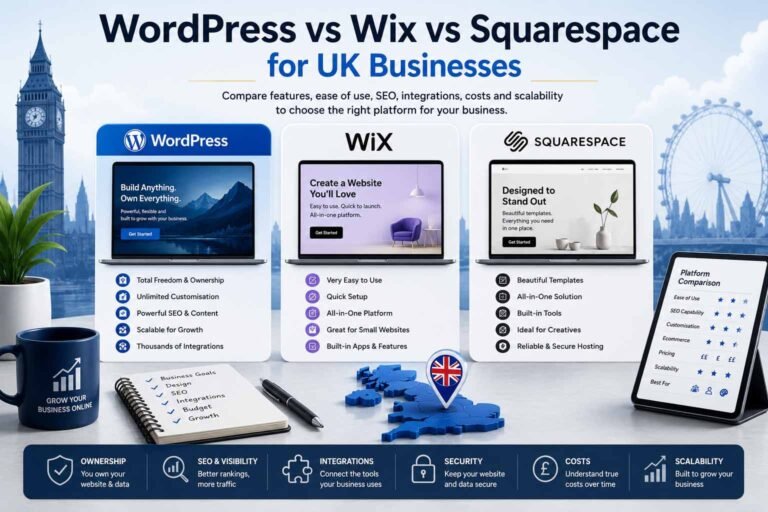
Is it cheaper to use Wix or Squarespace?
DIY builders can have a lower initial financial cost because hosting and templates are bundled. The total value depends on your time, required apps, ecommerce, ownership, search needs and whether professional design or migration is needed. Compare platform ownership, portability, app costs, ecommerce limits and support before deciding.
Is WordPress free?
The WordPress software is free to use, but hosting, domain, design, development, premium plugins, maintenance, content and support may still be required.
Should I pay monthly or pay upfront?
Upfront projects can provide clearer ownership and lower long-term cost, while monthly packages spread expenditure and may include support. Compare total contract cost, cancellation rights, ownership, access, transferability and included service.
Why do agency websites cost more?
Agencies may include strategy, project management, specialist design, development, copy, SEO, testing, governance and post-launch support. Some agencies are highly standardised, so the scope still needs to be compared carefully.
Can a freelancer build a good business website?
Yes. An experienced freelancer can deliver an effective website when the scope matches their skills and capacity. Check process, relevant work, continuity, support, ownership and whether specialist content, SEO or integration help is required.
Does website design include SEO?
Some providers include essential technical and on-page foundations. Ongoing content, authority building, digital PR and continued optimisation are normally separate. Ask the provider to define exactly what “SEO included” means.
Does the price include copywriting?
Not always. Some quotations assume all final text and images will be supplied. Others include editing or original copywriting. This should be explicit because content delays are a common cause of project overruns.
Does the website price include hosting?
Sometimes. Hosting may be included for a period, bundled into a monthly service or charged separately. Confirm renewal price, support, backups, security and account ownership.
How much should I budget for website maintenance?
A small WordPress website may require approximately £75–£300 or more per month for managed updates, backups, monitoring and support. The level of service and response time should be documented.
Can I redesign my website without losing rankings?
Risk can be reduced through a structured migration process that records current URLs, queries, content, links, backlinks and analytics before change. No migration is risk-free, but unnecessary losses can often be avoided.
How long does a website take to build?
A focused website with prepared content may take four to eight weeks. A larger, content-led, ecommerce or integrated project may take eight to twenty weeks or longer. Stakeholder review and content readiness materially affect the schedule.
How can I get a more accurate website estimate?
Start with the BhavPro Website Cost Calculator to create a requirement-based planning estimate. For a confirmed proposal, share your current website, required pages, content status, functionality, integrations, launch timing and migration considerations so the assumptions and dependencies can be reviewed.
Need a scope-based estimate rather than a generic range?
Share the current website, required pages, content readiness, integrations, migration considerations and target launch date.
Executive Summary
- Do not compare page count alone. Strategy, content depth, integrations, migration and governance often drive more work than the visible number of pages.
- Separate build cost from ownership cost. Hosting, maintenance, licences, support, content and marketing continue after launch.
- Compare scope before price. Confirm ownership, populated pages, SEO foundations, testing, training, support, VAT and third-party costs.
- Reduce scope safely. Phase optional features, prepare content early and preserve useful URLs rather than removing essential quality controls.
- Use commercial responsibility. Spend in proportion to the website’s role in credibility, lead generation, ecommerce or business operations.
Plan a Website Budget Around Your Actual Requirements
Build an initial requirement-based estimate with the calculator, then request a reviewed website plan that accounts for content ownership, functionality, integrations, existing rankings, launch risk and post-launch support.
How These Website Cost Estimates Were Prepared
These ranges combine representative UK supplier guidance reviewed in July 2026 with BhavPro’s practical experience of website delivery, content, integrations and migration planning. They are indicative estimates rather than an official tariff or guaranteed quotation, and suppliers may include different work within similar price bands.
The Scope-to-Cost estimator starts with the project ranges shown in this guide and adjusts them for page scale, content, design, integrations, migration and delivery pace. Your selections are calculated in the browser and are not submitted or stored.