
Choose a Web Design Agency With Evidence, Control and a Clear Exit Route
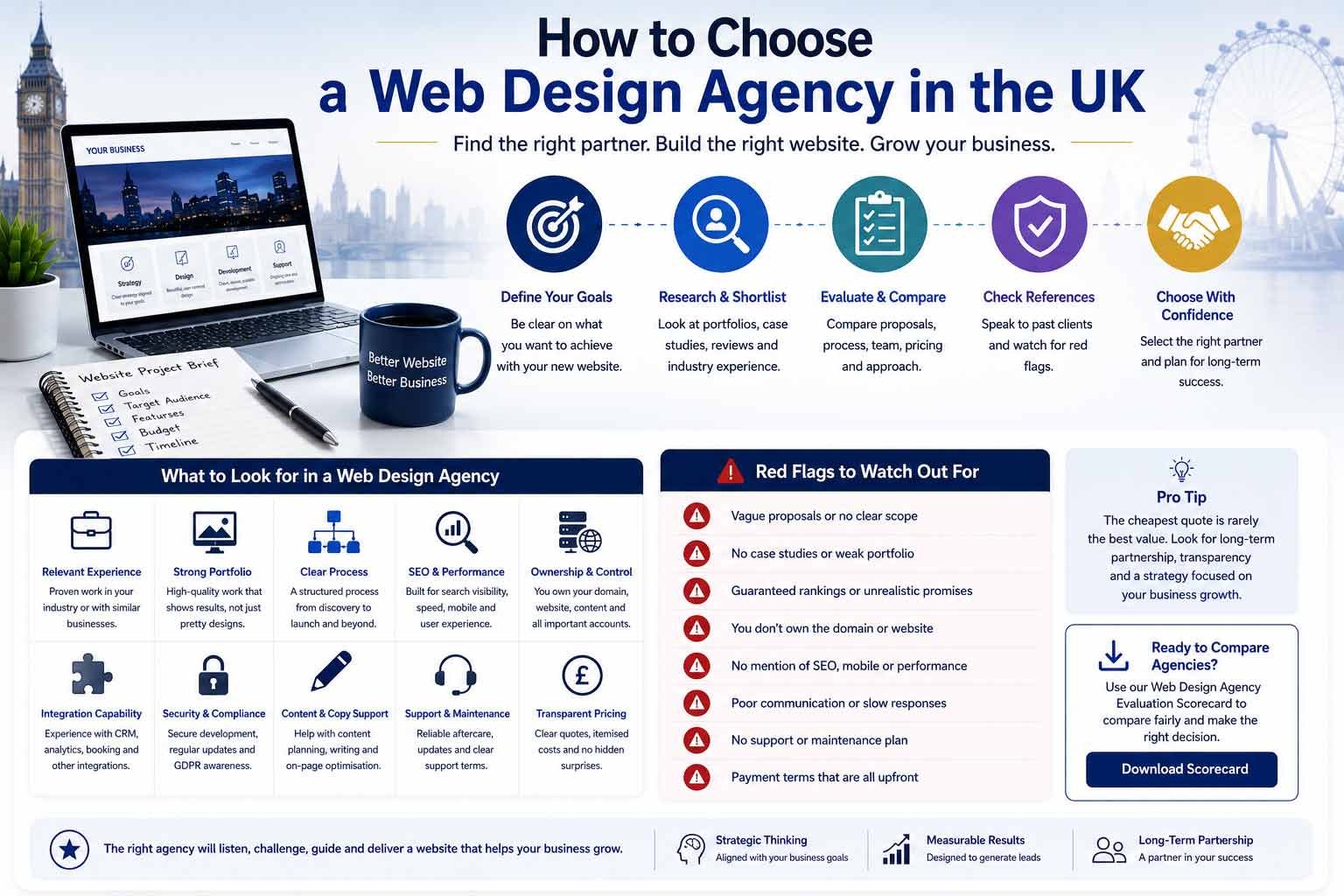
Compare agencies by relevant evidence, scope, ownership, migration planning, data handling, project control and support—not visual style or price alone. A reliable supplier should explain what it will deliver, how quality will be accepted, who controls every account and asset, and how your business can operate or change provider after launch.
How to use this guide: define the website’s responsibility first, shortlist proportionate suppliers, complete the scorecard from actual evidence, resolve critical ownership and risk issues, then record every clarification in the contract or statement of work.
BhavPro provides website and connected business-system services. This guide is designed to help you evaluate BhavPro and other suppliers using the same criteria.
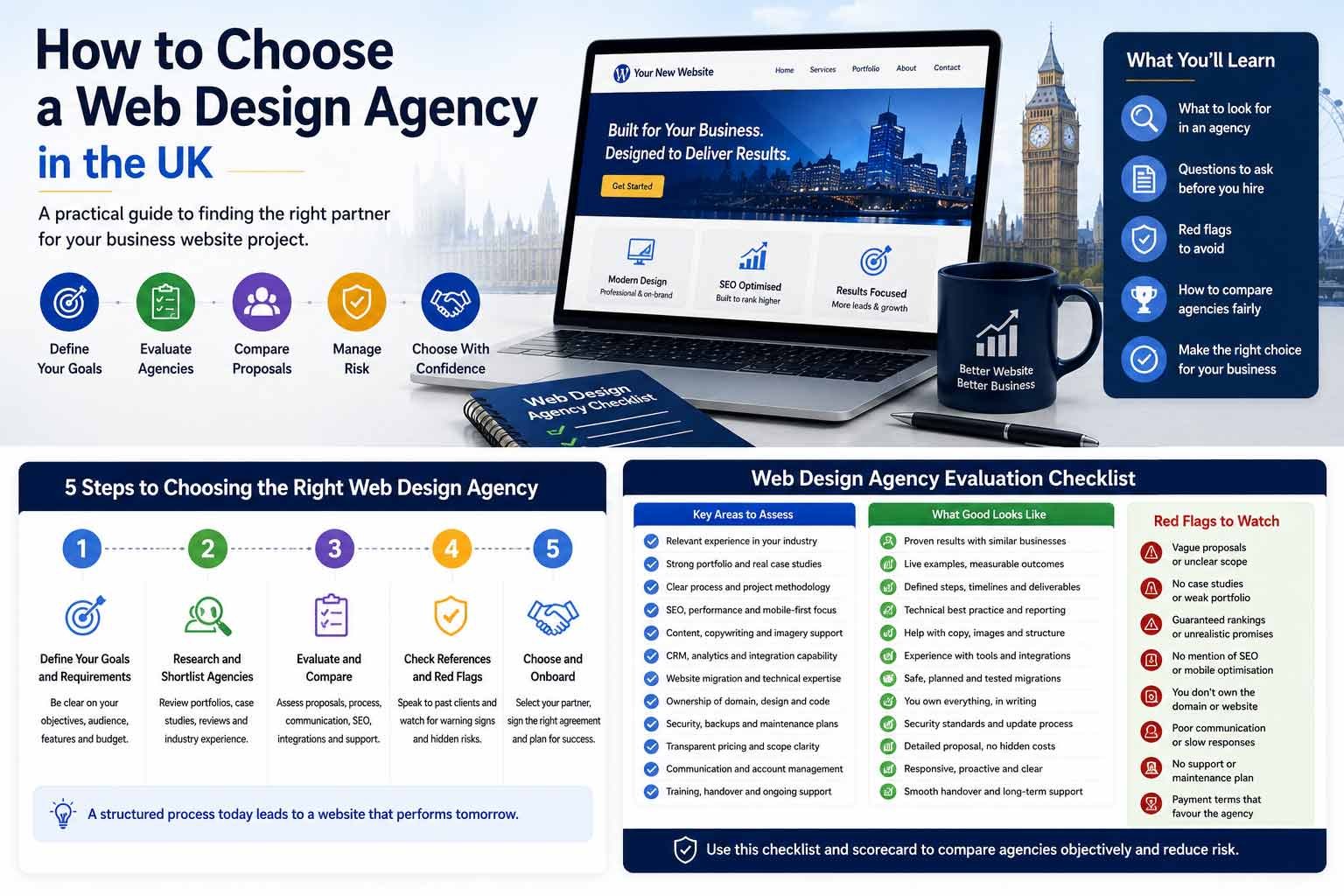
The Seven Tests Every Agency Should Pass
A strong supplier does not need to be the largest or most decorated. It needs to be proportionate to the project and reliable in the areas that create commercial, technical and operational risk.
Business Fit
The supplier understands your audience, offer, commercial goals and operational context.
Relevant Evidence
Comparable work is explained with scope, responsibility, constraints and verifiable outcomes.
Scope Clarity
Deliverables, responsibilities, assumptions, exclusions and recurring costs are written clearly.
Delivery Control
Milestones, decisions, testing, acceptance and changes have named owners and defined processes.
Asset Control
The business controls its domain, accounts, content, data and project-specific assets.
Risk Management
Migration, security, accessibility, privacy, backup and rollback responsibilities are addressed.
Continuity
Handover, maintenance, documentation, support and supplier-exit arrangements are credible.
| Test | What a credible agency should demonstrate |
|---|---|
| Business Fit | The supplier understands your audience, offer, commercial goals and operational context. |
| Relevant Evidence | Comparable work is explained with scope, responsibility, constraints and verifiable outcomes. |
| Scope Clarity | Deliverables, responsibilities, assumptions, exclusions and recurring costs are written clearly. |
| Delivery Control | Milestones, decisions, testing, acceptance and changes have named owners and defined processes. |
| Asset Control | The business controls its domain, accounts, content, data and project-specific assets. |
| Risk Management | Migration, security, accessibility, privacy, backup and rollback responsibilities are addressed. |
| Continuity | Handover, maintenance, documentation, support and supplier-exit arrangements are credible. |
Choose the agency that can demonstrate control of the entire delivery risk—not merely attractive design.
Complete the Web Design Agency Scorecard
Score an Agency Against Evidence, Control and Continuity
Rate each category from 0 to 5. The tool converts the ten equally weighted categories into a score out of 100 and highlights any critical issue that should be resolved before appointment.
| Score | Interpretation |
|---|---|
| 85–100 | Strong fit, subject to contract and reference checks. |
| 70–84 | Potential fit; resolve the identified weaknesses before appointment. |
| 55–69 | Material concerns; renegotiate the scope or assess alternatives. |
| Below 55 | High selection risk. |
Important: A score supports judgement; it does not replace contract review, references, legal advice or technical due diligence. Any critical issue should be resolved in writing before appointment.
Define What the Website Must Do
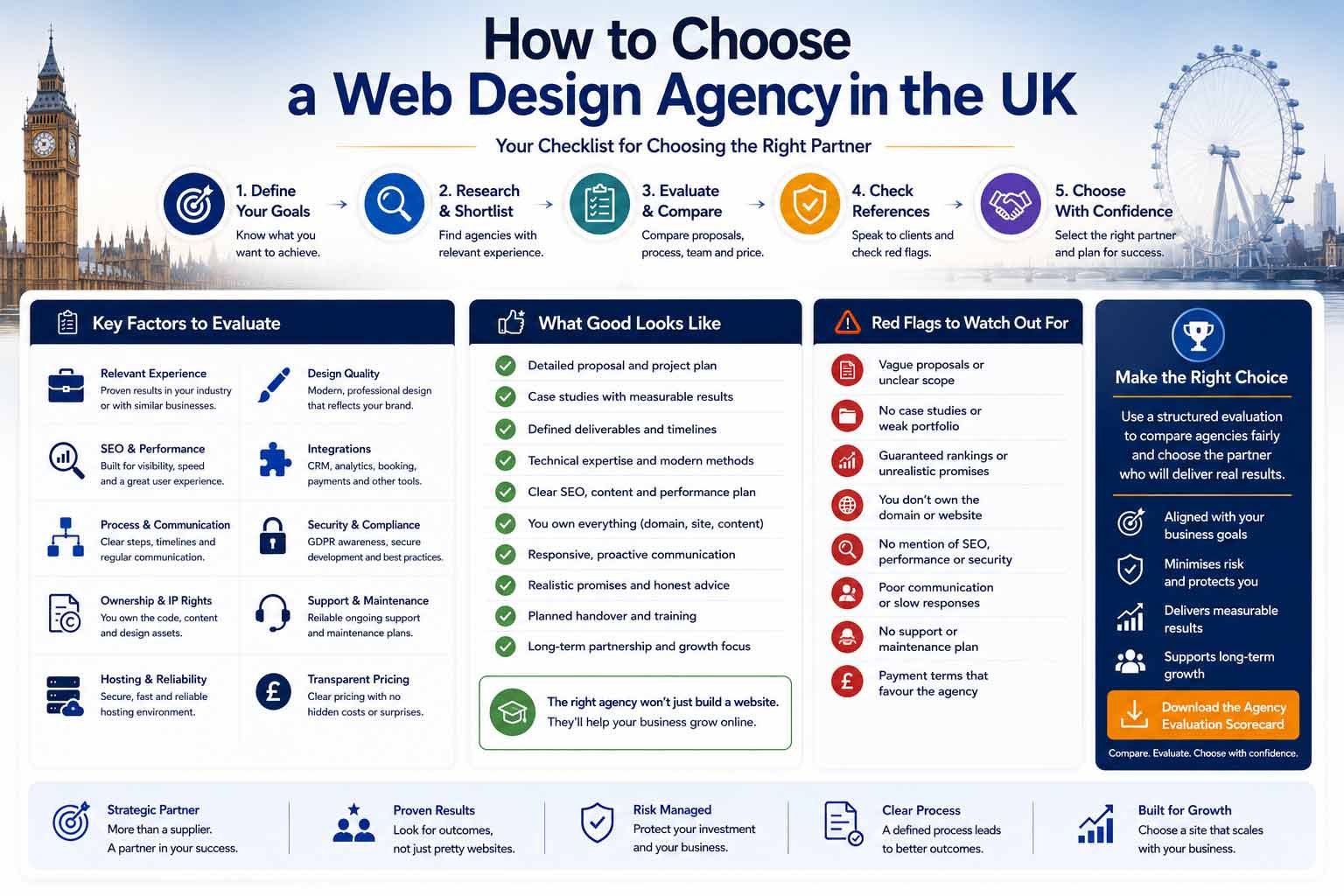
A supplier cannot recommend the right solution when the business has not agreed what the website is responsible for. Start with a short brief that identifies one primary outcome, the most valuable audiences, existing problems and the practical constraints.
Business and Outcomes
- Priority customers and services
- Main outcome: credibility, leads, sales, bookings, recruitment, support or publishing
- Commercial value of an enquiry or sale
- Evidence that supports important claims
- Three-year growth expectations
Constraints and Risks
- Budget range and target launch
- Content and brand readiness
- Existing rankings and backlinks
- CRM, analytics and operational integrations
- Legal, accessibility or procurement requirements
- Internal decision-makers and technical capability
Record what is failing now: weak enquiries, unclear services, poor mobile experience, difficult editing, unreliable forms, lost rankings, no measurement, duplicate content, missing CRM connections or supplier dependency. A useful brief allows agencies to explain trade-offs instead of guessing.
Delivery ModelFreelancer, Studio, Agency or Consultant?
The right supplier model depends on project risk, specialist coverage, decision speed and the support required after launch. Do not assume that a larger team is automatically safer or that direct freelance delivery is automatically cheaper.
| Supplier model | Often suitable when | Main checks |
|---|---|---|
| Freelancer | The scope is focused and direct communication matters. | Capacity, continuity, specialist gaps, support and documentation. |
| Specialist studio | The project needs a coordinated design and development team. | Who performs the work, subcontracting, quality assurance and post-launch support. |
| Full-service agency | The website sits within wider campaigns, content or formal procurement. | Assigned team, account layers, retainers, staff continuity and proportionality. |
| Consultant-led delivery | The project needs senior involvement and operational understanding. | Delivery capacity, named collaborators, boundaries and implementation evidence. |
| Platform specialist | The platform has already been selected through genuine requirements analysis. | Limitations, recurring costs, portability, dependencies and migration route. |
Choose a platform specialist only after the platform has been shown to fit the requirement. Familiarity with one product is not a substitute for platform selection.
Market SearchBuild a Focused Longlist
Potential suppliers may come from professional referrals, search results, local business networks, LinkedIn, platform directories, specialist marketplaces or relevant case-study searches. Search visibility proves that an agency can market itself; it does not prove project fit, delivery quality or contract strength.
- Supplier name, location and delivery model
- Main services and platform specialism
- Relevant industries and comparable projects
- Indicative project range and team size
- Named contact and support model
- Potential conflicts, dependencies and initial concerns
A longlist of five to eight credible suppliers is usually sufficient. Reduce it to a shortlist using evidence and essential requirements before requesting detailed proposals.
Initial EvidenceTreat the Agency Website as One Signal
An agency website can demonstrate message clarity, design discipline, mobile usability, accessibility awareness, content quality, case-study depth, process transparency and basic legal hygiene. It is not complete proof: excellent suppliers sometimes neglect their own site, while weak delivery companies can have polished sales pages.
Useful Checks
- Can you understand the offer quickly?
- Is the site usable on mobile?
- Are real projects explained beyond screenshots?
- Are claims qualified and contact routes clear?
- Are privacy and cookie controls present?
- Are there broken links or unfinished sections?
Avoid a Style Bias
Do not reject a supplier solely because its own visual style differs from yours. The more important question is whether the team can design for your audience, brand and commercial journey rather than reproducing its own identity.
Look Beyond Attractive Portfolio Screenshots
Ask what problem the client had, what the agency delivered, what the client supplied, which platform and integrations were involved, how quality was tested and what happened after launch.
Stronger Evidence
- Business context and initial problem
- Objectives, scope and constraints
- Named agency responsibilities
- Implementation and migration detail
- Measured results with baseline and timeframe
- Lessons and transparent client attribution
Weaker Evidence
- Mock-ups presented as completed work
- Screenshots without project context
- Logos without scope details
- Outcomes without a baseline or timeframe
- Work mainly delivered by another company
- Template demonstrations presented as bespoke builds
Sector experience can shorten discovery, but it is not always essential. Strong research, comparable buyer journeys, regulated-process experience and integration capability may be more valuable than a repeated sector template.
Independent SignalsVerify Reviews, Testimonials and References
Useful reviews describe the original problem, communication, handling of challenges, reliability, support and outcome. Vague praise is a weak signal.
- Is the reviewer and company identifiable?
- Does the project appear in the portfolio?
- Is the review available on an independent platform?
- Is identical wording repeated across websites?
- Are negative or mixed reviews answered professionally?
For a material project, request one or two relevant references where client permission allows. Ask whether scope changes were handled clearly, whether unexpected costs arose, whether handover was usable and what the client would do differently.
RequirementsA Strong Agency Asks Before It Recommends
Be cautious when a supplier recommends a complete solution after a short sales call without examining the audience, current performance, content, systems, rankings, integrations and internal capability.
Good Discovery Questions
- What must change for the business?
- Which customers and actions are most valuable?
- Which current pages already perform?
- What happens after an enquiry?
- Which systems must connect?
- What cannot fail during migration?
Useful Discovery Outputs
- Requirements and audience summary
- Sitemap and user journeys
- Content and feature plan
- Integration map
- Migration and analytics plan
- Risks, phases and refined quotation
A paid discovery phase can be proportionate for complex projects. Confirm which outputs the client owns and whether they can be used with another supplier.
Technology ChoiceThe Platform Must Follow the Requirement
Ask why the platform is recommended, which alternatives were considered, what its limits are, which licences recur, what can be exported and what happens if the agency relationship ends.
- Hosting and technical-maintenance model
- Content export and hosting portability
- Custom code and third-party dependencies
- Integration methods and API limits
- Internal editing capability
- Migration route and exit cost
Warning signs include “we use this for every client”, “it is best for SEO” without qualification, and a proprietary account controlled only by the supplier.
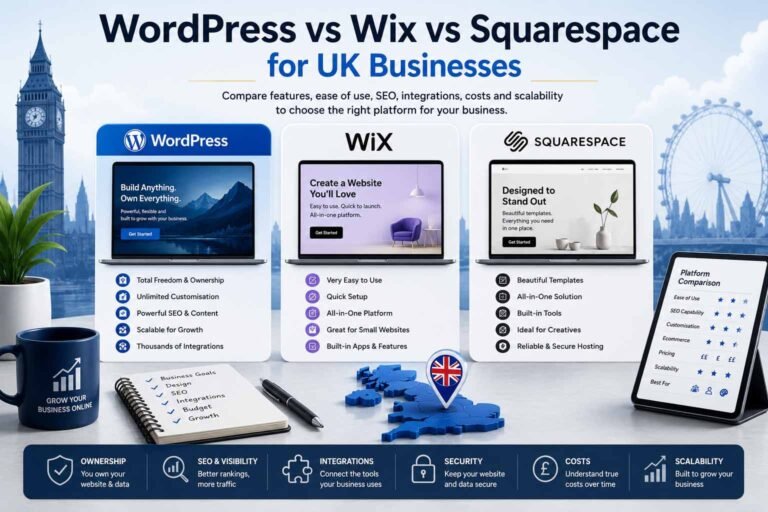
Use the WordPress, Wix and Squarespace comparison when the platform decision is still open.
Design and ContentReview the Decision Process, Not Only the Reveal
Design Process
A reliable process may include brand and content review, sitemap, wireframes, reusable components, responsive decisions, prototypes, accessibility consideration and defined approval stages.
- How many concepts and review rounds are included?
- Which pages or templates are designed individually?
- How are mobile, forms and interactions considered?
- What accessibility standard informs the work?
- Which changes become chargeable after approval?
Content Responsibility
Content is one of the most common causes of delay. Clarify responsibility for sitemap, copy, editing, claims, images, legal content, approvals, population, migration, metadata and redirects.
- Who interviews subject-matter experts?
- How many copy revisions are included?
- Who verifies commercial or regulated claims?
- Who licenses images and fonts?
- Does the quotation include populated pages or templates only?
- What happens when client content is late?
“Unlimited revisions” still needs a boundary: the agreed scope, approval milestone, structural changes, new pages and effect on the launch date should all be defined.
Search ProtectionDefine SEO and Migration Responsibilities
“SEO included” has no reliable meaning until the supplier defines the deliverables. Launch foundations can include intent-led architecture, titles, headings, internal links, indexation controls, canonicals, structured-data recommendations, analytics, Search Console and redirect mapping. Ongoing research, content, digital PR and optimisation are separate services.
Questions for a Redesign
- Which URLs will remain, change or be consolidated?
- What queries, traffic, backlinks and conversions exist now?
- Where will each old URL redirect?
- Will redirect chains and homepage dumping be avoided?
- Who updates internal links, canonicals and sitemaps?
- What is monitored after launch and what is the rollback plan?
Google recommends permanent server-side redirects for permanent URL moves and says redirects should generally remain in place for at least one year. Each old URL should point to the most relevant replacement rather than sending every removed page to the homepage. Read Google’s site-move guidance.
Existing search visibility is a business asset. Deleting or renaming pages without a baseline and redirect map is a material delivery risk.
Measure Important Actions and Connected Workflows
“Conversion-focused” should be supported by a defined journey and measurement plan. Relevant actions may include form starts, completed enquiries, calls, bookings, downloads, calculator completions, purchases, applications and qualified leads.
Measurement Questions
- Who controls analytics and tag-management accounts?
- Which events are included?
- How is consent handled?
- How are test submissions excluded?
- Can source information pass to the CRM?
- Who validates tracking after launch?
Integration Questions
- Is the connection native, plugin-based, webhook-based or custom?
- Is data one-way or two-way?
- How are fields and duplicates handled?
- What happens when the integration fails?
- Are logs and alerts available?
- Who owns recurring third-party costs?
The website often ends where the business process begins. BhavPro’s CRM and workflow integration guidance explains how forms, ownership, automation and operational follow-up can be connected.
AssuranceAccessibility, Privacy and Security Need Defined Scope
Accessibility
Ask which standard and level inform the work, which pages and components are in scope, whether testing is automated and manual, whether keyboard and screen-reader checks are included, and how third-party widgets are treated. A platform or template does not make the finished website automatically accessible.
Privacy and Data Protection
When an agency processes personal data on the client’s behalf, the UK GDPR requires an appropriate written controller–processor contract. Establish who decides the purpose of processing, where data is stored, which subprocessors are used, who has access, how long information is retained and what happens at contract end. Read the ICO’s contract guidance.
Security
Security should be considered throughout design, development, deployment and maintenance. Ask about MFA, administrator permissions, updates, off-site backups, restore tests, staging protection, logs, incident response and unsupported components. The NCSC describes secure-by-design practice as integrating security from the start of the development lifecycle. Review the NCSC secure-design guidance.
This is general commercial and procurement information, not legal, data-protection, security or accessibility advice. Obtain qualified advice where the project involves regulated data, formal compliance obligations or substantial contractual risk.
Business ControlControl Critical Accounts and Clarify Intellectual Property
The business should normally control, or have securely recoverable access to, its domain registrar, DNS, hosting, CMS administrator, analytics, Search Console, tag manager, email, payment provider, CRM, consent platform, CDN, backups and source repository where applicable.
Domain and Hosting Questions
- Who registers and renews the domain?
- Which company email and recovery controls are used?
- Is MFA enabled and are recovery codes held securely?
- Is hosting directly contracted or resold?
- What resources, backup and support levels apply?
- Can the site move without the current supplier?
Copyright and Licence Questions
Paying for a website does not automatically settle every ownership question. UK guidance states that a self-employed creator usually owns the intellectual property in commissioned work unless the contract gives the client the rights. The agreement should distinguish assignment, licence, reusable frameworks and third-party materials. Read the UK Government overview.
- What new work is assigned or licensed to the client?
- What pre-existing tools remain with the agency?
- Can another supplier modify and maintain the work?
- Are stock assets, fonts, themes and plugins transferable?
- Is custom source code included?
- When do rights transfer and what happens if the project stops?
Obtain legal advice for material intellectual-property, liability, termination and data-processing terms.
Commercial ComparisonNormalise the Scope Before Comparing Price
Two proposals can use different language for similar work or hide different exclusions. Create a common scope table before comparing price.
| Scope area | Supplier A | Supplier B | Supplier C |
|---|---|---|---|
| Discovery and sitemap | |||
| Copy and content population | |||
| Design concepts and page types | |||
| Forms and integrations | |||
| SEO foundations and migration | |||
| Analytics and consent | |||
| Accessibility and testing | |||
| Hosting, licences and maintenance | |||
| Training, handover and support | |||
| Ownership, exclusions, VAT and total cost |
Price Clarifications
- Is VAT included?
- Is discovery chargeable and reusable?
- What payment milestones apply?
- What assumptions and exclusions affect price?
- Which licences, apps, hosting and maintenance recur?
- How are meetings, delays and changes charged?
- What happens if the project is paused or terminated?
Do not ask suppliers to reduce the price before deciding which scope is appropriate. Remove, simplify or phase requirements deliberately. Use the website cost calculator and the UK website cost guide for budget planning.
Project ControlA Date Is Not a Delivery Plan
Ask the agency to show discovery, content, sitemap, design, development, integration, migration, testing, approval, launch and monitoring. The plan should identify client dependencies, decision deadlines, contingency and the launch owner.
Named Roles
- Client sponsor and project owner
- Agency project manager
- Designer, developer and copywriter
- SEO and integration specialists
- Data-protection contact
- Launch approver
Governance Controls
- Meeting and reporting schedule
- Project-management system
- Decision and risk logs
- Change-request process
- Escalation route
- Document and access storage
Confirm which work is subcontracted, where collaborators are located, who quality-checks it, how absences are covered and whether the sales contact remains involved.
Quality ControlDefine Completion, Changes and Testing
Acceptance Criteria
Define what complete means: agreed pages exist, content is approved, navigation and forms work, integrations pass test cases, tracking fires, redirects are implemented, documentation is delivered and account access is transferred.
Agree defect severity—critical, high, medium, low and enhancement—so a new feature is not treated as a defect simply because it was discussed informally.
Change Control
Every material change should record the request, reason, scope impact, cost, timeline impact, risk and approval. A lightweight written process protects both parties from invisible scope growth.
Testing
- Responsive and browser testing
- Forms, email and payment testing
- Integration and error-path testing
- Accessibility and keyboard checks
- Links, redirects and analytics
- Consent and cookie behaviour
- Performance, backup and restore
- User-acceptance and regression testing
Ask which devices and browsers are included, who supplies test data, how defects are recorded and what is retested after launch.
Operational OwnershipHandover, Support and Exit Must Be Practical
Handover
The client should receive appropriate administrator access, domain and hosting access, analytics, form and integration settings, licences, backups, source materials, documentation, training, renewal dates and emergency contacts.
Post-Launch Support
Clarify the defect-support period, response times, emergency coverage, update responsibility, backup frequency, monitoring, content support, integration support, licence renewals, hour limits and excluded work.
Supplier Exit
- Can all accounts and data be transferred?
- Are source code and design files available where agreed?
- What notice, assistance and exit charges apply?
- What happens to agency-owned licences?
- Can the site remain live during transition?
- How quickly will access, DNS and documentation be handed over?
A professional supplier should be able to explain continuity if the agency closes, a key person leaves, hosting fails, a component becomes unsupported or the commercial relationship ends.
Risk SignalsWarning Signs and Positive Indicators
Red Flags
- Pressure to sign immediately
- No written scope or unclear VAT
- Guaranteed rankings, revenue or compliance
- Platform chosen before discovery
- No content, testing or migration plan
- Supplier-only control of domain or analytics
- Shared administrator passwords or no MFA
- Portfolio claims without context or verification
- No handover, maintenance owner or exit route
Green Flags
- Asks detailed questions before recommending
- Explains limitations and trade-offs
- Separates essential and optional work
- Shows comparable, contextual evidence
- Supports client-controlled accounts
- Defines migration, testing and acceptance
- Communicates risk early
- Provides documentation and an exit route
- Recommends a simpler option when appropriate
The strongest positive signal is a supplier willing to advise against unnecessary expenditure. One red flag may have an explanation; several usually indicate structural risk.
40 Questions to Ask a Web Design Agency
Use the questions that match the material risks in your project. Ask for evidence and written clarification rather than accepting broad assurances.
Business and Strategy
- How will you learn about our business, audience and sales process?
- What do you believe the website must achieve?
- Which requirements are essential and which can be phased?
- How will success be measured?
- What assumptions are you making?
Evidence
- Which projects are most comparable?
- What exactly did your team deliver?
- Which outcomes are independently verifiable?
- Can we speak with a relevant client?
- Who from those projects would work on ours?
Platform and Architecture
- Which platform do you recommend and why?
- Which alternatives did you reject?
- What limitations should we understand?
- How can the website be exported or migrated?
- What recurring licences and dependencies apply?
Content and SEO
- Who creates, verifies and approves content?
- How will search intent shape the sitemap?
- What does SEO included mean?
- How will existing rankings and backlinks be protected?
- Who owns redirects and post-launch monitoring?
Design and Accessibility
- Which design stages are included?
- How is mobile considered?
- What accessibility standard informs the work?
- What testing is included?
- How many review rounds are allowed?
Technology and Integration
- How will forms connect to our CRM or workflows?
- How are integration failures handled?
- Which security controls are included?
- Who applies updates?
- What backup and recovery process applies?
Ownership and Contract
- Who owns the domain, design, content and custom code?
- Which rights are assigned or licensed?
- Who owns third-party accounts?
- What happens if the project stops?
- What is the supplier-exit process?
Project Control
- Who manages the project?
- How are changes priced and approved?
- What are the acceptance criteria?
- What happens when the timeline slips?
- What support applies after launch?
Shortlist Proportionately and Select on Risk-Adjusted Value
How Many Suppliers?
Two or three credible proposals may be sufficient for a focused project. Three to five can support comparison for a medium business-critical project. Formal or high-risk work may require a capability questionnaire, shortlist, written brief, clarification, presentation, references and contract review.
Tell shortlisted suppliers how many businesses are involved, the selection criteria, deadline, decision process and whether substantial creative or discovery work is paid. Avoid requesting extensive free strategy from many suppliers.
Should You Request a Free Design Concept?
A speculative homepage can show visual ability but rarely proves discovery, content strategy, SEO architecture, technical implementation, accessibility, integration, migration or support. Better evidence includes relevant case studies, previous wireframes, a paid discovery phase or a compensated prototype of a high-risk interaction.
Final Decision
- Review the scorecard and critical issues
- Check references and the named team
- Normalise scope and total cost
- Confirm ownership, migration and support
- Resolve contract and data-processing points
- Record all clarifications in the contract or statement of work
Do not select solely on price, agency size, awards, location, followers, fastest promised date, a favourite visual concept, personal rapport or search ranking.
Transparent EvaluationApply the Same Standard to BhavPro
BhavPro should be evaluated using the same evidence and controls as every other supplier. Its proposed strengths include direct senior involvement, WordPress delivery, search-intent architecture, lead-generation planning, CRM and workflow integration, communications-system understanding, analytics and ranking-aware migration.
These should be supported through live work, a clear scope, ownership terms, integration documentation, migration controls, a measurement plan, handover and transparent limitations—not accepted as sales claims.
BhavPro May Fit When
- A UK service business needs search-led architecture
- The website must connect to CRM or operational workflows
- Direct senior involvement is valuable
- WordPress, Astra and Elementor are appropriate
- Migration and measurement need named ownership
Another Supplier May Fit Better When
- A very low-cost DIY site is sufficient
- A large international agency team is required
- A specialist enterprise-commerce implementation is needed
- The project needs a large product-development squad
- Formal certification is required beyond BhavPro’s scope
Review BhavPro’s portfolio and web design services in Leicester, then apply the scorecard without lowering the standard.
Buyer QuestionsChoosing a Web Design Agency FAQs
How do I choose a good web design agency?
Define the website’s main business outcome, then compare agencies on relevant evidence, scope clarity, process, ownership, migration planning, data handling, support and commercial fit. Do not select only on visual style or price.
How many web design agencies should I speak to?
Two or three credible suppliers may be enough for a focused project. A medium or complex project may justify three to five shortlisted agencies. Too many proposals create unnecessary work and make comparison difficult.
What questions should I ask a website designer?
Ask how the supplier will understand the business, which platform it recommends, who creates content, how SEO and migration are handled, who owns accounts and assets, what testing is included, how changes are priced and what support applies after launch.
Should I choose a local web design agency?
A local agency can provide convenient meetings and market familiarity, but location should not outweigh capability, evidence, process and support. Many projects can be delivered effectively through remote collaboration.
Should I use a freelancer or an agency?
A freelancer can suit a focused project requiring direct communication and limited specialist coverage. An agency may suit a larger project needing several disciplines, capacity and formal governance. Choose the model that matches the risk and scope.
How can I check an agency’s portfolio?
Review live websites and ask what the agency actually delivered. Look for project context, scope, implementation, constraints and verified outcomes rather than attractive screenshots alone.
Are web design awards important?
Awards can indicate creative or industry recognition, but they do not prove the agency understands your business, protects rankings, manages data, delivers reliably or provides effective support. Treat awards as one signal.
Should a web design agency understand SEO?
A business-critical redesign should involve search awareness. The agency should explain page intent, metadata, internal links, indexation, redirects and migration. Ongoing SEO may require a separate service.
Can a website redesign reduce rankings?
Yes. Rankings may change when URLs, content, internal links, canonicals, rendering or site structure change. A responsible agency should record current performance and implement relevant redirects and monitoring.
Who should own the website domain?
The business should normally control the domain account or have secure, recoverable access. Avoid arrangements where only the supplier controls registration, renewal and transfer.
Who owns a website after it is built?
Ownership depends on the contract. Commissioning and paying for work does not automatically settle every intellectual-property right. The agreement should address content, design, code, images, licences and reusable components.
Should the agency provide source code?
For custom work, the contract should clarify whether source code is delivered, assigned or licensed. Standard themes, plugins and reusable frameworks may remain subject to third-party or agency licences.
What should be included in a web design contract?
The contract or statement of work should define scope, responsibilities, price, payment, timeline, changes, acceptance, ownership, licences, data handling, confidentiality, support, termination, liability and exit arrangements. Obtain legal advice for material terms.
Does a web agency need a data-processing agreement?
When the agency processes personal data on the client’s behalf, a written controller–processor contract may be required under the UK GDPR. The precise roles and clauses depend on the processing arrangement.
How should I compare web design quotes?
Create a common scope table covering strategy, pages, content, design, forms, SEO, migration, analytics, integrations, hosting, licences, training, support, ownership, VAT and exclusions. Compare like with like.
Is the cheapest web design quote risky?
Not automatically. A lower-cost supplier may be suitable for a simple project. Risk arises when necessary work is excluded or the project has greater commercial, migration, security or integration responsibility than the delivery model supports.
Is the most expensive agency automatically better?
No. A higher fee may reflect scale, specialist teams, branding, overhead or governance. The additional cost is valuable only when it addresses requirements and risks relevant to your organisation.
Should I ask for unlimited revisions?
Defined review rounds are normally clearer. An unlimited-revisions promise should still specify the agreed scope, approval milestone, structural changes, new pages and effect on timing.
What happens if the agency misses the deadline?
The contract should define dependencies, responsibilities, notification, revised planning and any agreed remedies. A delay caused by missing client content is different from an unexplained supplier delay.
What support should I expect after launch?
Confirm the defect-support period, hosting, updates, backups, monitoring, response times, content support, integration support and excluded work. Ongoing maintenance should be documented separately where required.
Can I change web design agency later?
You should be able to change supplier when accounts, domain, data, source materials, licences and documentation are controlled properly. Review the exit process before signing the original agreement.
How do I know whether BhavPro is the right agency?
Use the same scorecard. Review relevant BhavPro work, scope, ownership, migration process, integration capability, support and project fit. BhavPro should explain when another delivery model would be more suitable.
Web Design Agency Selection: Decision Summary
- Start with the website’s commercial responsibility, not a preferred supplier or platform.
- Compare evidence in context: problem, scope, responsibility, constraints and outcome.
- Normalise proposals before comparing price, timeline or features.
- Protect ownership and continuity through client-controlled accounts, clear rights, documentation and an exit route.
- Treat migration, personal data, security and integrations as delivery risks, not optional details.
- Use the scorecard as a decision aid, then complete references, contract review and technical due diligence.
Compare Agencies With Evidence, Not Sales Promises
Use the scorecard before appointing any supplier. BhavPro can also review your brief, platform requirements, integrations, migration risk and budget so you can compare proposals on a consistent basis.
How This Agency-Selection Guide Was Prepared
This framework combines practical website-procurement risks with current authoritative guidance on copyright, data-processing contracts, secure development and website migration. It is designed to help buyers ask better questions rather than rank agencies or replace professional advice.
- UK Government: Intellectual property and commissioned work
- Information Commissioner’s Office: Controller and processor contracts
- National Cyber Security Centre: Secure design and development
- Google Search Central: Site moves with URL changes
- Google Search Central: Redirects and Search
Reviewed 14 July 2026. This guide provides general commercial and procurement information. It does not constitute legal, data-protection, security, accessibility, tax or financial advice.