
Top 10 AI Automation Companies in the UK for 2026
Compare UK AI automation companies by the factors that matter after the demo: business fit, integration depth, AI boundaries, failure recovery, governance, ownership, evidence, pricing and year-one operating cost.
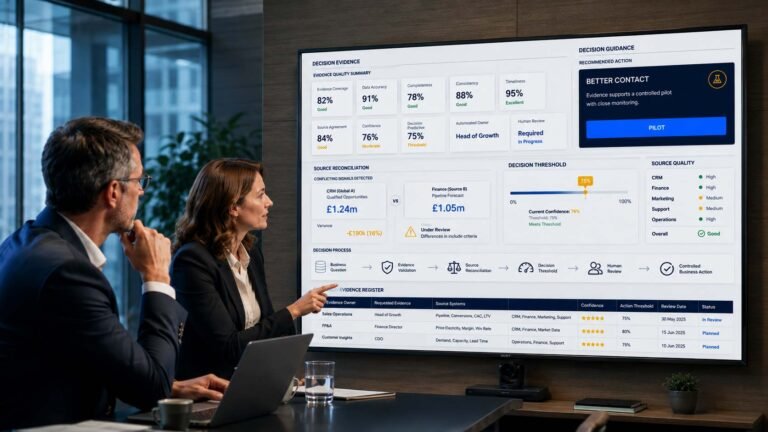
Fast answer: there is no single best AI automation company for every UK business. The right provider depends on whether you need a contained workflow, several connected business systems, AI agents, bespoke software or organisation-wide AI transformation. Shortlist companies by problem fit, integration depth, reliability, governance, ownership, evidence and total cost rather than choosing from an unexplained “#1” ranking.
Top AI Automation Companies UK: Quick Comparison
Use this table as a first-pass shortlist, not as a universal ranking. A provider that is ideal for one business problem can be unnecessarily complex—or insufficient—for another.
| Company | Potentially Strongest Fit | Typical Delivery Focus | Pricing Visibility | Buyer Should Verify |
|---|---|---|---|---|
| AutoMazen | Small-business workflow automation | Lead handling, follow-up, admin and connected SaaS workflows | Public starting ranges | Monitoring and support for critical workflows |
| BhavPro | Connected CRM, communications and operational automation | Workflow design, CRM, APIs, communications and AI-assisted business systems | Public starting points | Fit for highly specialised ML/software research requirements |
| BrainBox Automations | AI-native applications, agents and bespoke software | Retrieval-augmented generation (RAG), document AI, SaaS, agents and custom development | Selected public package pricing | Whether a smaller workflow requires this level of engineering |
| Elevate AI | UK SMEs seeking AI opportunity assessment or managed outbound | Paid AI consulting, prioritised costed roadmap; managed B2B outbound | Consulting priced to scope; build separate | Who carries out implementation and how it is costed |
| Flowio | Technical n8n/Python workflows and AI voice | n8n, Python, CRM, messaging, voice and custom apps | Published £750 starting point; scope-based quote | Monitoring, support and running costs |
| Molo Agency | Engineering-led agents with operational controls | AI agents, digital products, software and controlled workflows | Consultation-led | Comparable production evidence for the proposed use case |
| MQLFlow | SME marketing and sales automation | Zapier, marketing systems, integrations and AI agents | Relatively transparent | Architecture for larger multi-system operations |
| Ronins | AI plus wider product and digital work | Custom AI, workflow agents, product and growth delivery | Consultation-led | Value of broader agency scope versus a specialist |
| Softomate Solutions | CRM, ERP, GoHighLevel, chatbot and voice automation | CRM/ERP, GHL, agents, chatbots and voice | Selected public starting prices | Source-of-truth and conflict handling across systems |
| VAYRO | SME and mid-market AI leadership and operating-model adoption | Embedded AI leadership, readiness, agent platform and organisational adoption | Request a scoped proposal | Whether a contained workflow needs an embedded management model |
Important: the numbering used later is for navigation. It is not a best-to-worst league table.
A Buyer’s Guide, Not Just a Ranking
Most “best AI agency” articles start with company names. A buyer normally needs to start one step earlier: what type of automation is being purchased, how much authority will AI receive, which systems must cooperate and what happens when the workflow fails?
This guide therefore evaluates providers through eight buying controls:
Problem Fit
Does the provider diagnose the workflow and business outcome before choosing technology?
Integration Fit
Can it connect the CRM, finance, helpdesk, communications, databases and APIs involved?
AI Responsibility
Is AI used only where interpretation is needed, while clear business rules remain rule-based?
Reliability
Are retries, duplicate protection, validation, exception queues, alerts and recovery designed?
Governance
Are data access, permissions, approval gates, security and audit responsibilities understood?
Ownership
Will the business own the workflows, code, accounts, prompts, credentials and documentation?
Proof & Measurement
Does the proposal define measurable acceptance criteria rather than relying on broad AI claims?
Total Cost
Does the buyer understand implementation plus year-one licences, APIs, support and maintenance?
Why Supplier Selection Matters More in 2026
UK businesses are moving beyond casual AI experimentation toward operational use. ONS reported that around 35% of businesses with 10 or more employees were using at least one AI technology in June 2026, while government research continues to identify skills, uncertain business need, cost, ethical considerations and regulatory uncertainty as barriers to deeper adoption.
The practical implication is that buying AI automation is increasingly an operating-model and business-systems decision, not simply a software purchase. A successful project has to fit the process, data, people, controls and existing technology around it.
Diagnose the RequirementBefore Comparing Companies: Decide What You Are Actually Buying
Single Workflow
Example: capture → validate → enrich → CRM → route → follow-up. This may need bounded workflow automation, not a transformation programme.
Connected Processes
Example: website → CRM → proposal → order → billing → support → reporting. Integration, state and ownership become central.
AI Agent
The system interprets requests, retrieves knowledge and may choose tools. Confidence, permissions, evaluation and fallback matter more.
Bespoke AI Product
Retrieval-augmented generation (RAG), document intelligence, proprietary AI apps or SaaS move the requirement toward software engineering.
AI Transformation
Multiple use cases, process redesign, data readiness, governance, adoption and workforce capability require a broader operating model.
Find the Right Type of AI Automation Provider
Choose the shape of your requirement. This tool recommends a supplier type and useful shortlist direction rather than declaring a universal winner.
Still defining the first automation?
Use BhavPro’s broader AI automation page to map the business problem before committing to a supplier or platform.
10 UK AI Automation Companies to Consider in 2026
Each company is reviewed using the same practical template: likely fit, public focus, why it may deserve a shortlist place and what the buyer should verify before signing.
1. AutoMazen
Best suited to: small businesses wanting practical, done-for-you automation.
AutoMazen has an accessible proposition for businesses that know they have repetitive administrative work but do not maintain an internal automation team. Its public service material centres on practical commercial workflows rather than broad enterprise transformation.
A potentially strong first automation partner when the requirement is clearly defined, relatively contained and centred around common SME software.
Ask how monitoring, exception handling, documentation and support work once a workflow becomes business-critical.
2. BhavPro
Best suited to: businesses needing automation across CRM, communications, APIs and operational processes.
BhavPro’s differentiator is the combination of process, systems integration and operational implementation rather than treating automation as a standalone no-code discipline. The approach becomes particularly relevant where a workflow crosses lead generation, CRM, communications, sales, service and reporting.
Consider BhavPro where the brief is closer to “redesign this business process and coordinate several systems safely” than “connect application A to application B.”
Highly specialised foundational-model research or large-scale ML engineering may be better suited to a dedicated AI software/research studio.
3. BrainBox Automations
Best suited to: AI-native applications, agents, retrieval-augmented generation (RAG) systems and bespoke software.
BrainBox sits further toward the software-engineering end of the market. Its public offering covers automation but also full-stack SaaS applications, retrieval-augmented generation, document AI and custom product development.
Useful when the requirement includes bespoke AI software, sophisticated document processing, retrieval-based AI, agents or substantial custom development.
For a small CRM or marketing workflow, check whether software-development-heavy scope is more capability than the business actually needs.
4. Elevate AI
Best suited to: UK SMEs deciding where AI will deliver value, or requiring managed B2B outbound.
Elevate AI currently positions its core engagement as paid AI consulting: it evaluates business opportunities and supplies a prioritised, costed roadmap owned by the client. Implementation is agreed separately. Its other principal offering is a managed B2B Outbound Sales Engine.
Suitable for SMEs requiring an independent-looking decision pack before a build, or a separately scoped managed B2B outbound service. Confirm the scope and any delivery arrangements.
Ask for the paid consulting deliverables and fee, and distinguish any later implementation quote or managed outbound subscription, minimum term and responsibilities.
5. Flowio
Best suited to: technical workflow automation, n8n/Python builds, CRM and AI voice.
Flowio combines low-code orchestration with custom technical development. Its public positioning covers n8n and Python alongside CRM, messaging, voice and custom applications, providing a broader technical surface than single-platform automation shops.
Useful where the requirement includes custom n8n work, technical APIs, AI voice, CRM or messaging workflows.
For customer-facing or critical workflows, ask for specific monitoring, alerting, incident and post-launch support commitments.
6. Molo Agency
Best suited to: organisations that value engineering discipline and controlled AI-agent deployment.
Molo stands out because its public material discusses operational details often absent from AI-agency marketing, including safe retries, protection against duplicate actions, timeouts, human review, monitoring and maintenance.
Potentially strong where software-engineering discipline, safeguards and controlled agent behaviour matter as much as the automation itself.
Ask which parts of the proposed architecture have comparable production evidence and which would represent new engineering work.
7. MQLFlow
Best suited to: smaller businesses, marketing operations, Zapier and connected sales systems.
MQLFlow is comparatively transparent about entry pricing and is strongly relevant where automation intersects with marketing, lead management and common SaaS platforms.
Potentially useful for marketing workflows, Zapier implementation, lead-management systems and smaller integrations.
If the workflow expands beyond marketing and sales, confirm architecture, monitoring visibility and ownership for larger multi-system operation.
8. Ronins
Best suited to: organisations combining AI automation with broader product, growth or digital work.
Ronins differs from pure automation boutiques because AI sits within a wider digital-agency capability. That can help where automation is one component of a larger customer-facing product or digital programme.
Consider it where the programme combines automation with customer-facing digital/product work rather than back-office workflow alone.
For tightly bounded operations automation, compare the broader-agency model with a specialist to determine the better value and ownership model.
9. Softomate Solutions
Best suited to: businesses using CRM, ERP, GoHighLevel, chatbots or voice automation.
Softomate covers a broad collection of business applications. The combination of CRM, ERP, GoHighLevel, chat and voice may appeal to service organisations wanting customer and operational systems connected.
Potential fit for GHL environments, CRM/ERP integration, chatbots, AI voice and service-business automation.
Where several applications are involved, identify the authoritative system and how conflicts, duplicates and partial failures are handled.
10. VAYRO
Best suited to: mid-market organisations pursuing wider AI adoption and operating-model change.
VAYRO occupies a different position from companies focused on individual workflow builds. Its public proposition combines AI engineering with embedded transformation support, leadership and organisational adoption.
Potentially suitable for mid-market businesses with several AI workstreams that need engineering plus internal capability development.
A single contained automation may not require a transformation-led engagement model.
Which Type of AI Automation Supplier Should You Choose?
| Your Requirement | Supplier Type to Investigate | What to Prioritise |
|---|---|---|
| One simple repeatable workflow | Automation specialist or experienced freelancer | Fast deployment, ownership, monitoring |
| Several SME workflows | SME automation agency | Standardisation, integrations, support |
| CRM + finance + support + APIs | Business systems automation partner | Architecture, source of truth, recovery |
| Complex AI agents / retrieval-based AI / product | AI software engineering studio | Evaluation, software quality, monitoring visibility |
| AI voice and communications | Voice/communications automation specialist | Telephony, handoff, latency, integrations |
| Organisation-wide adoption | Transformation consultancy + engineering | Governance, operating model, portfolio value |
| Marketing-led automations | Marketing automation specialist | CRM quality, attribution, campaign operations |
| High-risk operational workflow | Provider with strong controls and recovery | Permissions, approval, audit, fallback |
How Much Do AI Automation Companies Charge in the UK?
There is no single meaningful UK market price because “AI automation” can mean anything from one bounded workflow to a bespoke multi-system platform. Public examples reviewed for this article illustrate the spread rather than a like-for-like price ranking.
| Provider | Public Pricing Example | Interpretation |
|---|---|---|
| AutoMazen | Single automation £500–£2,000 one-off; managed from £1,000/month (provider pricing) | Company-published packages; scope and running costs to confirm |
| BhavPro | AI Business Systems Audit from £750 + VAT; Workflow/CRM Sprint from £3,500 + VAT (published service pricing) | Different scope of discovery versus a bounded implementation sprint |
| BrainBox | AI-native MVP packages quoted at $5,000–$6,000 USD, varying by scope (provider FAQ) | Product/MVP engineering, not a basic integration quote; currency USD |
| Elevate AI | Paid consulting priced to an agreed brief; implementation scoped separately (current engagement) | Earlier indicative pilot ranges are not a verified current Elevate AI rate card |
| Flowio | Automation packages from £750 for a single workflow; final quote depends on scope (provider pricing) | Starting price; confirm exclusions, API usage and support |
| Molo | No comparable fixed AI project figure identified | Scope-led pricing |
| MQLFlow | Automation set-up from £800; strategy from £3,200; agents from £4,000 (published prices) | Company prices subject to scope; £800 day rate stated |
| Ronins | No comparable fixed public figure identified | Broader agency scope |
| Softomate | Business-process automation cost guide quotes £1,500–£5,000 for a single workflow (published guide) | Illustrative guide range, not a binding individual quote or rate card |
| VAYRO | Retainer-led model; no comparable fixed public project figure identified | Transformation/embedded model |
Ask for Year-One Cost, Not Only Build Price
Year-one automation cost = implementation + automation platform + AI/API usage + infrastructure + licences + support + maintenance + internal oversight + expected change.
A £2,000 workflow requiring frequent repair can cost more than a £6,000 implementation designed with monitoring, recovery and maintainability from the start.
Buying StageBuy the Service That Matches Your Current Stage
Discover
You know inefficiency exists but have not identified the first automation. Buy assessment or process discovery.
Define
The process, baseline and owner are known. Buy technical design and a scoped pilot.
Validate
You need evidence that the workflow creates measurable value. Buy a controlled pilot with acceptance criteria.
Prepare for Production
The pilot works. Buy monitoring, recovery, security, documentation, ownership and support.
Scale
Several workflows are live. Buy architecture, governance, reusable components and portfolio management.
Common buying mistake: buying a Stage 5 transformation programme when the organisation has not completed Stage 1.
Should You Automate This Process Yet?
| Question | Positive Signal | Warning Signal |
|---|---|---|
| Is the process repeated frequently? | Yes | Rare or ad hoc |
| Is there a clear process owner? | Yes | Nobody owns it |
| Can the current steps be explained? | Yes | Process varies constantly |
| Is the input data accessible? | Yes | Fragmented or unavailable |
| Can success be measured? | Yes | No baseline |
| Can errors be detected? | Yes | Failures may go unnoticed |
| Can a human intervene? | Yes | No fallback |
| Is the process stable enough? | Yes | Rules change weekly |
If several answers fall into the warning column, the better first investment may be process standardisation, not AI automation.
Failure EngineeringThe Buying Question Most Proposals Underprice: What Happens When It Fails?
Consider a customer onboarding workflow: form submitted → AI extracts information → CRM record created → welcome message sent → project created. A demonstration shows five successful steps. Production introduces a harder question: what happens when step three succeeds and step four fails?
The real workflow may require validation, state, retry rules, reconciliation, duplicate protection, alerts, logs, an owner and a manual recovery path. This is why the cheapest implementation quote can become the highest-cost automation.
Buyer test: ask every shortlisted supplier to demonstrate the failure path—not only the happy path.
How to Compare Two AI Automation Quotes Properly
Suppose Supplier A quotes £4,000 and Supplier B quotes £8,000. The first appears cheaper until the operating scope is normalised.
| Buying Question | Supplier A | Supplier B |
|---|---|---|
| Discovery/process mapping | Limited | Included |
| Error handling | Basic | Designed |
| Monitoring | No | Included |
| Documentation | Minimal | Included |
| Client-owned accounts | Unclear | Yes |
| Human approval controls | No | Where required |
| Handover | Additional fee | Included |
| Post-launch optimisation | No | Defined period |
AI Automation Proposal Scorecard
Score each area as Strong / Needs clarification / Red flag. Award confidence for observable delivery evidence—not for terms such as “revolutionary”, “autonomous” or “cutting-edge”.
| Area | Strong Evidence |
|---|---|
| Business outcome | Clear measurable problem and baseline |
| Workflow understanding | Current process and exceptions mapped |
| AI responsibility | Clearly bounded |
| Integration design | Systems and source-of-truth defined |
| Failure recovery | Retries, validation, alerts and fallback |
| Security | Permissions and data flows explained |
| Human control | Approval points defined |
| Measurement | Baseline + acceptance criteria |
| Ownership | Client ownership documented |
| Documentation | Included and maintainable |
| Support | Post-launch responsibilities clear |
| Exit | Handover possible without artificial lock-in |
| Total cost | Year-one costs visible |
10 Questions to Ask Every AI Automation Company
- What would you automate first—and why? A credible supplier should prioritise rather than automate everything.
- Which decisions will AI make? Identify where AI judgement or uncertainty enters the workflow.
- What remains rule-based or human-controlled? Not every decision should be delegated.
- Which systems and data will the automation access? This reveals integration and security complexity.
- What happens when the automation fails? Ask for specific recovery behaviour.
- How will success be measured? Require the baseline and acceptance criteria.
- Who owns the workflows, code and accounts? Resolve ownership before implementation.
- Where is our data processed and retained? Especially important for customer and sensitive information.
- What is the realistic 12-month cost? Include licences, APIs, monitoring, maintenance and support.
- How can another supplier take over? Ask what documentation and handover assets you receive.
AI Automation Red Flags to Watch For
“We Can Automate Everything”
Selective automation is normally safer and more valuable than turning every process into an AI project.
Guaranteed ROI Without a Baseline
Savings cannot be credibly quantified without current volumes, effort, cost, errors and business value.
Tool-First Discovery
If every business problem requires the provider’s preferred tool, test whether the process or the technology is driving the solution.
No Failure Discussion
Production workflows fail. Recovery maturity often differentiates a prototype from operational infrastructure.
“Fully Autonomous” by Default
Higher-impact work may need explicit human decision points rather than maximum autonomy.
Supplier-Owned Critical Accounts
This can make future handover unnecessarily difficult.
No Ongoing Cost Model
AI usage, automation platforms, cloud infrastructure and support can materially change total cost.
No Documentation or Exit Plan
Operational automation is infrastructure. Treat its documentation accordingly.
When You Should Not Hire an AI Automation Agency Yet
Sometimes the strongest conclusion from discovery is not yet. Delay implementation when nobody can explain the current process, responsibilities are unclear, data is unreliable, rules change continuously, there is no measurable problem or leaders expect AI to repair a fundamentally broken process.
Automation principle: automating disorder frequently creates faster disorder. Standardise the process first, then automate.
AI Agent, Workflow Automation or Traditional Integration?
| Architecture | Best When | Main Control Question |
|---|---|---|
| Traditional integration | Stable rule: if X happens, perform Y | Are data mapping and failure handling reliable? |
| Workflow automation | Several systems, rules and actions must be orchestrated | How are state, retries, duplicates and exceptions handled? |
| AI-assisted workflow | Part of the process requires classification, extraction, summarisation or drafting | What is AI allowed to decide? |
| AI agent | The system must interpret, choose tools or determine actions within boundaries | How are permissions, evaluation, monitoring and human control enforced? |
Do not buy an “agent” because the term sounds more advanced. Buy the least complex architecture capable of producing the required business outcome.
Shortlist StrategyBuild a Three-Company Shortlist Before Requesting Proposals
After defining the requirement, narrow the market to three providers:
- Closest specialist: strongest direct fit to the workflow.
- Adjacent alternative: a provider with a different delivery model.
- Different approach: a company that may solve the same business problem differently.
Then give all three exactly the same brief. A useful brief describes volumes, current handling time, systems, users, required controls, failure expectations and success measures—not “tell us what AI can do for us.”
Buying JourneyA Better AI Automation Buying Journey
Business problem → Process baseline → Automation suitability → AI boundary → Integration requirements → Risk/governance → Supplier shortlist → Comparable brief → Pilot → Acceptance testing → Production controls → Measurement → Scale
Notice where supplier selection appears: it is not step one.
Need practical use cases before you shortlist a supplier?
Review 50 AI automation examples across sales, operations, service, finance, marketing, HR and other business functions.
AI Automation Companies UK FAQs
What is the best AI automation company in the UK?
There is no universal best provider. The right company depends on whether you need a simple workflow, several connected systems, AI voice, bespoke software, agents or wider transformation. Compare process fit, integration capability, reliability, governance, ownership, evidence and total cost rather than relying on a generic #1 ranking.
What does an AI automation company do?
An AI automation company helps organisations reduce manual work, coordinate software systems, assist decision-making or automate defined processes using workflow technology, integrations and AI. Providers range from low-code specialists to bespoke AI software studios and transformation consultancies.
How much does AI automation cost in the UK?
Costs vary significantly. Public examples reviewed for this guide range from sub-£1,000 entry services to multi-thousand-pound pilots and much larger implementations. Compare scope and year-one operating cost—including licences, model/API usage, monitoring and maintenance—rather than build price alone.
What should a business automate first?
A strong first automation is usually frequent, measurable and reasonably stable, with accessible data, a clear owner and detectable errors. Highly variable or poorly defined processes are weaker first candidates.
Is an AI agent the same as workflow automation?
No. Workflow automation usually follows defined orchestration and business rules. An AI agent may have more discretion to interpret situations, select tools or determine actions within boundaries, which normally increases the need for evaluation, permissions, monitoring and human oversight.
Should I choose an agency that specialises in one automation tool?
Tool specialisation can be useful when you have already selected the platform. If you have not, test whether the provider's preferred tool genuinely fits your architecture, ownership, data and reliability requirements.
Who should own the workflows and automation accounts?
Ownership should be agreed before implementation. Clarify code, workflows, automation-platform accounts, prompts, cloud resources, credentials, documentation and what happens if you later change supplier.
Do I need a UK-based AI automation company?
Not necessarily. Delivery can be global. A UK-focused provider may nevertheless be useful where local business context, working hours, purchasing requirements or familiarity with UK governance and data-protection requirements matter.
How do I compare two AI automation proposals?
Give suppliers the same measurable business brief and compare discovery, integration scope, AI responsibility, failure recovery, security, ownership, documentation, support and 12-month operating cost. Do not compare headline prices without comparing deliverables.
Can AI automation reduce costs?
It can where automation reduces repeated manual activity, delays or errors. Savings should be measured against a baseline and include implementation, licences, AI/API usage, support and maintenance rather than assuming every automated task creates a net saving.
Executive Decision Summary
- Start with the process, not the provider. Supplier selection works better after the workflow, baseline, systems and risk are defined.
- Match supplier type to the requirement. A contained SME workflow, bespoke AI product and transformation programme need different operating models.
- Ask to see failure behaviour. Production value depends on recovery, monitoring and human fallback—not only a successful demo.
- Normalise total cost and ownership. Include year-one licences, APIs, support, documentation and exit before comparing quotes.
- Avoid artificial #1 rankings. The strongest provider is the one whose delivery model best fits the process, systems and control requirements.
Start With the Workflow Before You Commit to the Supplier
If the process spans CRM, customer communications, APIs or operational systems, BhavPro can help define the automation boundary, controls, implementation route and measurable acceptance criteria before a larger commitment.
Sources Used for This Comparison
Provider positioning derives from supplier-published websites. Selected current-offer and pricing sources were checked again on 18 October 2026; other profiles are based on the original 8 September research and still require buyer verification. No provider underwent an independent technical audit or controlled comparative test. Wider UK market, data-protection and secure-AI context uses primary public-sector guidance.
- Office for National Statistics — Artificial intelligence in UK businesses, 2023 to 2026
- UK Government / DSIT — AI adoption research
- National Cyber Security Centre — Guidelines for secure AI system development
- Information Commissioner's Office — AI and data protection guidance
- AutoMazen — official website
- BrainBox Automations — official website
- Elevate AI — official website
- Flowio — official website
- Molo Agency — official website
- MQLFlow — official website
- Ronins — official website
- Softomate Solutions — official website
- VAYRO — official website