
50 Practical AI Automation Examples for UK Businesses
Explore 50 bounded AI automation examples across ten business functions, with the operating situation, AI responsibility, controls, measures and clear reasons not to proceed.
Fast answer: AI automation can help UK businesses classify enquiries, extract document data, prepare drafts, summarise conversations, identify exceptions and coordinate routine work across CRM, finance, support, marketing and operations. The strongest use cases have an owner, reliable inputs, measurable outcomes, human review and a safe route when the system is uncertain.
AI automation becomes useful when it improves a real operating responsibility: responding to an enquiry, extracting information from a document, preparing a decision, updating a record or helping a team manage exceptions. It becomes expensive noise when a business starts with a fashionable tool and then searches for work to give it.
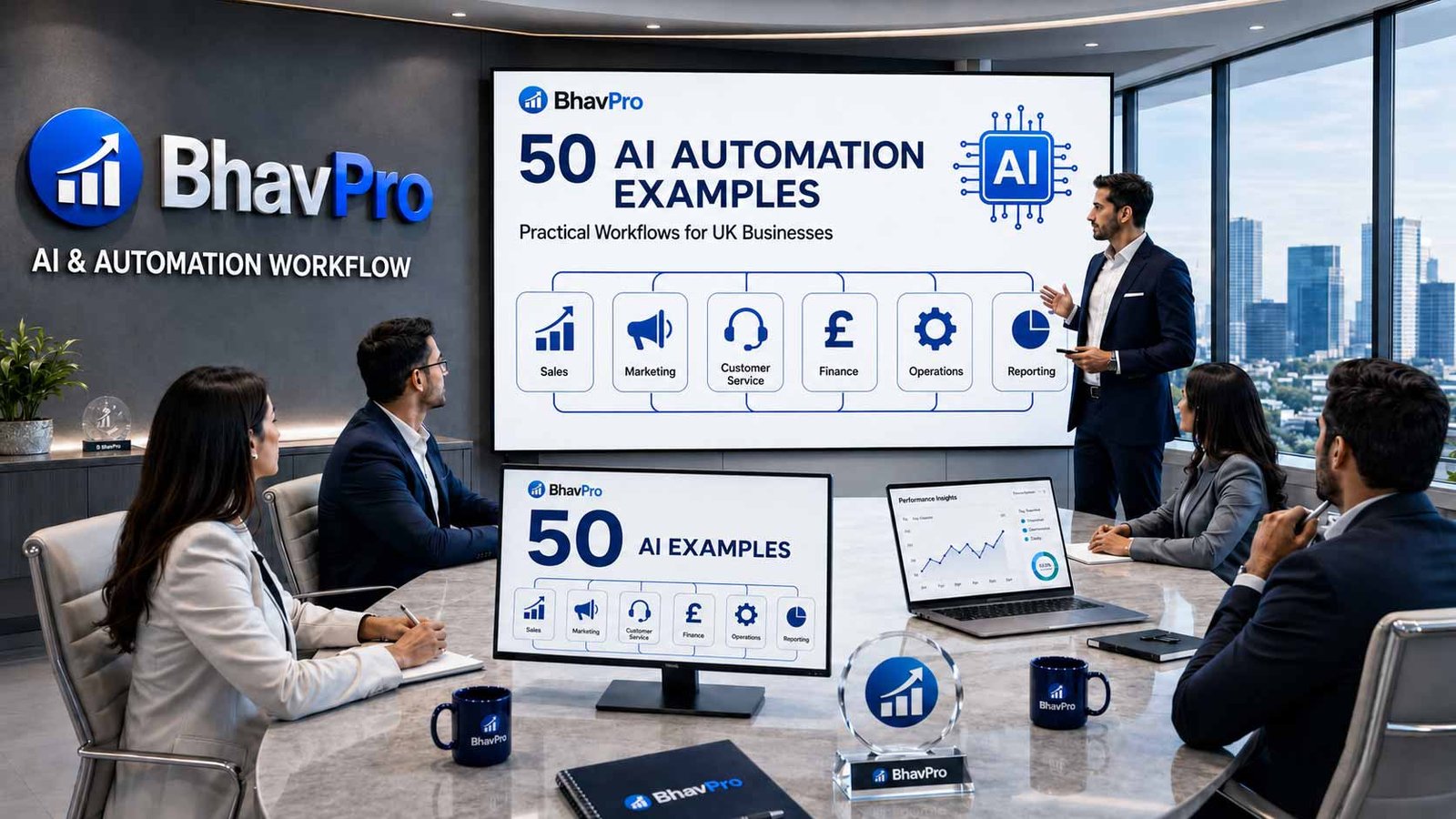
This guide presents 50 practical AI automation examples for UK businesses across sales, customer service, marketing, finance, people operations, project delivery, CRM, IT, communications and management. Each example identifies the business situation, the bounded responsibility AI could support, the controls that remain necessary, the measures that matter and the conditions that should stop or delay implementation.
Executive Insight
- Start with the business problem, not the model, agent or automation platform.
- Use AI where language, documents, images, prediction or variable context genuinely need interpretation.
- Prefer standard software, rules or direct integration when the correct result can be defined deterministically.
- Measure the complete outcome, including human review, exceptions, corrections, support and customer impact.
- Keep an accountable person responsible for the process, even when software performs part of the work.
- Restrict data and permissions to the minimum required for the approved responsibility.
- Pilot one bounded use case before expanding into adjacent teams or connected systems.
Why Practical AI Use Cases Matter Now
AI adoption is increasing across the UK, but adoption depth remains uneven. The Office for National Statistics reported that self-declared AI use among UK businesses with ten or more employees increased from around 12% in late 2023 to around 35% in 2026. However, the average number of AI technologies used by adopting businesses rose only modestly, suggesting that much implementation remains limited rather than deeply connected to day-to-day operations.
The UK Government's AI Adoption Plan for Digital and Technologies also highlights management capability: leaders need to identify suitable use cases, manage change, evaluate outputs and redesign workflows. Technology availability alone does not create operational value.
That is why this guide concentrates on complete business responsibilities rather than impressive demonstrations. A useful example should show who owns the work, what information is required, what the AI is allowed to do, what remains under explicit control and how the business will know whether the outcome improved.
Scope and BoundariesWhat This Guide Covers
Use this page when you need examples of where AI-supported automation might fit across a business.
Use BhavPro's separate guidance when you need to:
- remove, simplify or standardise repetitive work before automating it;
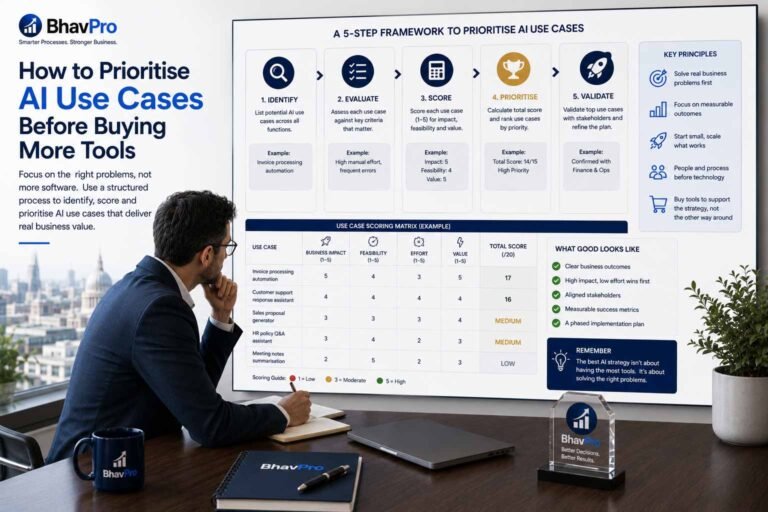
- prioritise competing AI use cases and select a controlled pilot;
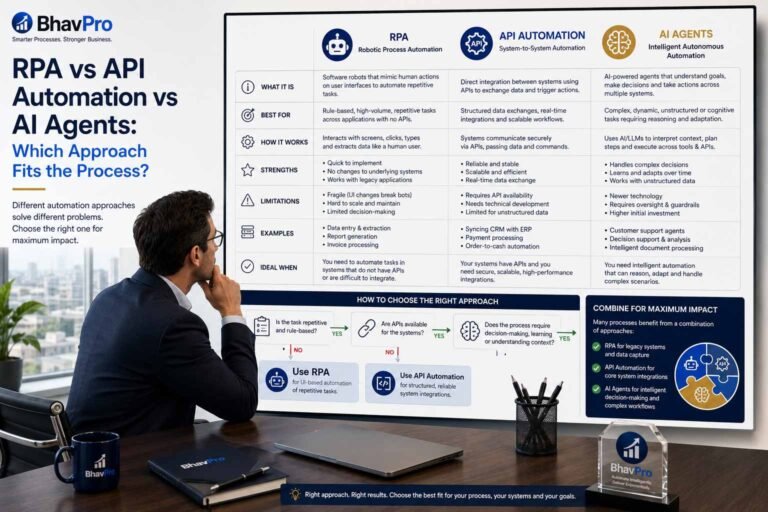
- choose between RPA, API automation and AI agents;
- establish practical AI governance for a UK business;
- diagnose connected workflow, data, CRM, communication and reporting gaps; or
- implement a defined, controlled cross-system workflow.
Browse the 50 AI Automation Examples
Choose the business function closest to the responsibility you want to improve. Each department contains five examples using the same five-part operating and control structure.
What AI Automation Means in Practice
AI automation combines an AI capability with a defined business workflow. The AI element may classify variable text, extract fields from differently formatted documents, summarise approved information, draft content, identify patterns or recommend a next step. The surrounding workflow should still control identity, permissions, required fields, numerical rules, approval thresholds, actions, outcome verification and exception handling.
Not every automation needs AI. A supported API is usually more reliable when two systems simply need to exchange structured information. A fixed rule is normally better when an agreed field or threshold determines the result. Robotic process automation can act as a controlled bridge when a stable user interface must be used and no suitable direct integration exists.
AI is most defensible when it performs one bounded responsibility that ordinary rules cannot handle adequately. Giving an agent a broad goal, unrestricted data access and authority to take consequential action creates a different and much higher-risk system.
The National Cyber Security Centre advises organisations adopting agentic AI to maintain visibility, meaningful human oversight and control, and never give an agent unrestricted access to sensitive data or critical systems. If an organisation cannot understand, monitor or contain an agent's actions, the NCSC says it is not ready for deployment.
Five-Part StructureHow to Read the Examples
Every example uses the same five-part structure:
| Field | What it tells you |
|---|---|
| Business situation | The operating problem or repeated responsibility that creates demand. |
| AI-supported responsibility | The limited part of the work that may benefit from AI. |
| Controls and ownership | The information, permissions, rules, review and accountable roles that remain necessary. |
| Measures | Evidence that shows whether the complete workflow is improving. |
| Do not proceed when | A condition that should stop, simplify or redesign the proposal. |
The examples are not ranked. A simple internal use case may be a better first pilot than a high-value customer-facing proposal because it is easier to measure, control and reverse. Use the AI use-case prioritisation guide after identifying a shortlist.
Sales and Lead Management Examples
These examples focus on reducing sales administration and response delay without allowing AI to make uncontrolled commercial commitments or replace accountable relationship ownership.
Enquiry Classification and Lead Routing
- Situation
- Website forms, shared mailboxes and referral channels produce mixed enquiries that staff must read before deciding which service, location or owner should respond.
- AI-supported responsibility
- Classify the stated requirement against an approved service taxonomy, prepare a short summary and recommend the correct queue or owner.
- Controls and ownership
- Validate contact and consent fields outside the model. Use fixed territory, capacity and ownership rules. Send ambiguous, sensitive or high-value enquiries to a human review queue.
- Measures
- Time to assignment, first-response time, misrouting rate, unclassified enquiries and manual correction rate.
- Do not proceed when
- The business has no agreed service categories, lead ownership rules or process for handling unmatched enquiries.
Lead Record Summarisation
- Situation
- A salesperson opens a lead and must assemble context from a form, email thread, call note and previous activity before responding.
- AI-supported responsibility
- Summarise approved source records into a consistent briefing covering stated need, timeline, stakeholders, questions and previous contact.
- Controls and ownership
- Retain links to source evidence. Distinguish customer-stated facts from generated interpretation. Require staff confirmation before writing inferred information into permanent CRM fields.
- Measures
- Preparation time, record completeness, correction rate, source-traceability rate and user acceptance of the summary.
- Do not proceed when
- Staff cannot identify the current source of truth or access controls expose unrelated customer information.
Call and Meeting Follow-Up Preparation
- Situation
- Actions are delayed because notes, promises and questions from sales calls are captured inconsistently or entered into the CRM late.
- AI-supported responsibility
- Produce a transcript-derived summary, proposed action list, CRM note and follow-up email draft for the account owner to review.
- Controls and ownership
- Establish an appropriate recording and transcription process, provide required notices, restrict retention and prevent the system from creating commitments that were not stated. The account owner approves the final record and message.
- Measures
- Time from meeting to follow-up, action acceptance rate, corrections, missed commitments and percentage of meetings recorded in the CRM on time.
- Do not proceed when
- Recording, privacy, participant expectations or access to confidential conversations have not been resolved.
Proposal First-Draft Assembly
- Situation
- Teams repeatedly copy service descriptions, discovery notes, implementation assumptions and standard terms into proposal documents.
- AI-supported responsibility
- Assemble a first draft from an approved template, validated discovery information and the current service catalogue.
- Controls and ownership
- Keep prices, tax, discounts, dates, legal clauses and contractual limits under deterministic controls. Require commercial and delivery approval before issue. Exclude obsolete templates and unapproved claims from the knowledge source.
- Measures
- Drafting time, number of factual corrections, approval turnaround, template compliance and proposal rework after customer review.
- Do not proceed when
- Scope, pricing or service descriptions change informally and the business cannot identify approved current versions.
Renewal Review Preparation
- Situation
- Account managers spend time gathering contract dates, service usage, support history, open issues and previous commitments before a renewal conversation.
- AI-supported responsibility
- Prepare an evidence-linked renewal brief and identify records that require investigation before the customer is contacted.
- Controls and ownership
- Use verified contract and billing data for dates and values. Do not allow the model to set price, alter a contract, promise a service change or judge customer eligibility. The account owner decides the renewal approach.
- Measures
- Review preparation time, overdue renewals, missing-data rate, unresolved issue rate before contact and manager corrections.
- Do not proceed when
- Contract, billing and service records cannot be reconciled to the same customer and agreement.
Customer Service and Experience Examples
Customer-facing automation must be designed around approved knowledge, identity, human handoff and safe failure. Fluent wording is not evidence that an answer is correct or that an action is authorised.
Knowledge-Grounded Customer FAQ Assistant
- Situation
- Customers repeatedly ask straightforward questions about services, opening hours, preparation steps, policies or published processes.
- AI-supported responsibility
- Retrieve approved public knowledge and produce a relevant answer within a defined subject boundary.
- Controls and ownership
- Use owned, versioned sources with content owners and review dates. Prevent access to drafts, private files and account data. Require the assistant to admit uncertainty and provide a human route when evidence is missing or conflicting.
- Measures
- Supported-answer rate, successful handoff, customer correction, repeat-contact rate, source coverage and unsafe or unsupported answer rate.
- Do not proceed when
- The knowledge base is outdated, contradictory, unowned or too incomplete to support reliable answers.
Support Ticket Classification and Queue Preparation
- Situation
- A support team manually reads each incoming issue before assigning category, affected service and working queue.
- AI-supported responsibility
- Summarise the reported issue and suggest a category based on the customer's words and approved service taxonomy.
- Controls and ownership
- Apply explicit severity and security rules outside the model. Do not infer identity or reveal account existence. Route suspected incidents, complaints, vulnerable customers and unclassified cases to named human queues.
- Measures
- Time to queue, classification correction rate, reassignment rate, backlog age and percentage of tickets with sufficient context for first review.
- Do not proceed when
- Categories, escalation thresholds and team ownership are inconsistent or change without governance.
Human Handoff Summary
- Situation
- Customers repeat information when moving from chatbot, form or first-line support to a specialist, increasing frustration and handling time.
- AI-supported responsibility
- Prepare a concise transfer summary containing the customer's stated objective, completed checks, verified identity level, attempted steps and unresolved question.
- Controls and ownership
- Transfer only necessary data. Label unverified statements and exclude hidden model speculation. Confirm that the receiving team can accept the context and that the customer still has a direct route to a person.
- Measures
- Repeat-question rate, handoff acceptance, transfer time, missing-context rate, resolution time and customer correction.
- Do not proceed when
- Teams use different case identifiers or the receiving queue cannot access the sources referenced in the summary.
Customer Reply Drafting from Approved Case Data
- Situation
- Service teams write similar acknowledgement, update and next-step emails while manually checking case status and approved wording.
- AI-supported responsibility
- Draft a response using the current case record, approved templates and the specific information the customer requested.
- Controls and ownership
- Retrieve status from the source system rather than asking the model to guess. Keep refunds, liability, eligibility, deadlines and contractual statements under explicit approval. A named agent reviews before sending.
- Measures
- Draft acceptance rate, editing time, factual correction rate, response time and reopened contacts caused by unclear answers.
- Do not proceed when
- Case statuses are unreliable or staff cannot see which evidence supported the draft.
Repeat-Contact and Related-Case Suggestions
- Situation
- The same issue arrives through email, web form, chat and telephone, creating duplicate work or disconnected customer histories.
- AI-supported responsibility
- Compare message content and available identifiers, then suggest records that may relate to the same underlying issue.
- Controls and ownership
- Treat the result as a suggestion, not an automatic merge. Require verified customer and account matching, preserve source records and provide rollback for an incorrect association.
- Measures
- Duplicate-case rate, accepted match rate, incorrect match rate, handling time and number of cases with a complete interaction history.
- Do not proceed when
- The business lacks reliable identifiers or combining records could expose one customer's information to another.
Marketing and Content Operations Examples
AI can accelerate preparation and variation, but brand claims, evidence, copyright, data use and final publication remain business responsibilities.
Evidence-Based Content Brief Preparation
- Situation
- Marketers spend time converting keyword research, customer questions, product facts and existing site coverage into a usable content brief.
- AI-supported responsibility
- Organise approved research into audience, intent, questions, entities, evidence requirements and a proposed structure.
- Controls and ownership
- Use current first-party and approved external sources. Check existing site intent before commissioning content. Require an editor to remove unsupported claims, duplication and sections that belong to another page.
- Measures
- Brief preparation time, editor correction rate, source coverage, content overlap detected before drafting and published-page performance against its assigned intent.
- Do not proceed when
- The business has no content inventory, evidence standard or accountable editor.
Campaign Message Variation
- Situation
- A campaign needs controlled variations for different channels, audiences or stages without changing the approved offer.
- AI-supported responsibility
- Draft message variants from an approved proposition, audience definition, channel limits and brand voice.
- Controls and ownership
- Lock price, eligibility, deadline, disclaimer and proof points. Prohibit fabricated urgency, testimonials or performance claims. Require channel and compliance approval before activation.
- Measures
- Approval rate, editing time, policy rejection rate, engagement by controlled variant and downstream qualified response rather than clicks alone.
- Do not proceed when
- The offer, audience or required disclosures are not confirmed.
Customer Research Theme Synthesis
- Situation
- Interviews, survey responses, support conversations and sales notes contain useful themes but are difficult to review consistently at scale.
- AI-supported responsibility
- Group de-identified responses into recurring needs, objections, language patterns and questions, with links back to source evidence.
- Controls and ownership
- Remove unnecessary personal data, preserve minority and contradictory feedback, prohibit invented quotations and have a researcher validate the themes.
- Measures
- Source coverage, theme traceability, analyst correction rate, number of evidence-backed actions and whether subsequent research confirms or rejects the initial themes.
- Do not proceed when
- Consent, research purpose or data provenance is unclear, or the sample is too biased to support the intended conclusion.
Newsletter and Social Content Repurposing
- Situation
- A business has approved long-form guidance but repeatedly rewrites summaries for newsletters and company social channels.
- AI-supported responsibility
- Produce channel-appropriate drafts that preserve the original meaning, source link and approved call to action.
- Controls and ownership
- Keep the original article as the source of truth. Prevent the draft from strengthening claims, inventing statistics or removing necessary context. Require editorial approval for every published version.
- Measures
- Preparation time, correction rate, message consistency, source clicks and qualified enquiries attributed to the content journey.
- Do not proceed when
- The source content is outdated or the channel requires claims and context that the source does not support.
Content and Claim Quality Assurance
- Situation
- Teams need to check whether drafts use approved terminology, current product facts, required disclaimers and accessible formatting before review.
- AI-supported responsibility
- Compare a draft against an approved checklist and flag missing evidence, inconsistent names, ambiguous wording and possible policy conflicts.
- Controls and ownership
- Treat flags as review prompts rather than compliance certification. Use deterministic checks for required phrases, dates and fields. Keep final legal, regulatory and brand approval with qualified owners.
- Measures
- Issues found before publication, false-alert rate, review time, repeated defect rate and post-publication corrections.
- Do not proceed when
- The checklist, product facts or policy sources have no current owner or effective date.
Finance, Billing and Procurement Examples
Finance automation needs exact calculations, duplicate prevention, access control, reconciliation and approval. AI may interpret variable documents, but it should not replace the accounting system or authorised financial decision-maker.
Supplier Invoice Data Extraction
- Situation
- Finance staff manually copy supplier, invoice, date, currency, line and tax information from differently formatted documents.
- AI-supported responsibility
- Extract agreed fields into a fixed structure and identify unreadable or missing information.
- Controls and ownership
- Validate supplier identity, purchase order, totals, tax, currency, duplicate invoice number and permitted file type using deterministic rules. Route uncertainty and mismatches to finance review.
- Measures
- Extraction accuracy by field, manual correction time, duplicate prevention, processing time and exception rate by supplier or document format.
- Do not proceed when
- Supplier and purchase-order records are unreliable or the destination system cannot prevent duplicate posting.
Invoice Exception Classification
- Situation
- Staff investigate mismatches such as missing purchase orders, price differences, duplicate references or incomplete delivery evidence.
- AI-supported responsibility
- Summarise the exception evidence and recommend an approved exception category for human review.
- Controls and ownership
- Calculate tolerances outside the model. Do not approve payment, create supplier bank details or override segregation of duties. Record the reviewer, evidence and final resolution.
- Measures
- Time to categorise, correct-category rate, ageing by exception type, repeated supplier issues and percentage resolved without unnecessary handoffs.
- Do not proceed when
- Approval authority, tolerance rules or required evidence are undocumented.
Accounts Receivable Follow-Up Drafts
- Situation
- Credit-control teams prepare routine reminders while checking invoice status, disputes, promises to pay and account relationships.
- AI-supported responsibility
- Draft an appropriate message from verified balance, due-date and case information, reflecting the approved stage of the collection process.
- Controls and ownership
- Use finance-system values for all amounts and dates. Suppress disputed, vulnerable, insolvent or legally escalated accounts from routine automation. Require approval for changes to terms, fees or enforcement language.
- Measures
- Draft preparation time, incorrect-contact rate, dispute routing, promise-to-pay follow-up and overdue balance movement without attributing causation prematurely.
- Do not proceed when
- Customer matching, balance status or dispute records cannot be trusted.
Expense Evidence and Policy Review
- Situation
- Managers review receipts and explanations for missing fields, policy exceptions and supporting evidence.
- AI-supported responsibility
- Extract receipt information, compare narrative context with the relevant policy section and prepare questions for the claimant or approver.
- Controls and ownership
- Calculate limits and tax treatment using approved rules. Do not make disciplinary conclusions or automatically reject unusual claims. Preserve claimant access, correction and human approval.
- Measures
- Review time, missing-evidence rate, policy exception rate, correction rate and recurring causes of incomplete claims.
- Do not proceed when
- Policies are ambiguous, inconsistently applied or unavailable in current versioned form.
Purchase Request Intake and Routing
- Situation
- Purchase requests arrive through free-text email with inconsistent descriptions, cost centres, urgency and supplier information.
- AI-supported responsibility
- Extract the stated need, prepare a structured request and suggest the appropriate procurement category.
- Controls and ownership
- Validate budget code, supplier status, approval level, conflicts, security review and contract requirements outside the model. The authorised approver retains the decision.
- Measures
- Time to complete a valid request, missing-field rate, routing corrections, approval-cycle time and off-process purchasing.
- Do not proceed when
- Approval thresholds, procurement categories or supplier controls are not enforced consistently.
HR, Recruitment and People Operations Examples
People-related use cases can affect opportunity, income, wellbeing and legal rights. AI can support administration and preparation, but consequential employment decisions require fairness, transparency, appropriate review and a reliable way for people to correct information or challenge outcomes.
Role Description First Draft
- Situation
- Hiring managers start from inconsistent or outdated job descriptions that do not clearly distinguish outcomes, responsibilities and required capabilities.
- AI-supported responsibility
- Assemble a first draft from the approved role profile, team structure, responsibilities and employment template.
- Controls and ownership
- Require HR and hiring-manager review. Remove unsupported qualification barriers, biased language, inflated requirements and invented benefits. Confirm salary, location, working pattern and contractual wording from authoritative sources.
- Measures
- Drafting time, correction rate, template compliance, approval time and recurring clarity issues identified by applicants or hiring teams.
- Do not proceed when
- The organisation has not defined the role, employment status, responsibilities or approved terms.
Application Information Extraction and Administrative Routing
- Situation
- Recruitment teams manually identify contact details, declared qualifications, availability and role-specific evidence from differently formatted applications.
- AI-supported responsibility
- Extract stated information into a review form and route incomplete applications for administrative follow-up.
- Controls and ownership
- Do not infer protected characteristics, personality, suitability or honesty. Do not automatically reject candidates. Provide source visibility, correction routes and meaningful human review. Apply current recruitment and data-protection guidance.
- Measures
- Field accuracy, candidate correction rate, administration time, incomplete-application turnaround and differences in error rates across document formats or applicant groups.
- Do not proceed when
- The system cannot support fairness testing, transparency, correction and human review.
Interview Note Summarisation
- Situation
- Interviewers capture evidence inconsistently, making later discussion dependent on memory and unstructured notes.
- AI-supported responsibility
- Organise interviewer notes against approved competency questions and identify where evidence is missing or contradictory.
- Controls and ownership
- Use only authorised notes and recordings. Do not generate a candidate score from tone, accent, facial expression or unsupported personality inference. Interviewers verify the summary and make the decision through the approved process.
- Measures
- Time to complete records, evidence coverage, correction rate, interviewer disagreement and audit completeness.
- Do not proceed when
- Interview criteria are undefined or recording and applicant transparency have not been addressed.
Employee Onboarding Plan Preparation
- Situation
- New starters receive inconsistent tasks, access requests, training and introductions because several teams own different parts of onboarding.
- AI-supported responsibility
- Generate a role-specific checklist and orientation draft from the approved onboarding template, start date, location and role profile.
- Controls and ownership
- Create system access only through approved identity and permission workflows. Managers confirm the plan, owners and dates. Prevent the model from granting permissions or exposing another employee's records.
- Measures
- Tasks completed by start date, access errors, manager corrections, new-starter questions and time to productive readiness.
- Do not proceed when
- The organisation has no role-based access model or accountable owner for each onboarding task.
Employee Policy Assistant
- Situation
- Employees search across handbooks, intranet pages and shared documents for routine policy questions.
- AI-supported responsibility
- Retrieve and explain the relevant approved policy section, effective date and contact route.
- Controls and ownership
- Restrict sources to published, permissioned policies. Distinguish general information from an individual employment decision. Route grievances, health, safeguarding, disciplinary and exceptional cases to qualified people.
- Measures
- Source-supported answer rate, successful escalation, employee correction, repeated unanswered questions and policy gaps identified.
- Do not proceed when
- Policies conflict, lack effective dates or are applied differently from their published wording.
Operations and Project Delivery Examples
Operational automation should improve the route from request to verified completion. Starting a workflow is not enough: the team must be able to identify incomplete work, manage exceptions and continue safely when a system is unavailable.
Work Order and Task Intake
- Situation
- Operational requests arrive through email, forms and messages with inconsistent descriptions, priorities, locations and supporting evidence.
- AI-supported responsibility
- Summarise the request, extract agreed fields and suggest an approved work category for coordinator review.
- Controls and ownership
- Apply priority, safety, entitlement and assignment rules outside the model. Require essential fields before creation and verify the resulting task or work-order identifier in the destination system.
- Measures
- Time to create a valid task, missing-field rate, categorisation corrections, reassignment rate and requests lost outside the system of record.
- Do not proceed when
- The business has no agreed task categories, priority rules, ownership model or system of record.
Project Status Synthesis
- Situation
- Project managers manually combine task updates, risks, decisions, milestones and dependencies into recurring stakeholder reports.
- AI-supported responsibility
- Prepare an evidence-linked status narrative from approved project records and identify missing or conflicting updates.
- Controls and ownership
- Calculate dates, completion percentages and budget values from source data rather than generated text. Label stale information and unresolved dependencies. The project manager approves the interpretation and forecast.
- Measures
- Report preparation time, data freshness, stakeholder corrections, overdue action visibility and differences between reported and actual milestone status.
- Do not proceed when
- Team members do not maintain the underlying plan or use incompatible definitions of progress and completion.
Standard Operating Procedure Drafting and Change Comparison
- Situation
- Teams need to document a working process or identify what changed between approved procedure versions.
- AI-supported responsibility
- Turn validated process notes into a structured draft or compare two versions and summarise proposed changes for the process owner.
- Controls and ownership
- Verify every step with the people who perform and own the work. Preserve version history, effective dates and approval. Do not treat generated wording as proof that the process is safe, compliant or operationally complete.
- Measures
- Documentation time, owner corrections, missing-step rate, approval time and defects traced to unclear procedures.
- Do not proceed when
- The real process varies materially between staff, locations or systems and has not first been mapped.
Quality and Inspection Note Classification
- Situation
- Free-text inspection notes, photographs and defect descriptions must be organised before quality teams can investigate recurring issues.
- AI-supported responsibility
- Suggest a controlled defect category, summarise the evidence and flag records that need specialist review.
- Controls and ownership
- Keep safety limits, acceptance thresholds and release decisions outside the model. Retain original evidence and reviewer corrections. Test performance across products, sites, conditions and image quality.
- Measures
- Correct-category rate, time to quality review, unclassified records, false escalations, missed critical defects and repeat defects by category.
- Do not proceed when
- Defect definitions are inconsistent or an incorrect classification could release unsafe or non-conforming work without qualified review.
Demand and Stock Exception Support
- Situation
- Teams review sales history, stock, open orders, lead times and seasonal patterns to identify possible shortages or excess inventory.
- AI-supported responsibility
- Highlight unusual demand or stock conditions and prepare a planning explanation from approved data for a human planner.
- Controls and ownership
- Reconcile units, dates, returns, promotions and supplier lead times. Keep purchase commitments and safety-stock policy under explicit rules and authorised approval. Compare predictions with a simple baseline.
- Measures
- Forecast error by item and period, shortage frequency, excess stock, planner overrides, service level and value of avoidable emergency orders.
- Do not proceed when
- Product identity, historical demand or stock balances are unreliable, or the business cannot act on the warning in time.
CRM and Data Management Examples
AI can help interpret and organise messy records, but the CRM or other approved system remains the source of truth. Every automated update needs identity matching, field validation, duplicate control and a recoverable change history.
Duplicate Customer Record Suggestions
- Situation
- Contacts and companies are created with spelling differences, personal and business email addresses, old phone numbers or incomplete identifiers.
- AI-supported responsibility
- Compare permitted fields and explain why two records may represent the same person or organisation.
- Controls and ownership
- Use deterministic exact matching before probabilistic suggestions. Require review before merging, preserve source records and provide rollback. Never merge solely because names look similar.
- Measures
- Accepted match rate, incorrect merge rate, duplicate creation rate, review time and records restored after an incorrect match.
- Do not proceed when
- The system lacks stable identifiers, merge history or a safe way to reverse a decision.
Free-Text Record Categorisation
- Situation
- CRM notes, enquiry reasons, loss explanations and service descriptions contain valuable information but use inconsistent language.
- AI-supported responsibility
- Map free text to an approved category set and identify statements that do not fit an existing category.
- Controls and ownership
- Preserve original text, confidence and reviewer correction. Do not convert opinion into fact or infer sensitive attributes. Review categories regularly so the model does not hide emerging customer needs inside an unsuitable label.
- Measures
- Correct-category rate, unclassified rate, reviewer disagreement, taxonomy changes and completeness of reporting fields.
- Do not proceed when
- The categories are designed around internal convenience rather than meaningful business decisions.
Missing and Conflicting Data Detection
- Situation
- Customer, supplier or project records contain missing fields, contradictory dates and values that do not agree across connected systems.
- AI-supported responsibility
- Explain likely inconsistencies and prepare a correction queue using approved data-quality rules and source context.
- Controls and ownership
- Define which system owns each field. Use deterministic validation for formats, allowed values and required fields. Do not allow the model to invent missing data or overwrite a trusted source.
- Measures
- Exceptions found, confirmed-error rate, correction time, recurring root causes and reduction in downstream failures linked to bad records.
- Do not proceed when
- No data owner or source-of-truth rule exists for the disputed fields.
Customer Account Briefing
- Situation
- Service and account teams need a current view of products, open work, invoices, recent conversations, risks and commitments before customer contact.
- AI-supported responsibility
- Prepare a role-appropriate summary from authorised records and flag evidence that requires confirmation.
- Controls and ownership
- Apply access according to user role and customer relationship. Separate confirmed facts, customer statements and generated observations. Exclude unrelated personal or confidential information.
- Measures
- Preparation time, source coverage, correction rate, access incidents and percentage of customer interactions logged with accurate next steps.
- Do not proceed when
- Cross-system customer identity is unreliable or staff receive broader data access than their role requires.
Next-Action Recommendation for Human Review
- Situation
- Teams have many open accounts, tasks and cases but inconsistent discipline about the next accountable action.
- AI-supported responsibility
- Recommend a bounded next step from approved status, service rules, deadlines and recorded customer context.
- Controls and ownership
- Prevent automatic pricing, eligibility, cancellation, legal or financial decisions. Show supporting evidence and alternatives. Let the responsible employee accept, change or reject the recommendation and record the reason.
- Measures
- Recommendation acceptance, override reasons, overdue-action rate, outcome by recommendation type and evidence of unfair or repeatedly unsuitable suggestions.
- Do not proceed when
- The process has no defined stage meanings, service commitments or owner capable of acting on the recommendation.
IT, Cybersecurity and Internal Support Examples
AI can help teams organise evidence and manage workload, but it does not replace identity security, patching, backups, logging, incident ownership or qualified technical judgement. Treat user input, retrieved content and generated output as potentially untrusted.
Internal Service Desk Triage
- Situation
- Employees submit mixed technical requests with incomplete device, service, location and impact information.
- AI-supported responsibility
- Summarise the request, suggest an approved category and ask for missing non-sensitive information.
- Controls and ownership
- Apply severity, identity and security escalation rules outside the model. Never ask users to provide passwords or authentication codes. Route suspected compromise and business-critical outages immediately to the correct team.
- Measures
- Time to triage, reassignment rate, missing-information rate, security escalation accuracy and first-contact resolution for eligible requests.
- Do not proceed when
- The service catalogue, escalation route or ownership of critical systems is unclear.
Security Incident Evidence Summarisation
- Situation
- Analysts must assemble alerts, user reports, affected assets, timestamps and previous actions before deciding how to investigate.
- AI-supported responsibility
- Create an evidence-linked chronology and identify gaps or contradictions requiring analyst attention.
- Controls and ownership
- Restrict access to sensitive logs and incident data. Preserve original evidence, timestamps and chain of custody. Do not allow generated interpretation to trigger containment, deletion or account action without authorised validation.
- Measures
- Time to initial chronology, missing-evidence detection, analyst correction, false confidence, incident handoff quality and investigation time.
- Do not proceed when
- The system cannot preserve evidence provenance or may expose credentials, vulnerabilities or personal data to an unsuitable service.
Reported Phishing Triage Assistance
- Situation
- Security teams receive large numbers of reported emails and must distinguish common spam, suspicious content and credible compromise indicators.
- AI-supported responsibility
- Summarise visible indicators, extract URLs and claimed identities, and prepare an analyst review record.
- Controls and ownership
- Analyse attachments and links only in approved isolated tooling. Treat content as hostile. Use independent security controls for reputation, authentication and technical analysis. A qualified analyst decides containment and notification.
- Measures
- Analyst review time, false-negative and false-positive rates, repeat campaign identification and time to contain confirmed threats.
- Do not proceed when
- The model or workflow can follow untrusted instructions, open content unsafely or take unrestricted mailbox and identity actions.
Access Request Preparation
- Situation
- Employees request access using informal descriptions that do not specify the required system, role, duration or business justification.
- AI-supported responsibility
- Convert the request into a structured approval form and identify missing information.
- Controls and ownership
- Use the identity platform and role catalogue for permissions. AI must not approve, grant or extend access. Require the correct manager and system owner to authorise the exact scope, with expiry where appropriate.
- Measures
- Time to valid request, missing-field rate, approval rework, excessive-access findings and access removed on time.
- Do not proceed when
- The organisation lacks role definitions, approval authority, periodic review or access revocation controls.
Knowledge-Base Gap Detection
- Situation
- Repeated tickets reveal missing, unclear or outdated support guidance, but teams struggle to identify the most valuable articles to improve.
- AI-supported responsibility
- Group resolved tickets by recurring question, failed instruction and handoff reason, then propose a content gap for the knowledge owner.
- Controls and ownership
- Use appropriately minimised case data. Exclude secrets and customer-specific details. Require technical owners to verify the proposed guidance before publication and retire superseded versions.
- Measures
- Repeated-ticket volume, article usefulness, correction rate, self-service success and reduction in contacts only after accounting for service and demand changes.
- Do not proceed when
- Ticket resolution notes are unreliable or the business has no owner for publishing and maintaining support knowledge.
Business Communications and VoIP Examples
Communication automation can reduce missed actions and routing delays, but recording, identity, access, customer expectation and emergency or vulnerable-person handling must be designed explicitly.
Call Transcription and Action Capture
- Situation
- Customer and internal calls generate commitments, questions and follow-up work that are recorded inconsistently.
- AI-supported responsibility
- Transcribe the authorised call and prepare a summary, action list and suggested CRM note.
- Controls and ownership
- Establish the lawful and transparent recording process, limit retention and access, and protect payment, authentication and sensitive personal information. The call owner confirms every action before it becomes a business commitment.
- Measures
- Time to complete call notes, action correction rate, missed follow-ups, record completion and customer disputes about recorded commitments.
- Do not proceed when
- Recording notices, retention, access or sensitive-data handling are unresolved.
Missed-Call Qualification and Callback Routing
- Situation
- Missed calls and voicemail messages wait in a shared queue without enough context to prioritise the callback.
- AI-supported responsibility
- Transcribe the message, identify the stated reason and suggest an approved callback queue.
- Controls and ownership
- Do not infer identity from voice. Apply emergency, safeguarding, complaint and existing-customer verification routes outside the model. Restrict voicemail content to authorised staff.
- Measures
- Time to callback, routing corrections, abandoned follow-up, urgent-message escalation and percentage of callers reached within the service target.
- Do not proceed when
- The business cannot define safe urgent-message handling or protect voicemail containing personal information.
Call Quality Review Sampling
- Situation
- Supervisors can manually review only a small portion of calls and may miss recurring process or coaching issues.
- AI-supported responsibility
- Flag calls for human review based on approved observable features such as missing required wording, long silence, repeated transfers or unresolved questions.
- Controls and ownership
- Do not infer emotion, honesty, protected characteristics or employee intent from voice. Validate flags across accents, languages and call conditions. Use qualified human review before coaching, performance or disciplinary action.
- Measures
- Flag precision, reviewer agreement, missed required statements, repeat customer contact and fairness differences across teams or call conditions.
- Do not proceed when
- The proposal is designed as covert worker monitoring or feeds directly into significant employment decisions.
Voice Assistant for Routine Appointment Management
- Situation
- Customers call to request, confirm, move or cancel straightforward appointments outside staffed hours.
- AI-supported responsibility
- Hold a bounded conversation, collect minimum required details and propose available times through an approved scheduling interface.
- Controls and ownership
- Separate general callers from verified customers. Confirm the exact appointment before creation, prevent double booking and provide immediate human or alternative-channel escalation. Exclude urgent, clinical, legal or complex advice.
- Measures
- Correct booking rate, correction and cancellation rate, handoff success, abandoned calls and scheduling conflicts.
- Do not proceed when
- Identity, availability, cancellation policy or urgent-case handling cannot be enforced reliably.
Multilingual Communication Draft Support
- Situation
- Teams need to understand and respond to routine messages from customers or suppliers who use different languages.
- AI-supported responsibility
- Prepare a translation and response draft from approved source text while preserving key names, dates, amounts and reference numbers.
- Controls and ownership
- Use professional or qualified review where wording affects rights, safety, contracts, healthcare, finance or complaints. Show the original text, identify uncertainty and avoid presenting generated translation as certified.
- Measures
- Review correction rate, response time, misunderstood-message rate, successful resolution and escalation to qualified language support.
- Do not proceed when
- An error could materially affect safety, legal position, eligibility or financial outcome without competent review.
Management, Risk and Compliance Examples
Leadership and compliance use cases should improve evidence preparation rather than manufacture certainty. Source data, calculations, interpretation, legal conclusions and accountable decisions must remain visible.
Management Report Narrative Preparation
- Situation
- Managers repeatedly convert validated operational data into commentary explaining performance, exceptions and questions for review.
- AI-supported responsibility
- Draft a narrative from an approved dataset and identify material movements that require owner explanation.
- Controls and ownership
- Reconcile totals and calculation rules before the model receives the data. Distinguish measured facts from suggested explanations. The responsible manager approves the interpretation and action.
- Measures
- Preparation time, numerical correction rate, unsupported-explanation rate, questions resolved before the meeting and actions completed after review.
- Do not proceed when
- Teams dispute metric definitions or source data cannot be reconciled to the reporting period.
Contract and Policy Comparison
- Situation
- Teams need to identify wording differences between an approved standard and a supplier, customer or revised policy document.
- AI-supported responsibility
- Extract relevant clauses, align comparable sections and prepare a difference summary for qualified review.
- Controls and ownership
- Preserve page and clause references. Do not claim legal meaning, risk acceptance or compliance. Route missing, conflicting and materially changed provisions to the appropriate legal, commercial or policy owner.
- Measures
- Review preparation time, clause-reference accuracy, missed material differences, reviewer corrections and time to reach an accountable decision.
- Do not proceed when
- The documents are incomplete, scanning quality is poor or the business expects generated output to replace legal advice.
Audit Evidence Pack Assembly
- Situation
- Staff gather policies, approvals, access reviews, tickets, logs and test records from multiple systems for an internal or external review.
- AI-supported responsibility
- Map available evidence to an approved request list, summarise coverage and identify missing or expired records.
- Controls and ownership
- Keep original evidence immutable and access-controlled. Record source, owner, date and version. Do not fabricate missing evidence or state that a control operated effectively merely because a document exists.
- Measures
- Preparation time, evidence completeness, expired-document rate, auditor follow-up and discrepancies between stated and observed control operation.
- Do not proceed when
- Evidence provenance, retention or access cannot be demonstrated.
Regulatory and Policy Update Triage
- Situation
- Organisations monitor official publications and need to decide which changes deserve qualified analysis.
- AI-supported responsibility
- Summarise a new official publication, identify potentially affected internal policies or processes and prepare questions for the responsible specialist.
- Controls and ownership
- Use named authoritative sources, effective dates and saved source links. Do not infer legal applicability or provide final legal advice. Require a qualified owner to assess scope, obligations and action.
- Measures
- Time to initial triage, source accuracy, relevant-update recall, false alerts, owner response and completion of confirmed actions.
- Do not proceed when
- The workflow relies on uncontrolled secondary summaries or no qualified person owns applicability decisions.
Leadership Decision-Pack Synthesis
- Situation
- A leadership team must compare options using financial, operational, customer, security and delivery evidence spread across several documents.
- AI-supported responsibility
- Organise approved evidence into options, assumptions, unresolved questions, dependencies and recorded stakeholder positions.
- Controls and ownership
- Preserve sources and contradictory evidence. Keep financial calculations and decision thresholds explicit. Prohibit invented consensus or recommendation presented as fact. The named decision owner remains accountable.
- Measures
- Preparation time, source coverage, unresolved-assumption visibility, decision rework and whether agreed actions, owners and review dates are recorded.
- Do not proceed when
- The requested pack is intended to justify a predetermined answer or relevant evidence is deliberately excluded.
How to Move from an Example to a Controlled Pilot
The 50 examples are starting points, not implementation specifications. Convert only a small shortlist into complete use cases before comparing tools.
Name the Operating Responsibility
Write one sentence identifying the user, bounded responsibility, required information, intended outcome and prohibited boundary. Avoid goals such as “automate sales” or “use an AI agent”.
Measure the Current Process
Record volume, handling time, waiting time, error, rework, exceptions, cost and customer or employee impact. The existing baseline is the comparison point for the pilot.
Test Whether AI Is Necessary
Ask whether ordinary process improvement, an approved template, a database query, fixed rules, an API or RPA can handle the work more reliably. AI is justified only where a specific capability adds enough value to outweigh its additional uncertainty and operating burden.
Define Data, Access and Human Boundaries
Specify approved sources, personal or confidential data, retention, user access, system permissions, review requirements, prohibited actions and the person who can pause the workflow.
Design Evidence and Failure Handling
Define what proves success in the destination system, how duplicates are prevented, what happens when data is missing, how uncertainty reaches a person and how the business continues during an outage.
Test Representative and Difficult Cases
Include normal, incomplete, ambiguous, duplicate, conflicting, unavailable and adversarial inputs. Test the human process as well as model output: approvals, alerts, corrections, handoffs and fallback must work for the people responsible.
Decide Whether to Continue, Redesign or Stop
Compare measured outcomes with the baseline and the full operating cost. Retain the right to narrow the use case, switch to a simpler method or stop when quality, risk, adoption or economics do not support expansion.
Use BhavPro's AI use-case prioritisation guide for the complete scoring and portfolio method. When several systems and competing problems need diagnosis, begin with an AI Business Systems Audit.
Common AI Automation Mistakes
- Buying a tool before defining the business responsibility.
- Automating work that should first be removed or simplified.
- Treating generated text as verified data or accountable judgement.
- Giving an agent broader data and system access than the task requires.
- Measuring time saved while ignoring review, correction and exception work.
- Allowing duplicate triggers to create duplicate records, messages or payments.
- Reporting workflow success before confirming the destination outcome.
- Launching without a named owner, manual fallback or stop route.
- Reusing personal or confidential data for a new purpose without assessment.
- Expanding a pilot before representative evidence and user adoption are understood.
AI Automation Frequently Asked Questions
What is AI automation in business?
AI automation uses an AI capability within a defined business workflow. The AI may classify, extract, summarise, draft, translate, predict or recommend, while explicit controls manage data, permissions, approvals, actions, outcome verification and exceptions.
What is the difference between AI automation and standard workflow automation?
Standard workflow automation follows defined rules and structured inputs. AI is useful when language, documents, images or variable context require interpretation. A workflow may combine both, using AI for one bounded responsibility and deterministic rules for critical decisions and actions.
Which AI automation use case should a small business start with?
Start with a frequent, clearly owned and measurable responsibility that uses available data, has manageable consequences and can be reviewed easily. Internal drafting, classification or summarisation may be easier to control than autonomous customer or financial actions, but the correct choice depends on the business.
Do all 50 examples require an AI agent?
No. Many are better implemented with a direct API, native software feature, fixed rule, approved template or RPA. An agent is appropriate only when variable planning or tool selection is necessary and its data, tools, actions and duration can be restricted and monitored.
Can AI update a CRM automatically?
It can update approved fields through a controlled integration, but the workflow should validate identity, source, field format, permission and duplicate status. Higher-impact changes should require confirmation or human approval, and every update should be traceable and recoverable.
Can AI send customer emails without review?
Some low-risk messages may eventually support controlled sending when the source data, template, permitted claims, recipient and outcome are validated. Start with draft-only operation. Keep complaints, contractual statements, financial changes, vulnerable customers and unusual cases under human review.
Can AI make recruitment or employee decisions?
People-related automation requires particular care because it can affect opportunity, income and rights. UK data-protection rules and current ICO guidance require organisations to consider fairness, transparency, automated decision-making, meaningful human involvement and routes for correction or challenge. Administrative assistance is different from an automated employment decision.
Is AI automation automatically UK GDPR compliant?
No. Compliance depends on the purpose, data, lawful basis, transparency, minimisation, accuracy, retention, security, processor arrangements, individual rights and whether significant automated decisions are involved. High-risk processing may require a data protection impact assessment before it begins.
What data should an AI workflow receive?
Only the minimum approved information needed for its defined responsibility. Confirm where the data comes from, who owns it, whether it is current, where it is processed, how long it is retained, whether it is used for supplier training and who can access it.
How should an AI automation pilot be measured?
Use the existing business baseline plus task-specific measures such as completion quality, correction rate, false positives, false negatives, handling time, waiting time, exception volume, customer impact, user adoption and total operating cost. Include the effort required for human review and support.
When should a business not automate a process?
Do not automate when the work no longer supports a required outcome, the process is unstable, data cannot be trusted, nobody owns exceptions, incorrect action would create unacceptable harm or a simpler process or integration would solve the problem more reliably.
How can BhavPro help with AI automation?
BhavPro helps businesses diagnose workflow and system gaps, define AI use cases, assess governance and integration requirements, and implement controlled workflows where the process is ready. The appropriate route may be an AI Business Systems Audit, AI Consulting, AI Integration Advisory or AI Workflow Automation.
Final Decision Summary
- Use the 50 examples to identify relevant operating responsibilities, not to create an uncontrolled automation backlog.
- Prefer the simplest reliable method; AI is not required when templates, rules or APIs can solve the problem.
- Give each use case a named owner, measurable baseline, approved data boundary and safe exception route.
- Keep financial, legal, employment, access, safety and other consequential decisions under appropriate human and deterministic control.
- Test the whole workflow, including corrections, approvals, destination evidence, outages and manual fallback.
- Scale only after representative pilot evidence shows that the outcome, risk, adoption and operating cost justify expansion.
Turn an Example into a Controlled Business Workflow
The most useful next step is not choosing software. It is selecting one responsibility that matters, confirming the current baseline and defining what the system must do, must not do and must prove.
BhavPro can review the process, connected systems, data, ownership, risks and expected outcome before recommending whether to remove work, simplify it, integrate systems, run a controlled AI pilot or retain the human process.
Sources and Methodology
This guide was developed for UK business owners, operations leaders and technology decision-makers. The 50 examples are structured operational patterns based on common responsibilities across business functions. They are not presented as individual BhavPro case studies or proof that a specific technology will produce a stated result.
The control principles used throughout the guide are informed by the following authoritative sources:
- Office for National Statistics — Artificial intelligence in UK businesses: 2023 to 2026 reports the growth and depth of self-declared AI adoption across UK businesses.
- UK Government — AI Adoption Plan: Digital and Technologies covers use-case identification, management capability, adoption barriers, evaluation and workflow redesign.
- UK Government — AI Management Essentials guidance describes organisational governance and management practices for developing and using AI systems.
- NIST — AI Risk Management Framework provides the Govern, Map, Measure and Manage structure for identifying and managing AI risks.
- NIST — Generative AI Profile addresses risks and controls specific to generative AI systems.
- National Cyber Security Centre — Thinking carefully before adopting agentic AI covers restricted access, monitoring, meaningful human oversight and containment.
- National Cyber Security Centre — Guidelines for secure AI system development covers secure design, development, deployment, operation and maintenance.
- Information Commissioner's Office — Guidance on AI and data protection explains how UK data-protection principles apply to AI systems.
- Information Commissioner's Office — Rights related to automated decision-making explains the requirements and safeguards surrounding significant automated decisions.
- Information Commissioner's Office — Recruitment and automated decisions highlights benefits and risks when automated systems affect recruitment.
Official guidance, legislation, supplier terms, model behaviour and security threats change. Validate each proposed use case against the organisation's current data, contracts, sector requirements, systems and qualified legal, data-protection, employment, finance, security or safety advice where appropriate.