
Where Leads Drop Out of the Buyer Journey—and How to Diagnose the Cause
Measure adjacent-stage losses from acquisition and form capture through routing, response, qualification, proposal and decision so the first broken stage is corrected before more traffic or automation is added.
Fast answer: Find lead drop-off by timestamping every stage from visit and form start through routing, response, qualification, proposal and decision. Calculate each transition against the immediately preceding stage, inspect delay and lost reasons, then fix the first material loss before increasing traffic, automation or sales activity.
Map the Buyer Journey as Observable Events
A funnel becomes useful only when each stage has a defined event, timestamp, owner and outcome. Labels such as marketing lead, hot lead or proposal sent are unreliable when different teams apply them differently.
Relevant visit
A buyer reaches the intended page, form, event or conversation entry point from a defined source.
Action started
The buyer starts a form, call, chat, booking or other contact action.
Lead recorded
The submission succeeds and creates one verifiable lead record with source evidence.
Owner accepts
The lead is assigned, visible and accepted by a named team member or queue.
Lead worked
An appropriate qualifying engagement occurs and the next action is recorded.
Qualification
The lead becomes a genuine opportunity or is disqualified with an auditable reason.
Decision process
Meeting, discovery, proposal, trial or commercial review moves toward a dated decision.
Outcome
The buyer becomes a customer, is lost for a recorded reason or enters defined nurture.
Stage conversion rate = next-stage records ÷ current-stage records. Stage drop-off rate = 1 − stage conversion rate.Build One Event-Level Lead Record
| Event | Required Evidence | Primary System | Common Failure |
|---|---|---|---|
| Destination view | Page, source, campaign, device and timestamp | Website analytics | Traffic is blended across unrelated intent |
| Form start or contact action | Form or contact route and timestamp | Analytics or communications platform | Only successful submissions are measured |
| Lead generated | Lead ID, source, offer, privacy evidence and timestamp | CRM or lead platform | Successful form does not create a CRM record |
| Owner assigned | Owner, queue, assignment time and acceptance | CRM | Record exists but nobody owns it |
| Working lead | First qualifying activity, result and next action | CRM | Automatic email is mistaken for real engagement |
| Qualified or disqualified | Criteria, decision, reason and decision-maker | CRM | Users apply stages inconsistently |
| Proposal or decision step | Scope, value, decision process, date and owner | CRM or quoting system | Proposal is sent without an agreed buying process |
| Won, lost or nurture | Outcome, value, reason, date and next review | CRM and billing system | Old opportunities remain open indefinitely |
Google Analytics recommends dedicated lead-generation events for generated, working, qualified, disqualified, converted and unconverted leads. Use website analytics for digital behaviour and the CRM for ownership, qualification and commercial outcomes rather than forcing one system to represent every event.
Stage 1Relevant Acquisition and Message Fit
Low lead volume can begin before the form. Traffic may match a broad topic but not the service, location, buyer role, urgency or commercial requirement.
Acquisition evidence
- Search term, campaign, referral or content source
- Geography, device and new or returning visitor
- Landing-page message and service intent
- Relevant engagement and next-step action
Likely acquisition loss
- High visits but very few form or contact starts
- Traffic concentrates on informational pages without a relevant next step
- Audience sits outside the supported market
- Offer and advert promise do not match the destination
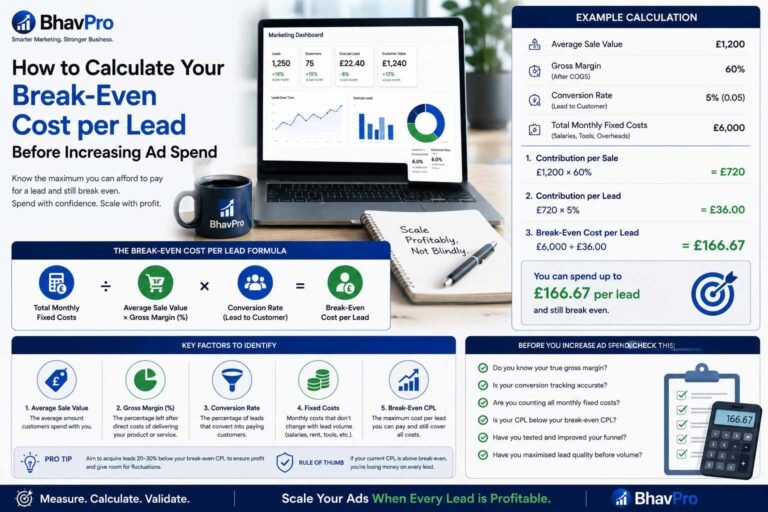
Where paid acquisition is involved, diagnose the commercial ceiling separately using BhavPro’s break-even cost-per-lead guide before increasing media spend.
Stage 2Form and Contact-Action Drop-Off
Google Analytics funnel exploration can compare page views, form starts and form submissions to show where people abandon a digital lead path. Segment the funnel by form, source, device and offer so one high-performing route does not hide another broken one.
| Observed Loss | Evidence to Inspect | Possible Cause | Test |
|---|---|---|---|
| Page viewed, form not started | Scroll, CTA click, device, source and content | Weak relevance, hidden CTA or unclear next step | Align headline, CTA and buyer-stage expectation |
| Form started, not submitted | Field errors, field order, mobile interaction and exit point | Excessive friction, trust gap or technical validation | Remove unnecessary fields and test every device |
| Submit clicked, no success | Network, validation, spam control and server response | Technical failure or unclear error | Log submission and server outcome separately |
| Lead generated, wrong offer | Source content, page and selected service | Generic destination or misleading promise | Create a dedicated destination for the intent |
| Many invalid submissions | Spam, duplicate, geography and qualification fields | Weak targeting or uncontrolled form | Improve validation without blocking legitimate buyers |
BhavPro’s landing-page design service can address message continuity, form usability, trust, mobile interaction and conversion tracking where the digital contact step is the main constraint.
Stage 3Lead Capture, Integration and Tracking Loss
A success message does not prove that the lead entered the sales process. Reconcile website submissions against CRM records using a stable lead or submission identifier.
Successful submitted leads = CRM records created or updated + controlled duplicates + rejected exceptions awaiting repair.- Record the submission ID in both the website and CRM.
- Alert a named owner when the CRM write fails.
- Preserve the new enquiry as an activity when updating an existing contact.
- Separate spam, duplicate, invalid and integration-failure reasons.
- Reconcile daily or according to lead volume and commercial urgency.
Lead Routing and Ownership Loss
A lead can exist in CRM and still be operationally lost. Assignment must produce an available owner, visible queue, acceptance state and escalation when the lead remains untouched.
| Control | Required Evidence | Failure Signal |
|---|---|---|
| Assignment rule | Service, location, account, availability and priority logic | Lead assigned to wrong or inactive user |
| Owner acceptance | Assignment timestamp and accepted or rejected state | Record sits in a personal queue without acknowledgement |
| Capacity | Open leads and required activities per owner | Assignment is correct but workload is impossible |
| Escalation | Reminder and reassignment after service-level breach | No one sees unworked leads |
| Availability | Leave, working hours, territory and specialist coverage | Leads arrive when no appropriate owner is available |
| Audit | Original owner, changes and reason | Ownership changes hide the actual response delay |
HubSpot’s current lead properties include lead owner, owner-assigned date, first outreach date, time to first touch, pipeline stage and disqualification reason. Regardless of platform, retain equivalent evidence for operational diagnosis.
Stage 5Response and Follow-Up Loss
Do not use one average response time. Report median, upper percentile, percentage inside the service level and leads receiving no qualifying engagement.
| Measure | Definition | Why It Matters |
|---|---|---|
| Assignment time | Lead creation to named owner or accepted queue | Separates routing delay from seller delay |
| First qualifying engagement | Lead creation to appropriate call, conversation or response | Excludes system messages that do not progress qualification |
| Follow-up completion | Required attempts and next actions completed | Shows whether leads disappear after the first attempt |
| Unworked rate | Leads with no qualifying activity inside the agreed period | Exposes queue and ownership failure |
| Recycled or nurture rate | Leads deliberately moved to a later review route | Prevents bad timing from being treated as permanent loss |
Qualification Loss and Inconsistent Criteria
Microsoft Dynamics describes qualification as validating that a lead is a genuine sales opportunity and associating the relevant account, contact and opportunity. Leads that do not meet criteria can be disqualified while retaining an audit trail.
Fit evidence
- Service or problem match
- Location, sector and supported customer type
- Commercial value and delivery feasibility
- Authority, stakeholders and decision process
Readiness evidence
- Current impact and urgency
- Timing and next decision date
- Access to required information
- Buyer commitment to the next step
Use controlled disqualification reasons
- Outside service, geography or customer type
- No current problem or business priority
- Insufficient commercial fit
- No authority or access to decision process
- Bad timing with a specific review date
- Duplicate or existing active opportunity
- Unable to contact after the approved sequence
- Invalid, fraudulent or test submission
Proposal and Decision-Process Loss
Qualified leads can stall because the sales process has no agreed next step, decision date, stakeholders or commercial owner. Sending a proposal is not progress when the buyer has not agreed what it must evaluate.
| Evidence Before Proposal | Failure When Missing | Control |
|---|---|---|
| Defined problem and desired outcome | Proposal describes services without buyer relevance | Confirm problem, impact and success criteria |
| Scope and exclusions | Buyer compares unlike offers or expects unsupported work | Document assumptions, dependencies and boundaries |
| Decision-makers and influencers | Proposal reaches a contact without authority or internal support | Map stakeholders and approval route |
| Commercial range and feasibility | Price objection appears after extensive unpaid work | Confirm budget context and delivery constraints earlier |
| Decision criteria and date | Opportunity remains open without a real process | Agree evaluation criteria, actions and decision date |
| Follow-up commitment | Seller sends and waits indefinitely | Book the review while the proposal is issued |
Closed-Lost, No-Decision and Nurture Outcomes
Do not combine every unsuccessful opportunity under price or no response. The reason should identify whether the loss belongs to targeting, qualification, proposition, evidence, commercial terms, decision process, timing or follow-up.
| Outcome | Meaning | Required Next Action |
|---|---|---|
| Competitor selected | Buyer completed a decision and selected another option | Record differentiator, evidence and commercial reason |
| No decision | Buyer did not proceed with any option | Record internal constraint and future trigger |
| Bad timing | Need may remain but timing is unsuitable | Set specific review date and nurture responsibility |
| Commercial mismatch | Price, value, term or scope does not fit | Separate affordability from perceived value and scope |
| Technical or delivery fit | Requirement cannot be met acceptably | Record the unsupported dependency |
| Unable to contact | Approved follow-up completed without engagement | Close with evidence and permitted future route |
| Withdrawn by business | Organisation chooses not to pursue | Record capacity, risk, margin or ethical reason |
Use Attribution Paths Without Replacing CRM Evidence
Google Analytics attribution-path reporting shows recognised touchpoints before key events such as form submissions. It helps explain assisted marketing journeys, but the CRM must still record ownership, qualification, proposal and customer outcomes.
- Keep original source and latest recognised source separately.
- Retain campaign, content, referral and landing-page details.
- Use a stable lead ID across analytics, CRM and downstream systems where permitted.
- State where consent, cross-device use or offline activity limits identity.
- Reconcile platform claims against CRM-qualified and customer outcomes.
Buyer Journey Lead Dropout Diagnostic
Enter one source, offer and mature reporting period. The result identifies the earliest material loss using indicative thresholds that should be replaced with the business’s own benchmarks.
Lead Journey First-Loss Checker
Use counts that describe the same cohort. Do not compare this month’s visits with sales created from older leads.
Buyer Journey Funnel Scorecard
| Transition | Rate | Delay | Reason Evidence | Primary Owner | First Correction |
|---|---|---|---|---|---|
| Relevant visit → action start | Starts ÷ relevant visits | Session duration and time to action | Source, intent and CTA behaviour | Marketing and web | Audience, message and next-step alignment |
| Action start → lead submitted | Leads ÷ starts | Time in form or contact route | Validation and abandonment point | Web and operations | Form, mobile, trust and technical repair |
| Submitted → CRM recorded | Recorded leads ÷ successful submissions | Connector processing time | Duplicate, rejection and integration errors | CRM and IT | Stable IDs, error queue and reconciliation |
| Recorded → owner accepted | Accepted leads ÷ recorded leads | Assignment and acceptance time | Rule, capacity and availability reason | Sales operations | Routing, queue and escalation control |
| Accepted → qualifying engagement | Worked leads ÷ accepted leads | First-touch and follow-up delay | No-contact and missed-service-level reason | Sales manager | Capacity, service level and sequence completion |
| Worked → qualified | Qualified ÷ worked leads | Time to qualification decision | Fit, readiness and disqualification reason | Sales owner | Criteria, discovery and source-quality correction |
| Qualified → proposal or decision | Decision processes ÷ qualified opportunities | Time to meeting, scope or proposal | Stakeholder, scope and process gap | Opportunity owner | Mutual next step and decision process |
| Proposal → won or lost | Customers ÷ mature proposals | Decision cycle and ageing | Controlled won, lost and no-decision reasons | Commercial leader | Evidence, scope, terms and decision follow-up |
Automate the Handoffs Without Hiding the Decisions
| Automation | Safe Responsibility | Required Control |
|---|---|---|
| Validation | Check required fields, formats, service and location | Do not silently discard uncertain records |
| Deduplication | Match and associate a new enquiry with an existing record | Preserve the new event and route conflicts |
| Assignment | Route by agreed service, geography, account and availability | Monitor acceptance and capacity |
| Notification | Alert owner and escalate overdue leads | Notification must not replace ownership |
| Nurture | Send permitted, relevant information according to stage | Respect preferences and stop conditions |
| Status monitoring | Identify ageing, missing actions and inconsistent fields | Named manager reviews exceptions |
| Reporting | Calculate adjacent-stage rates and time in stage | Definitions and cohorts remain consistent |
When the broken stages and ownership are understood, BhavPro’s sales funnel consulting service can help redesign lead magnets, landing pages, routing, nurture, CRM stages, sales handoffs and measurement as one operating system.
Define
Agree stages, event meaning, cohorts, owners and success conditions.
Connect
Link website, form, CRM, communication, proposal and outcome IDs.
Reconcile
Resolve missing submissions, duplicates, rejected records and owner gaps.
Measure
Calculate adjacent conversion, time in stage and reason completeness.
Correct
Fix the first material loss with one owned operational change.
Retest
Compare a new mature cohort and choose the next constraint.
Have leads entering the business but no reliable view of where they disappear?
BhavPro can map the journey, connect events and CRM stages, identify the first operational loss and design a controlled route from acquisition to customer outcome.
Buyer Journey and Lead Drop-Off FAQs
What does lead drop-off mean?
Lead drop-off is the loss between two defined stages of the buyer journey, such as landing-page visit to form start, submitted lead to assigned owner, qualified lead to proposal, or proposal to customer. Each drop-off needs a clear numerator, denominator and time window.
How do you find where leads are being lost?
Create one event-level record for each lead and timestamp every stage from acquisition through customer outcome. Calculate the transition rate between adjacent stages, review time spent in each stage and inspect the recorded reason for every disqualification, delay and lost decision.
What is the first material loss principle?
It means correcting the earliest stage with a commercially meaningful loss before optimising later stages. A weak form should be fixed before changing proposals, while a routing failure should be fixed before generating more traffic.
Should the buyer journey start with website traffic?
Start with the earliest measurable commercial audience relevant to the question. This may be ad clicks, qualified sessions, event attendees, referral introductions, phone enquiries or form views. Do not combine unrelated sources when their intent and process differ.
How should form abandonment be measured?
Track destination view, form view, form start, validation error and successful lead submission. Compare the same form, device, traffic source and period. Google Analytics supports funnel exploration using page and form events to identify the stages where users abandon.
Why do submitted leads disappear before sales follow-up?
Common causes include failed integrations, duplicate suppression, spam filtering, unowned inboxes, incorrect assignment rules, missing required fields, permissions, unavailable staff and workflows that create a record without notifying or accepting an owner.
How should lead response time be measured?
Measure from verified lead creation to first appropriate human or approved automated engagement. Also track owner-assignment time, median response, worst-case response, percentage within the service level and leads that received no qualifying engagement.
What is the difference between a lead and a qualified lead?
A lead has supplied information or expressed interest. A qualified lead meets the organisation's agreed fit and purchase criteria and is suitable for a defined sales process. The criteria should be explicit and disqualification should preserve an audit trail.
Why do qualified leads fail to receive proposals?
The opportunity may lack a clear next step, decision process, required evidence, internal technical input, pricing authority, scope or owner capacity. Some leads were marked qualified too early and should have remained in discovery or nurture.
Why do proposals fail to become sales?
Possible causes include weak problem evidence, unclear scope, poor commercial fit, missing decision-makers, unresolved risk, slow follow-up, no decision date, competitor advantage, budget change or a proposal delivered before the buyer was ready.
How should lost reasons be recorded?
Use a controlled primary reason, optional secondary reason, evidence note, decision date and owner. Separate no decision, bad timing, no response, competitor, price, scope, authority, trust, technical fit and business-priority changes rather than using a generic lost label.
Can attribution show the whole buyer journey?
Attribution can show recognised marketing touchpoints before a key event, but it does not replace CRM stages, sales activity and customer evidence. Use analytics paths, lead-source data and opportunity history together and state where identity or consent limitations create gaps.
What should be automated in a lead funnel?
Automate deterministic tasks such as validation, deduplication, assignment, notifications, reminders, status checks and approved nurture. Keep qualification judgement, consequential decisions and exceptions under named human ownership unless a controlled alternative has been properly tested.
When should a business generate more leads?
Increase acquisition only when tracking is reliable, the current audience and offer are relevant, submitted leads reach a named owner, response and follow-up service levels hold, qualification reasons are consistent and additional sales capacity exists.
Executive Decision Summary
- Define every stage as an event. Use stable IDs, timestamps, owners, sources and controlled reasons.
- Calculate adjacent-stage rates. Do not diagnose the journey from one overall lead-to-sale percentage.
- Reconcile submissions and CRM records. A form success is not a lead until the sales system contains an owned record.
- Separate routing from response. Measure assignment, acceptance, first qualifying engagement and follow-up completion.
- Record qualification and loss reasons. Preserve an audit trail instead of relying on generic lost or no-response labels.
- Fix the first material loss. Retest before adding traffic, automation or later-stage sales activity.
Find the First Broken Handoff Before Building a Larger Funnel
BhavPro can help connect acquisition, landing pages, CRM, response, qualification and sales evidence so improvements are directed at the stage causing the loss.
Official Sources Used in This Guide
The references below support the funnel exploration, lead-event, attribution, qualification, stage, ownership, response and direct-marketing guidance used throughout this page.
- Google Analytics — Funnel Exploration explains visualising user steps and identifying where users succeed or fail.
- Google Analytics — Report on a Lead Generation Form provides a funnel model for page views, form starts and submissions.
- Google Analytics — Recommended Lead-Generation Events defines generated, working, qualified, disqualified, converted and unconverted lead events.
- Google Analytics — Key Event Attribution Paths shows recognised touchpoints before form submissions and other key events.
- Microsoft Learn — Qualify and Convert a Lead explains qualification, opportunity creation, disqualification and audit history.
- HubSpot Knowledge Base — Default Lead Properties documents owner, assignment, first outreach, time to first touch, stage, source and disqualification fields.
- HubSpot Knowledge Base — Lifecycle Stages explains using stages and lead statuses to represent the marketing and sales process.
- Information Commissioner’s Office — Collect Information and Generate Leads explains transparency and data-protection duties when collecting information for direct marketing.
- ICO — Business-to-Business Marketing explains how UK GDPR and PECR may apply to business-contact marketing.