
AEO vs GEO vs LLMO: Quick Answer
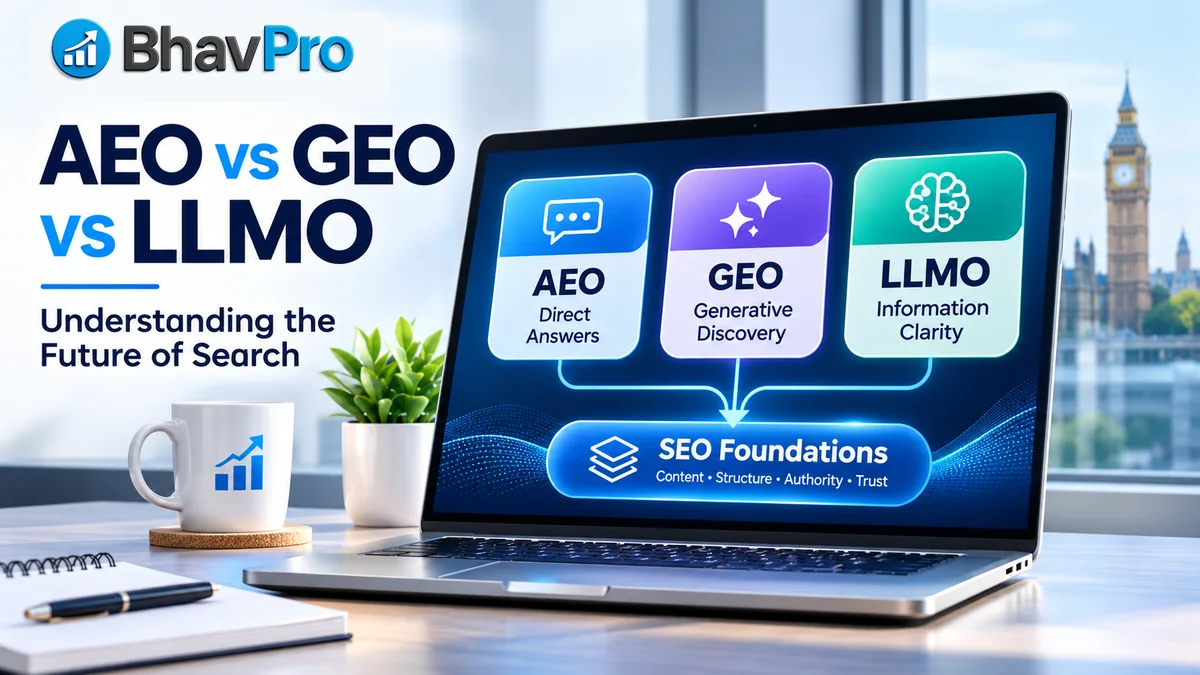
Answer Engine Optimisation (AEO) focuses on clear, direct answers to questions. Generative Engine Optimisation (GEO) focuses on visibility within generative search responses. Large Language Model Optimisation (LLMO) is a less standardised term for improving information representation in language-model-powered applications. All three overlap with traditional SEO and share foundations in accessible content, accurate facts and reliable evidence.
Search discovery now includes conventional search results, featured snippets and generated responses, including Google AI Overviews and AI Mode, ChatGPT Search and other assistants with web retrieval. Each interface works differently. The same business may be discovered through a search result, described in an answer, or considered in an AI-generated comparison.
For UK businesses, the practical question is which work helps customers find accurate information and make a decision. This guide compares the approaches, explains their limits and shows how to choose an appropriate scope without paying twice for the same work.
SEO vs AEO vs GEO vs LLMO: Comparison
Use this matrix as a planning framework, not a set of official ranking systems. In particular, GEO and LLMO have overlapping industry definitions.
| Dimension | SEO | AEO | GEO | LLMO |
|---|---|---|---|---|
| Full Name | Search Engine Optimisation | Answer Engine Optimisation | Generative Engine Optimisation | Large Language Model Optimisation |
| Main Goal | Relevant search discovery | Useful direct answers | Visibility in generative responses | Accurate information representation |
| Buyer Task | Find a relevant page or supplier | Get an answer to a question | Research or compare options | Understand facts or relationships through an AI application |
| Typical Work | Accessible pages, intent mapping, useful content and links | Clear definitions, answer-first sections and supporting detail | Useful comparisons, evidence, source clarity and retrieval accessibility | Consistent company facts, clear service descriptions and verifiable relationships |
| Measure | Impressions, clicks and conversions | Observed answer appearances and relevant engagement | Sampled mentions, citations, recommendations and referrals | Sampled factual accuracy and consistency |
| Do Not Assume | Ranking equals revenue | FAQ markup guarantees answers | Every platform uses the same ranking factors | Editing a website directly retrains an existing model |
The differences are matters of emphasis. A well-written page can support several approaches at once. A separate page is only useful when it answers a genuinely different reader task.
What Is Answer Engine Optimisation (AEO)?
AEO focuses on making information clear enough to answer a particular question. Start with what the user needs to know, then explain relevant conditions, exceptions and practical next steps. It may support discovery in conventional featured answers and AI-powered interfaces; no format guarantees selection.
What Work Does AEO Involve?
- Identify questions from customer enquiries, search data and the buying journey.
- Put a useful answer near the relevant heading, without forcing a fixed word count.
- Support it with definitions, examples, calculations or steps where they help.
- Keep the answer visible, accurate and accessible; use appropriate structured data only when it describes the content.
For example, a cloud phone system provider could explain that a cloud phone system uses a remotely hosted calling platform and internet connectivity. It should then describe compatible devices, call routing and resilience requirements. A short definition alone would not answer every purchasing question.
Ask someone unfamiliar with the topic to find the answer and explain any important limitation. Check the visible page against the underlying service facts. Record the completed content changes, not a promised featured snippet.
What Is Generative Engine Optimisation (GEO)?
GEO is used to describe work intended to improve visibility in generative information-discovery systems. A generated answer can combine information from several sources, and may mention a business, link to its site or neither. A mention is not necessarily a recommendation; a citation is not a conversion.
The academic paper GEO: Generative Engine Optimization (Aggarwal et al., KDD 2024) studied visibility in an experimental generative-engine benchmark. Its results are specific to the tested setup and do not establish universal rules for today’s commercial platforms.
What Work Does GEO Involve?
- Review representative buyer questions and examine the sources used in available responses.
- Publish material that adds useful context, such as selection criteria, worked examples and limitations.
- Support meaningful claims with reliable evidence and maintain current information.
- Make important source pages easy to discover and navigate.
- Record mentions and links separately under documented testing conditions.
A buyer asking which cloud phone system suits a 20-person UK business needs a comparison of requirements, connectivity, routing, support, migration and total cost. A useful guide completes that decision task instead of simply repeating a commercial keyword.
Check that the guide contains decision criteria, evidence and explicit limitations. Compare sampled responses before and after approved changes, but do not infer causation from a single citation or absence.
What Is Large Language Model Optimisation (LLMO)?
LLMO is a broad industry label, not a universally agreed web optimisation standard. In this guide it refers to improving the clarity and accuracy of business information that language-model-powered applications may access. It overlaps with GEO, entity SEO and conventional information quality work.
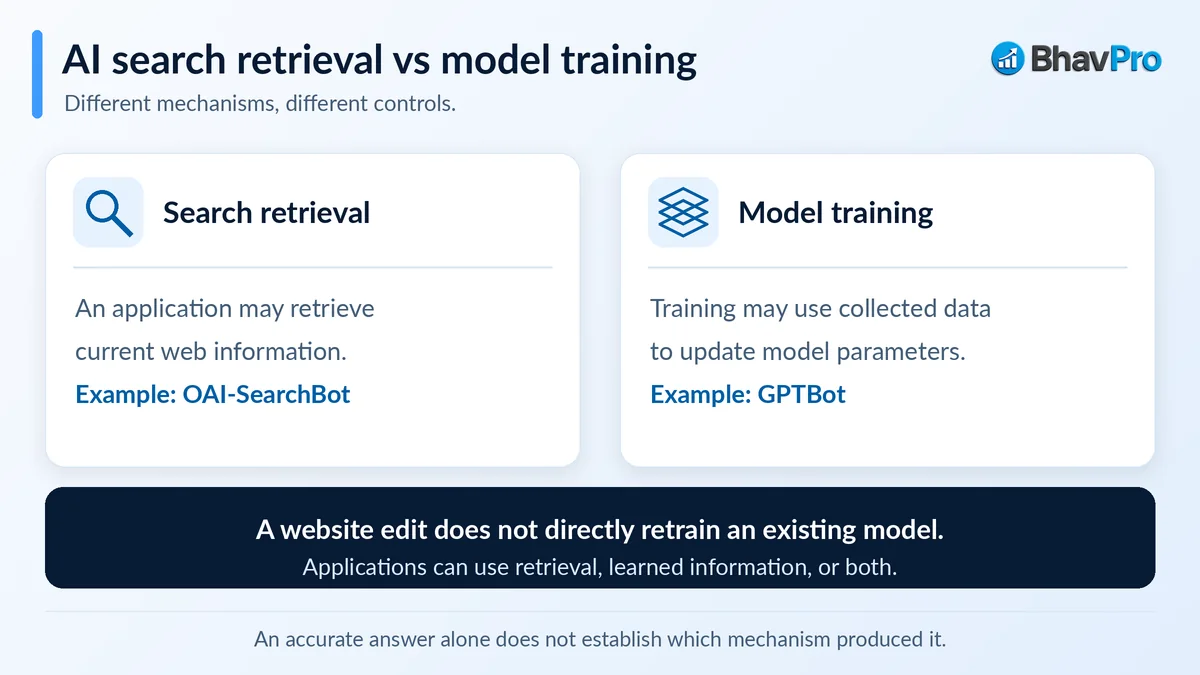
Search Retrieval and Model Training Are Different
An application may use a model’s learned parameters, retrieve fresh information, or do both. A website edit does not directly update the weights of an existing model. Nor does an accurate answer establish which mechanism produced it.
For a concrete example, OpenAI’s crawler documentation distinguishes OAI-SearchBot for ChatGPT search, GPTBot for potential model training, and ChatGPT-User for certain user-initiated visits. A website owner can allow OAI-SearchBot while disallowing GPTBot; search access and training permissions are separate decisions. Other providers have their own controls.
What Work Does LLMO-Related Optimisation Involve?
- Verify the business name, actual services, geographical scope and contact information against authoritative records.
- Make service relationships and limitations explicit in ordinary readable text.
- Resolve inconsistencies across owned pages and relevant external profiles where you have control.
- Use accurate Schema.org types and properties (for example, Organization or Person where appropriate) to describe visible facts, not to invent authority or outcomes. Markup is not proof that a language model has consumed or understood a fact.
- Review factual statements in sampled AI responses against the verified source of truth.
Create a fact register with the correct statement, source URL and review date. Check that company and service pages agree. Record any remaining inaccurate AI output without claiming that a schema edit will correct it.
Are AEO, GEO and LLMO All SEO?
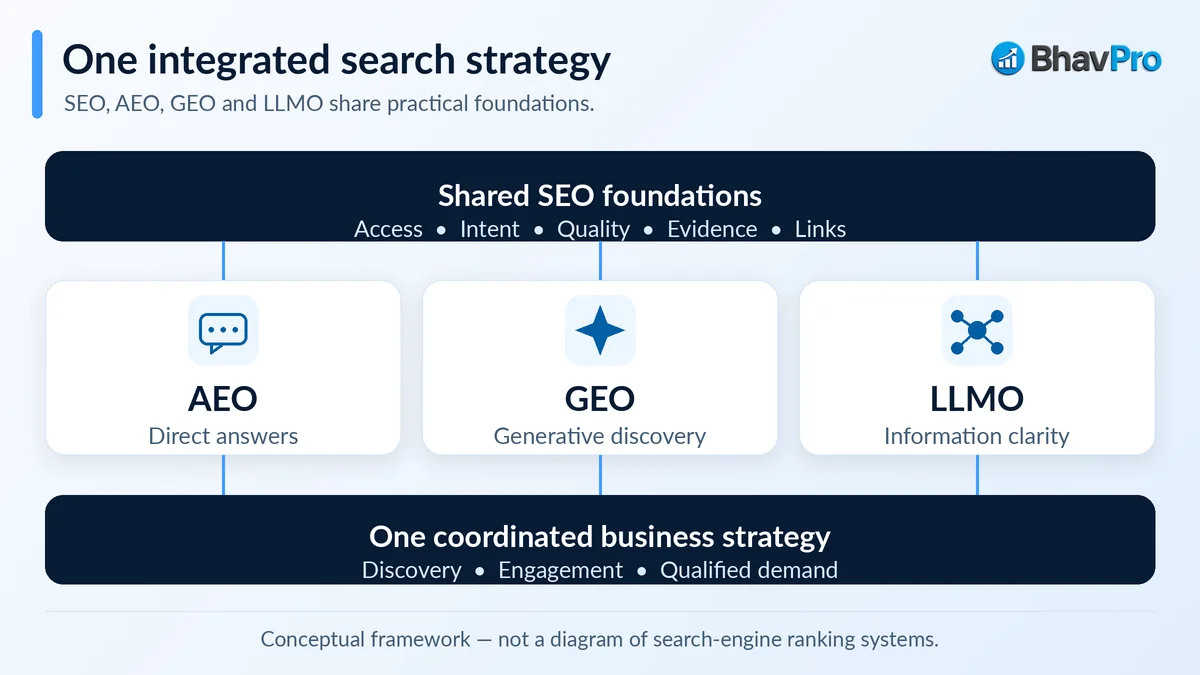
Many of their practical activities belong within established SEO, content strategy and information governance. The additional focus is on answer-led discovery, generated responses and accurate representation in AI interfaces. Businesses do not need to duplicate the underlying work merely because the terminology differs.
Access · intent · quality · evidence · links
Discovery · engagement · qualified demand
This is a conceptual framework, not a diagram of how every search engine operates. Google Search Central’s guidance on AI features explains that established SEO practices remain relevant to its AI Overviews and AI Mode, and that no additional special optimisation or schema is required for eligibility. Its generative AI optimisation guidance also explains that Google Search does not require llms.txt files or artificial content chunking. These are Google-specific conclusions; other applications may have different requirements.
| Shared Foundation | Practical Decision |
|---|---|
| Technical Eligibility | Confirm important pages can be accessed and are eligible for the intended discovery system. |
| Intent and Content | Assign one principal user task to each page; do not create duplicate acronym-specific pages. |
| Entity Consistency | Describe the same organisation and services accurately across relevant pages. |
| Evidence and Authorship | Make material claims verifiable; identify genuine expertise and sources. |
| Internal Links | Guide users to the correct related page rather than repeating everything. |
| Measurement | Use the same agreed baseline and distinguish visibility from business outcomes. |
For the technical detail, read how Google selects content for search results and AI answers. For broader commercial implementation, compare the scope of AI SEO, AEO and GEO services with your existing SEO work.
What Can Businesses Actually Control?
A useful strategy distinguishes changes the website owner can make from observations that depend on external systems. This avoids paying for guarantees a supplier cannot substantiate.
| Degree of Control | Examples | How to Evaluate |
|---|---|---|
| Direct Control | Owned content, internal links, published business facts, technical settings and conversion paths. | Review approved changes and test them. |
| Partial Influence | External references, accurate independent listings and genuine reputation. | Check the quality and accuracy of relevant sources; respect independent editorial control. |
| Outside Direct Control | Rankings, model training schedules, generated answers, source selection and citations. | Observe and document outcomes; no guaranteed position or inclusion. |
Google also documents controls for generative AI use. Review the available Search Console settings alongside crawling and snippet controls, and distinguish search inclusion from model-training permissions. Assess the potential effect on discovery before changing any settings. Treat a technical defect as a finding when there is evidence for it. If a competitor appears in an AI response and your business does not, this is an observation, not proof of a particular missing ranking signal.
One UK Business, Four Search Approaches
Consider a hypothetical UK communications supplier offering hosted telephony, CRM integration and migration support. The table illustrates how one coordinated website strategy could serve distinct buyer questions.
| Buyer Question | Useful Page or Answer | Emphasis |
|---|---|---|
| Business Phone Systems UK | A commercial service page that describes actual scope, requirements and next steps. | SEO |
| What Is a Cloud Phone System? | A direct definition followed by important practical constraints. | AEO |
| Which Phone System Suits a UK Firm with 20 Employees? | A requirements-led buying guide comparing alternatives, costs and migration risks. | GEO |
| Does This Supplier Offer CRM Integration and Migration? | Verified service descriptions, integrations and delivery responsibilities. | LLMO-related information clarity |
From Generic Claims to Decision-Useful Detail
Before: We provide innovative communications solutions.
After: An assessment reviews user numbers, call flows, broadband suitability, existing telephone numbers, CRM integration requirements and migration constraints before selecting an approach.
The improved statement is more useful because it identifies concrete considerations that a buyer can discuss with a supplier. The example is hypothetical; it is not an AI search experiment, a client case study or a claim about observed rankings.
Which Approach Should Your Business Prioritise?
Start with the business problem, rather than the acronym. For a UK SME with a limited budget, a confirmed accessibility or service-page problem may be more important than a new monitoring subscription. An established B2B or SaaS business may have a different priority: improving the evidence available during complex supplier research.
| Observed Problem | Evidence to Collect | First Activity |
|---|---|---|
| Important Pages Are Not Indexed | URL inspection, robots directives, HTTP status and canonical selection. | Technical SEO diagnosis. |
| Customers Cannot Find Clear Answers | Actual sales questions, customer feedback and content review. | Answer-first content improvements. |
| Competitors Appear in Sampled AI Comparisons | Prompts, dates, named suppliers and cited sources. | Generative search assessment. |
| An Assistant Misstates Your Services | Exact statement and verified authoritative facts. | Entity and factual consistency review. |
| No Measurable Improvement in Enquiries | Analytics, CRM records and landing-page data. | Conversion and attribution review. |
| Overlapping Agency Proposals | Written scope, outputs and exclusions. | Combine duplicated work and agree acceptance criteria. |
Interactive AI Search Priorities
Select the problems you experience to identify relevant review areas. No data is submitted or stored.
No problems selected. Use the recommendations below as a reference.
Inspect page eligibility, canonical URLs, access and internal navigation. Fix confirmed defects first.
Review genuine questions against existing pages and write accurate answers with supporting context.
Record representative prompts and cited sources. Investigate gaps in relevant information without assuming a cause.
Compare the claims with verified facts, correct inconsistencies on owned pages and monitor factual accuracy.
Agree a repeatable prompt sample and record mentions, recommendations, citations and referrals separately.
Check landing-page relevance, lead handling, CTA clarity and attributable commercial outcomes.
This decision aid is a self-assessment, not a technical audit, AI visibility score or prediction of rankings. Selections remain in this page; no data is submitted.
Where technical foundations need review, BhavPro’s website SEO analyzer can be a starting point. Its output should be interpreted within the scope of the tool rather than as a prediction of AI recommendations.
How to Avoid Paying Twice for Overlapping SEO, AEO and GEO Work
When comparing SEO, AEO, GEO and LLMO, separate shared work from genuinely additional activities. A crawl review, fact correction or content refresh can support several approaches, so scope it once. Additional work, such as sampling AI answers or reviewing cited sources, can be assessed separately when it addresses a distinct need.
| Work Area | Work to Scope Once | Acceptance Test |
|---|---|---|
| Technical SEO | Documented access, indexing and rendering assessment. | Recheck agreed issues and record unresolved dependencies. |
| AEO | Reviewed question and answer content. | Verify factual accuracy and usability against the buyer question. |
| GEO | Prompt baseline, source review and relevant content recommendations. | Record sample conditions and distinguish observations from hypotheses. |
| Entity Review | Verified business fact register and correction plan. | Check approved facts against owned public content. |
| Content and Links | Documented changes mapped to page intent. | Review originality, links, accuracy and preservation of existing useful content. |
| Reporting | Repeatable visibility measurements and qualified lead reporting where available. | Compare equivalent periods or samples; explain attribution limitations. |
Compare the activities and their acceptance tests, not the number of acronyms in a proposal. Completing the work is not the same as achieving a ranking, mention or sale.
How Success Metrics Differ Between SEO, AEO, GEO and LLMO
Traditional SEO, direct-answer optimisation, generative visibility and information accuracy need different evidence. Search impressions and clicks cannot be substituted for AI mentions or citations. For Google, the dedicated generative AI performance reports in Search Console provide a separate view of impressions within generative Search and Discover features. Those impressions are already included in overall performance; do not add the totals together. Use the report’s available page, country, date and device dimensions where supported. For other platforms, compare equivalent questions and conditions, recording the platform and date; small samples are not market-wide rankings.
| Metric | Definition and Use |
|---|---|
| Search Visibility | Relevant search impressions and clicks; review query-to-page ownership. |
| Google Generative AI Visibility | Impressions in the dedicated Search Console report. Compare relevant pages and periods; do not interpret impressions as clicks, citations or enquiries. |
| Answer Visibility | Observed presence in relevant answer formats within a defined sample. |
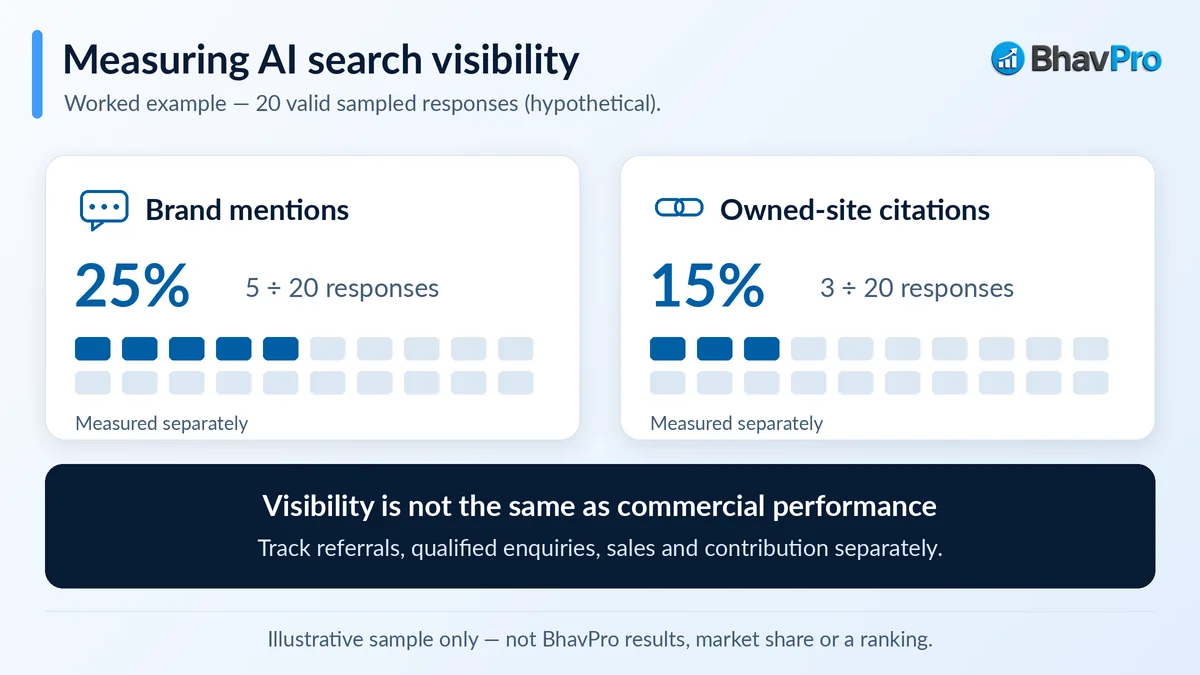
| Brand Mention Rate | Responses mentioning the brand ÷ all valid sampled responses. |
| Owned-Site Citation Rate | Responses linking to the owned website ÷ all valid sampled responses. |
| Factual Accuracy | Correct verifiable statements ÷ all reviewed verifiable statements; separately record unknown claims. |
| Commercial Engagement | Identifiable referral traffic, relevant landing-page engagement and qualified enquiries. |
| Commercial Value | Qualified leads and attributable financial contribution; assess separately from visibility. |
Suppose 20 valid responses are collected under a defined sampling protocol. Five mention the business and three link to its website. The observed mention rate is 25% and the citation rate is 15%. Repeat the same buyer questions on each selected platform, recording the date, language and model or search mode where displayed. Keep the denominator consistent and report failed or unavailable responses separately. These are hypothetical sample rates, not BhavPro results, market share or a stable platform ranking.
A mention without a click may still affect awareness, but its financial impact cannot be inferred reliably from that observation alone. Separate visibility metrics from CRM-qualified leads, sales and contribution.
When planning your investment in organic search, use our SEO ROI Calculator to estimate potential financial returns based on your business assumptions. Evaluate these scenarios against commercial objectives, not rankings, traffic or AI-generated mentions alone. Estimated SEO returns are not a measurement of the incremental impact of AI visibility.
Frequently Asked Questions
Does GEO Replace Traditional SEO?
No. Useful accessible content and established SEO practices remain important, including for Google’s generative features. GEO adds a focus on discovery and sources within generated responses.
Is LLMO the Same as GEO?
The terms overlap and are not uniformly defined. GEO typically emphasises generative discovery; LLMO is often used for information representation in LLM-powered applications. The same tasks may serve both.
Do I Need Separate AEO, GEO and LLMO Packages?
Not automatically. Compare the written scope, specific deliverables and underlying business problems. One coordinated programme may cover overlapping work.
Does Schema Guarantee AI Citations?
No. Structured data can describe visible facts and relationships, but it does not guarantee citation or accurate AI representation. Google does not require special AI schema for its generative search features.
Will Allowing a Training Crawler Make My Site Appear in AI Search?
Not necessarily. Some providers distinguish training access from search discovery. Review the provider’s current documentation and the site’s own policy objectives.
Is AI SEO Only Suitable for Large Businesses?
No. A small business can review core facts, buyer questions and technical eligibility. The appropriate scope depends on customer research behaviour, available evidence and budget.
Can One Page Support SEO, AEO, GEO and LLMO?
Yes, when the page serves one clear user task and contains accessible, accurate, useful information. A product comparison or service-question guide can support conventional discovery, direct answers and generative research without separate duplicate pages.
Choosing an Integrated Search Optimisation Strategy
Use the comparison and decision assessment above to choose the work that addresses your actual buyer questions. Fix confirmed foundational problems first, then add answer-led, generative-discovery or entity-related activities where there is a clear need. Protect useful existing content rather than creating separate pages for each acronym.
Where conventional search fundamentals need improvement, professional SEO services may be the appropriate starting point. If several approaches need to work together, review the scope of an integrated search strategy rather than buying overlapping packages.
Build a Coordinated AI Search Strategy
Explore the service scope, approach and available engagement options for UK businesses.
Explore BhavPro’s AI SEO ApproachSources and Methodology
This guide uses official platform documentation for technical claims, academic research for the origin of the GEO research framework, and clearly labelled illustrative business examples for practical decision-making. The comparison terminology and evidence-to-action framework are editorial interpretations. No first-party multi-platform experiment or ranking improvement is claimed.
- Google Search Central — AI features and your website — Google-specific eligibility and established SEO practices.
- Google Search Central — Generative AI optimisation guide — established practices and unsupported optimisation tactics.
- Google Search Central — Generative AI controls — settings and policy boundaries.
- Google Search Central — Generative AI performance reports — reporting scope and impression metrics.
- OpenAI — Overview of OpenAI crawlers — distinct crawler roles and controls.
- Aggarwal et al. — GEO: Generative Engine Optimization — research benchmark, revised 28 June 2024, accepted at KDD 2024.
References reviewed 26 November 2026. Provider behaviour and documentation can change; review the relevant policy before making technical changes.
Important limitation: Platform results vary. No optimisation technique guarantees inclusion, rankings, citations, recommendations or business outcomes.
Executive Insight
- SEO remains foundational: improve access, usefulness, facts and intent.
- AEO, GEO and LLMO overlap: prioritise specific activities, not labels.
- Measure the evidence: distinguish completed work, sampled visibility and qualified demand.
- Protect existing value: improve the right page before creating more content.
About This Guide and BhavPro
BhavPro is a UK-focused consultancy covering digital growth and business technology. This guide is designed to help businesses choose useful search optimisation activities and evaluate them against evidence, without promising outcomes beyond a supplier’s control.
Learn more about BhavPro.

Bhav Giva
Founder, BhavPro · Business Technology Consultant
Bhav’s background spans telecom operations, CRM development, websites and SEO. That experience informs the guide’s emphasis on connecting search visibility with customer enquiries, operational requirements and measurable business outcomes.