
CPaaS Providers in the UK (2026): Voice and Messaging APIs
Compare six CPaaS providers for UK SMS, programmable voice and customer messaging. Examine delivery controls, sender IDs, APIs, real pricing drivers and the questions to test before integration.
On This Page — Open Contents
What Is CPaaS, and When Should a UK Business Use It?
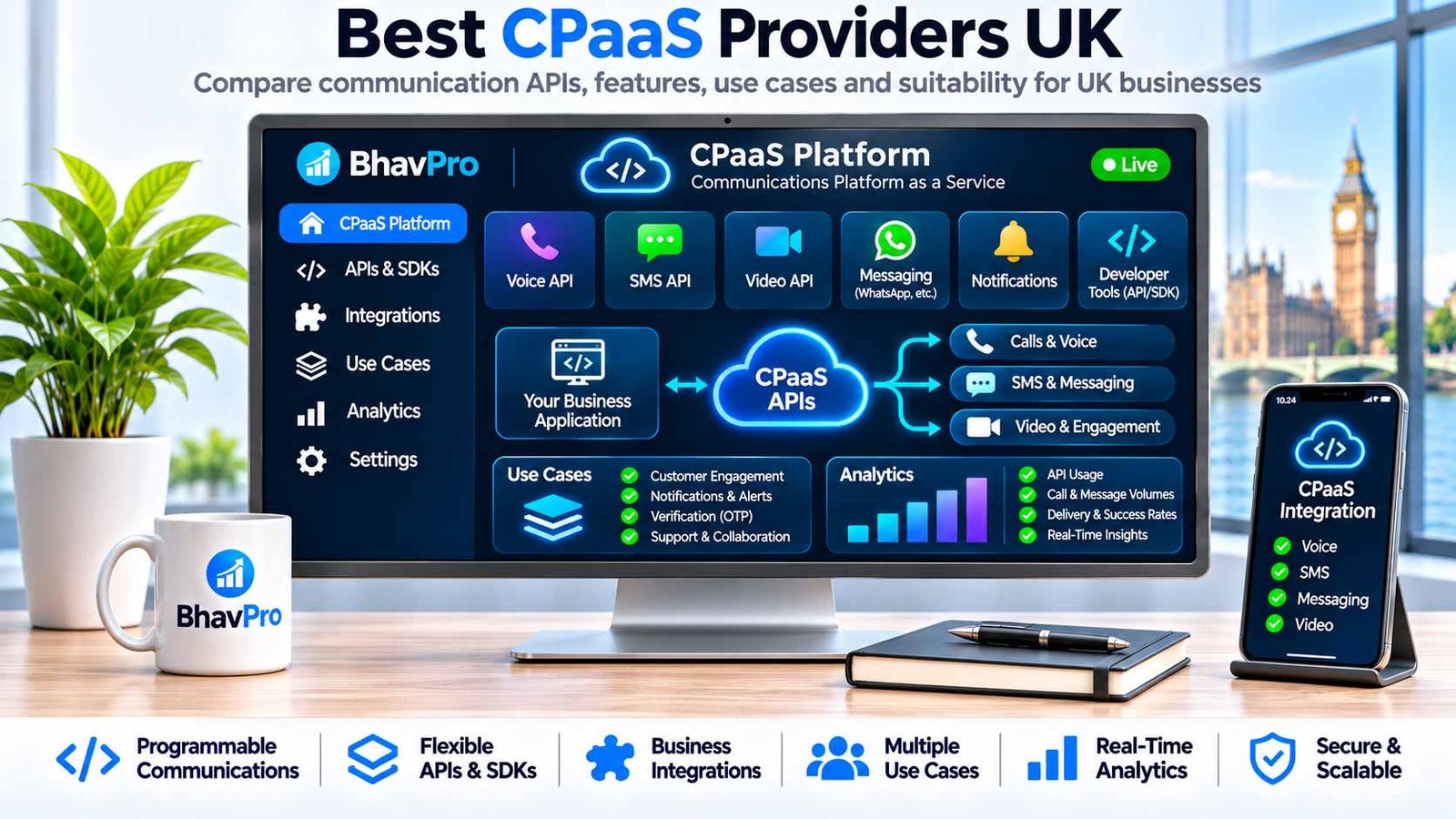
Short answer: Communications Platform as a Service (CPaaS) provides hosted APIs and supporting infrastructure for developers to add SMS, programmable voice, verification and other communications channels directly into their software. It suits businesses building communication workflows in apps or CRMs rather than buying a ready-made staff phone system.
For example, a booking platform can send a consented appointment reminder, receive its delivery status and write the result back to a CRM. A service portal might initiate a masked customer-to-driver call, or a helpdesk can trigger a verification code before updating sensitive account details. The application controls the business logic; the CPaaS provider exposes the relevant communications endpoints.
Decision in one sentence: Choose a CPaaS provider by the channels and countries you actually need, the resilience of its APIs and webhooks, your UK data/marketing requirements and the total cost of real message segments and call legs—not by a global feature list alone.
CPaaS Is Not the Same as UCaaS or CCaaS
| Model | Primary user task | Typical buyer | Key distinction |
|---|---|---|---|
| CPaaS | Embed SMS, calling, authentication and messaging into an application | Development/product/engineering | APIs, event handling, infrastructure and usage billing |
| UCaaS | Equip staff with a combined business calling and collaboration platform | IT/operations/telecoms buyer | User seats, devices, conferencing and admin |
| CCaaS | Operate agent-facing customer service queues and contact centre workflows | Contact centre leader | Agent desktop, routing, quality assurance and reporting |
| SMS marketing platform | Build or send marketing campaigns through a user interface | Marketing team | May not expose the same breadth of programmable voice and developer controls |
An organisation may combine them: a contact centre runs on CCaaS while its CRM sends SMS notifications using CPaaS APIs. This guide only compares the API layer; it is not a UCaaS or customer-service seat comparison.
Which CPaaS Use Cases Justify a Dedicated API Platform?
Define the customer journey before contacting vendors. A broad catalogue of available channels has little value if the supplier cannot support your particular UK number, sending identity or failure-handling requirement.
Practical use cases: appointment reminders with structured opt-out handling; incident alerts with an escalation path; two-way delivery updates linked to a ticket; and application-initiated calls that keep private numbers out of customer records. All need a clear owner for failures, complaints, retention and account-level permissions.
Six CPaaS Providers UK Buyers Can Shortlist
These six providers are comparative candidates, not a sponsored ranking. Each publishes communication APIs. Their real-world UK capabilities, local numbers, sender IDs, support packages and prices must be checked for your account and route before procurement.
| Provider | Documented product focus | Potential fit for | Confirm during UK pilot |
|---|---|---|---|
| Twilio | Programmable SMS/RCS and voice APIs; webhooks | Developer-led multi-channel application builds | UK number/sender eligibility, per-segment cost, webhooks and required add-ons |
| Vonage | SMS API, Messages API and communications APIs | SMS/WhatsApp journeys needing distinct API options | Messages vs legacy SMS migration, UK sender configuration, callbacks |
| Sinch | Conversation API, SMS and Voice APIs | Multi-channel messaging plus programmable calling | Product selection and regional enablement; voice v2 preview restrictions |
| Infobip | SMS/Messages APIs and Calls API | Orchestrated messaging and voice application scenarios | Activation requirements, UK routes and written support/retention terms |
| Plivo | Messaging and Voice APIs | Application-led SMS, WhatsApp and voice projects | Available UK senders, UK-number options and final route-based pricing |
| Telnyx | Messaging API and programmable Voice API | Network-aware messaging/calling architecture | UK availability, permissions, porting and billed call legs |
How to read this table: the entries identify documented product families. They do not certify equivalent channel coverage, equal deliverability, identical UK legal support, guaranteed uptime or a price advantage. Evaluate the application as a whole.
CPaaS Provider Profiles: Strengths, Trade-offs and Evidence
Twilio
Twilio publishes Programmable Messaging, voice API resources, a country-specific UK SMS pricing page and webhook signature-validation guidance.
When to evaluate: Strong candidate when a development team needs extensive API examples and event handling across messaging and voice.
UK pilot question: Validate actual UK mobile routes, sender identity rules, pricing by segment, incoming-number types and call recording choices.
Official source: Twilio Messaging API documentationVonage
Vonage documents both SMS API and a broader Messages API, including channel delivery and webhook behaviour.
When to evaluate: Consider if you need to connect SMS with supported additional messaging channels through an application layer.
UK pilot question: Ask which API is recommended for a new build, how existing SMS integrations migrate, and how UK delivery callbacks are authenticated.
Official source: Vonage Messages API documentationSinch
Sinch publishes Conversation API capabilities for messaging and separate programmable voice products; its Voice API v2 documentation identifies a public-preview status.
When to evaluate: Potential match for teams needing a unified messaging entry point with separately evaluated voice requirements.
UK pilot question: Confirm the supported production voice API version, region, channel capability, service-level terms and any account activation prerequisites.
Official source: Sinch Conversation API documentationInfobip
Infobip documents SMS and Messages APIs and a programmable Calls API for inbound/outbound scenarios.
When to evaluate: Consider for broader orchestration needs or voice use cases requiring configurable call scenarios.
UK pilot question: Obtain confirmed API access, UK route availability, number types, recording enablement and event-stream requirements.
Official source: Infobip product and communications API documentationPlivo
Plivo provides Messaging API, delivery-report concepts and a Voice API for creating, receiving and controlling calls.
When to evaluate: Potential fit for engineering teams building focused SMS/voice applications and wanting to compare route-level costs.
UK pilot question: Check UK sender/country constraints, one-way versus two-way availability, call leg charging and retry/idempotency design.
Official source: Plivo Messaging API documentationTelnyx
Telnyx publishes SMS and voice API product documentation with call-control and message-reporting features.
When to evaluate: Consider for systems where voice call control, messaging integration and number infrastructure must be considered together.
UK pilot question: Validate UK number support, route pricing, call event security, number portability and which features are enabled for your account.
Official source: Telnyx SMS API overviewUK SMS APIs: Delivery, Segments, Sender IDs and Two-Way Replies
Direct answer: compare SMS APIs on deliverable UK routes and sender identity first, then on delivery receipts, application retries, inbound replies, audit data and the billable segment cost of the message you actually send.
Why a Single SMS Can Cost More Than One Segment
Standard GSM-7 SMS allows up to 160 units in one message, or 153 per part when concatenated. Characters outside the GSM-7 set (including many emojis and curly quotes) generally trigger Unicode/UCS-2 billing constraints: 70 UTF-16 code units in one part or 67 per part in a concatenated message. Some GSM extension characters consume two septets. Providers may apply their own routing, encoding, length and billing policies. Twilio explains GSM-7 encoding.
| Messaging control | Minimum verification | Common failure |
|---|---|---|
| Sender ID | Is the alphanumeric sender permitted and corroborated for this exact business and UK route? | Unapproved or inconsistent identity; replies impossible to an alphanumeric name |
| Delivery status | Can delivered, failed and expired events be reconciled to an internal job ID? | Counting API acceptance as handset delivery |
| Two-way SMS | Is an inbound-capable number supported for the intended destination? | Using an outbound-only sender where replies are required |
| Retries and deduplication | Does your application prevent duplicate jobs and define retry limits? | Multiple charges or duplicate customer messages |
| Message composition | Test punctuation, Unicode, links, opt-out text and long bodies | Unexpected concatenation or filtering |
| Throughput | What account-specific limits and queue behaviour apply to your UK sender? | Rate limiting, late or out-of-order notifications |
2026 UK safeguard: Ofcom's strengthened anti-scam guidance requires relevant providers to check business senders' identities against information held about them and maintain appropriate Sender ID policies. Ask how the chosen provider supports your legitimate sender-registration and verification process. An API key is not proof of a permitted sender name.
Programmable Voice APIs: UK Numbers, Call Legs and Resilience
A programmable voice API lets an application place, receive or control a call according to business rules. Typical building blocks include telephone-number allocation, SIP connectivity, webhook-driven call instructions, speech/DTMF collection, recording controls and status events.
Application-Initiated Customer Call
Business caller ID, number rights, incoming/outgoing routes, busy conditions, call transfer, leg duration and webhook reconciliation.
A single connected conversation always equals a single billable minute. Bridged calls can create several metered legs; recording, transcription and media streaming may add charges.
Ask prospective suppliers for a written diagram of each billable leg, including UK PSTN origination and termination, minimum call billing increments, local number rental, SIP hand-off and contingency routing. Some applications must keep calls within the UK or another approved region, but do not infer residency or recording compliance from a sales page alone.
For emergency calling, distinguish a programmable API from a replacement business phone service: emergency access requirements, location handling and lawful call behaviour need their own technical and regulatory review. Never present an untested API bridge as an emergency-calling solution.
WhatsApp, RCS and Fallback: Why Channel Availability Is Not Universal
SMS, WhatsApp Business and Rich Communication Services (RCS) serve different customer interactions. WhatsApp business-initiated conversations may depend on approved templates and the applicable platform terms; RCS uses compatible handsets, registered business agents and destination availability. A vendor listing “RCS” does not prove it can deliver a specific UK campaign under your business identity.
| Channel | Suitable task | Activation/eligibility question | Fallback risk |
|---|---|---|---|
| SMS | Service notifications, authentication and broad handset reach | Sender IDs, opt-out policy, reply path, segment charging | Message encoding, route rejection or filtering |
| WhatsApp Business | Opted-in conversations with rich content | Business verification, approved templates, conversation/message pricing | No active opt-in or unavailable user/account |
| RCS for Business | Rich branded interactions where supported | Brand/agent approval, UK market activation, user/device support | App/device/carrier incompatibility |
| Voice | Urgent human conversation or workflow-specific outreach | Caller ID rights, UK number routing, human availability | Answer machine, misrouting or unavailable agent |
How Does CPaaS Pricing Work for UK Businesses?
There is no safe universal “cost per API message” across all CPaaS offers. Suppliers may bill by message segment, destination, network, number rental, voice direction and minutes, verification attempts, conversations, AI/media add-ons, committed minimums and support levels. Currency, VAT and exchange-rate exposure can also matter.
| Cost line | How it is commonly metered | What to ask the supplier |
|---|---|---|
| Outbound SMS | Submitted or delivered segment, destination and network dependent | Charge point, retries, UK routing and sender surcharges |
| Inbound SMS | Eligible received message or number-specific rate | Inbound-capable number, per-message fee and reply handling |
| Programmable voice | Connected minute or partial minute, by call leg and route | Per-leg charges, rounding, connections, transfers and international legs |
| Phone numbers | Monthly rental, setup or portability fees | Local number rights, contract, port-out and 2-way capability |
| Verification/identity | Attempt, successful check or API request depending on product | Fraud protection, resend policies and charge triggers |
| Other channels | Channel-specific categories, templates or conversations | WhatsApp/RCS pricing, platform pass-throughs, eligibility |
| Operations | Support tier, storage, recording, hosting, onboarding | SLA, data retention, minimum commits and incident reporting |
For comparable quotes, provide the same destination mix, message text, traffic peaks, call-leg topology, sender type and support conditions to every supplier. Also obtain a clause explaining what happens when a route, product, network fee or exchange rate changes.
Interactive CPaaS UK SMS and Voice Cost Estimator
Use this calculator to estimate your own monthly usage and first-year operating costs. It contains no claimed supplier tariffs: enter your confirmed GBP quote for each applicable rate. The SMS segment calculator uses standard GSM-7/UCS-2 thresholds as a planning approximation, not a billing guarantee.
Try your real message text. The estimator counts SMS segments, applies your route rates and combines SMS and voice with rentals and one-off costs. Nothing is transmitted or saved.
Calculation boundaries: this model assumes a uniform message body and fixed monthly volumes. Check route-based rates, retries, per-attempt charges, minimum increments, support tiers, carrier pass-through fees, taxes and usage spikes. The browser performs all calculations locally; actual supplier bills may differ.
API Security, Webhook Verification and Data Governance
CPaaS reliability depends as much on your own software as on the network. An API request can succeed even when the recipient never receives a message. Treat the HTTP submission, provider acceptance, carrier delivery and customer outcome as different events.
Send, Observe, Reconcile and Escalate
Store secrets server-side; use least-privilege keys, signature verification, strict HTTPS, rate limits, dead-letter queues, correlation IDs and audit logs.
Minimise payloads and retention. Identify controller/processor roles, country transfers, recording access, rights requests and incident notifications before go-live.
Use the supplier's current supported webhook-signature validation library, rather than merely checking a source IP or trusting unsigned requests. Review key rotation, replay protection, event ordering, unexpected extra fields and redelivery after non-2xx responses. Test with intentionally invalid signatures and duplicated webhook IDs.
For OTP and account recovery, mitigate enumeration, repeated requests, SIM-swap abuse and account takeover. SMS codes are one component of an authentication design, not a guarantee against sophisticated fraud. Evaluate an approved alternate authentication method for higher-risk accounts.
UK Compliance: PECR, Sender Identity, Recording and Data Protection
UK businesses should separate service messages from direct marketing. The ICO's PECR guidance explains when consent or the applicable soft opt-in is required for marketing texts, and how rules can differ between individual and corporate subscribers. Compliance also depends on the processing of personal data under UK GDPR.
| Risk area | Practical supplier + business test | Evidence to retain |
|---|---|---|
| Marketing text permission | Can messages be classified by purpose and sent only to eligible contacts? | Consent/soft opt-in records, preferences and suppression logs |
| Sender identity | Can the sender be verified for the declared UK organisation and brand? | Verification documentation, approved sender records, route tests |
| Opt-out handling | Can STOP and equivalent opt-out events reach the CRM quickly? | Audit trail, suppression sync and sample replies |
| Call recording and transcription | Are notices, lawful basis, access controls and retention appropriate? | Call flow, policies, security settings and deletion evidence |
| Data processing | Do data flows identify systems, subprocessors, transfers and retention? | DPA, subprocessor list, transfer assessment and security schedule |
| Incident response | Who owns fraud alerts, failed services and breach notification? | Supplier contacts, escalation timings, security agreement |
Relevant official guidance: ICO electronic mail marketing; Ofcom's 2026 anti-scam messaging guidance; NCSC business SMS best practice.
16-Point CPaaS Provider Pilot and Acceptance Checklist
Complete these tests against a real supplier pilot, not a sales demonstration. Failures and unavailable functions need documented owners and a written go/no-go decision.
Mark Pass, Fail, Not Available or Not Tested. This checklist stays on your device; no answers are sent to BhavPro.
Export includes the test, current status and expected verification. Do not upload sensitive account IDs or customer phone numbers into this public tool; it stores none.
How to Select a CPaaS Provider: a Six-Step UK Procurement Method
- Define the exact workflow: channel, application, UK audience, user consent, sender, emergency handling exclusions and desired outcome.
- Map routes and events: destinations, carrier/network availability, inbound replies, call legs, delivery status and every required failure state.
- Request like-for-like pricing: give suppliers one traffic profile and ask for written per-segment, per-leg, monthly, onboarding and support charges.
- Run the pilot: test real supported UK numbers and devices with duplicate webhooks, low balance, invalid recipient, timeouts and Unicode content.
- Review contract and security: DPA, use restrictions, service levels, portability, incident notices, auditability, data location and subprocessor controls.
- Document exit and rollback: test number port-out or reassignment, template recovery, message queue handling, API-key revocation and a secondary communication route.
- Which UK mobile networks and number types support our exact use case?
- How do you validate sender identity and handle failed delivery or suspected fraud?
- Which product features need manual approval, extra contracts or region-specific activation?
- Can we export events, recordings and sender settings before termination?
- What limits and prices apply during a traffic spike or a failover to another channel?
- What is the documented incident escalation and the realistic termination process?
CPaaS Providers UK — Frequently Asked Questions
What is the best CPaaS provider in the UK?
There is no single provider that is best for all UK applications. Compare the documented API features with your specific UK routing, channel eligibility, security, cost, resilience and support requirements, then test the shortlist.
Do UK businesses need a developer to use CPaaS?
Many CPaaS projects use developer-facing APIs and webhooks, although some suppliers offer low-code tools. A robust production integration still needs ownership of data flows, credentials, errors and support.
Is CPaaS the same as business VoIP or UCaaS?
No. CPaaS provides programmable communication building blocks. UCaaS generally gives employees a complete calling and collaboration service; business VoIP can be either an end-user service or part of the infrastructure.
Is WhatsApp or RCS included with every SMS API?
No. These are separate channels with additional activation, business identity, template, eligibility and pricing requirements. Confirm specific UK support.
Why does my SMS invoice count more segments than messages?
Long texts, GSM extension characters and Unicode can increase the number of billable SMS segments. Send the exact sample message and reconcile the account invoice before forecasting.
Can an alphanumeric Sender ID receive SMS replies?
Typically no. A named sender is not itself a reply-capable mobile number. A dedicated inbound-capable number may be needed for two-way messaging.
How do I choose between Twilio, Vonage, Sinch, Infobip, Plivo and Telnyx?
Use one written requirements matrix and test equivalent UK destinations. Evaluate current documented functionality, quotes, delivery evidence, operational support and exit rights rather than relying on one advertised starting tariff.
Can CPaaS integrate with an existing CRM or WordPress website?
Usually, provided the systems support an appropriate integration. Use server-side credentials, verified webhook endpoints, user permissions and a clear mapping between communications events and customer records.
Are automated appointment reminders subject to marketing consent rules?
Genuine administrative service reminders are different from direct marketing. If a message promotes products or services, PECR marketing rules can apply. Assess the content and recipient relationship instead of assuming all automated texts are exempt.
What should a UK business test before moving SMS numbers or voice traffic?
Test number rights, porting/transfer capability, caller ID, inbound routing, delivery receipts, opt-out suppression, security, resilience, billing, support escalation and rollback.
Do APIs guarantee message delivery?
No. An API submission response, a supplier-accepted event and a carrier/handset delivery event can represent different stages. Model failed, delayed and unknown outcomes.
Does the calculator show official provider prices?
No. The calculator uses a basic model and user-entered GBP rates. Obtain account-specific UK tariffs and add any excluded number, verification, channel, taxes and support charges.
Which CPaaS Provider Should You Shortlist?
Choose by the task, not a headline winner.
For a developer-led SMS and voice project, compare Twilio, Vonage, Plivo and Telnyx against your chosen test traffic. If broader cross-channel orchestration is central, include Sinch and Infobip. These are starting points for validation, not proof that one company is cheapest, has the best UK delivery or fits every account.
Before signing, secure a production-like UK pilot, full rate card, legal and security approval, tested event handling and a documented exit plan. If these are missing, the project is not procurement-ready.
Research Method, Official Sources and Editorial Boundaries
Method: This independent UK communications-API buying guide compares six suppliers using vendor product/developer documentation and primary UK regulator guidance reviewed on . Supplier claims are descriptions of documented capabilities, not the outcome of an independent performance test. No paid placement, affiliate ranking or quoted supplier rate is used in the comparison.
Prices, API versions, channel availability, UK route rules and product terms are subject to change. Contact suppliers for written confirmation. This guide is not a substitute for a pilot, bespoke quote, compliance assessment or legal advice.
- Twilio — Messaging API and segment handling
- Twilio — UK SMS pricing (quote/routing reference)
- Twilio — Programmable Voice API
- Vonage — Messages API
- Sinch — Conversation API
- Sinch — Voice API
- Infobip — Product and API documentation
- Infobip — Calls API
- Plivo — Messaging API
- Plivo — Voice API
- Telnyx — SMS API
- Telnyx — Voice API
- ICO — Electronic mail marketing under PECR
- Ofcom — Rules to combat messaging scams (2026)
- NCSC — Business SMS and telephone best practice
Need an Independent Review of Your UK Communications API Architecture?
If you are evaluating CPaaS for CRM-connected messaging, programmable calling or telecom SaaS workflows, BhavPro can discuss the requirements and integration decisions through its existing API Integration Services and Telecom SaaS Consulting pages.
Bring your intended destinations, sample message bodies, expected volumes, security requirements, existing phone-number arrangements and supplier quotations. Supplier selection and technical feasibility remain subject to the engagement scope and actual platform capabilities.
About the Author

Bhav Giva
Founder, BhavPro · VoIP, CRM & Business Technology Consultant
Bhav draws on more than 15 years of telecommunications, CRM and operational systems experience to frame practical integration and supplier-selection questions. This article is a documentation-based buyer guide; it does not claim hands-on benchmarking of every CPaaS provider.