
AI Consulting Services for UK Businesses
Turn AI interest into a practical business decision. BhavPro helps leadership teams define where AI can create value, which opportunities should be prioritised, how governance will work and what a controlled pilot must prove before further investment.
Launch high-impact pilots in 4–8 weeks
Safer deployments with governance & MLOps baked in
Measurable ROI across operations, customer experience, and growth
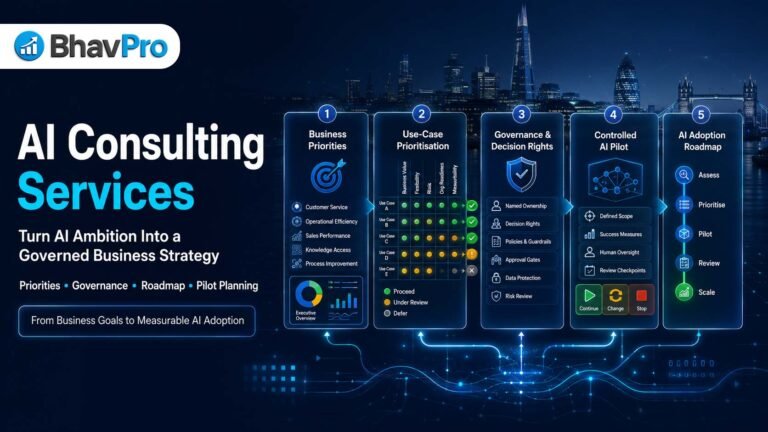
Fast answer: AI consulting helps leadership teams decide where AI should be used, which opportunities deserve investment, how risks will be governed and what should happen first. BhavPro turns business priorities into an adoption roadmap, pilot charter, decision framework and measurable success criteria before technical architecture or implementation begins across your organisation.
A Decision Framework Before Delivery
- Connect AI decisions to business priorities
- Set ownership, guardrails and review gates
- Define what a pilot must prove before scaling
When AI Consulting Is the Right Starting Point
AI consulting is appropriate when leadership needs to decide what AI should mean for the organisation. It provides direction before technical architecture, software selection or implementation begins.
Priorities Are Unclear
Several teams have ideas, but there is no shared method for deciding which opportunities support business goals and deserve investment.
Governance Needs Direction
Leaders need clear decision rights, approved-use boundaries, human accountability and a practical route for reviewing risk.
A Pilot Needs a Business Case
A proposed use case needs measurable outcomes, scope limits, ownership, acceptance criteria and a decision gate before money is committed.
Begin with an AI Business Systems Audit when processes, data problems and opportunities have not yet been diagnosed. Consulting begins when leadership needs a strategic direction and adoption plan.
What AI Consulting Delivers
The engagement converts broad AI ambition into decisions that leadership, operational owners and delivery teams can use. The depth of each output is matched to the organisation’s size, risk and decision stage.
AI Adoption Position
A concise statement of where AI can support business priorities, where it should not be used and which principles should guide decisions.
Use-Case Portfolio
A prioritised view of opportunities assessed against value, feasibility, risk, evidence requirements and organisational readiness.
Decision and Accountability Model
Named owners, approval routes, prohibited uses, human-review requirements and escalation paths for responsible adoption.
Sequenced Adoption Plan
Near-term actions, dependencies, owners and decision gates arranged in a realistic sequence rather than an unsupported transformation promise.
Pilot Charter
A controlled pilot brief defining scope, users, measures, controls, review points and the evidence required to continue, change or stop.
Success and Review Framework
Baseline measures, operational indicators, quality checks and management-review questions tied to the original business outcome.
Define Business Outcomes Before Selecting AI Use Cases
AI should be considered because a business outcome needs improvement—not because a particular tool is fashionable. The consulting process starts by defining the decision, service or operational change the organisation wants to achieve.
Clarify the Business Condition
- Which process, customer journey or management decision is under pressure?
- What evidence shows the problem exists?
- Who owns the outcome today?
- Which constraints cannot be ignored?
Define the Intended Change
- What should become faster, clearer, safer or more consistent?
- Which people should benefit?
- What quality must be preserved?
- What result would justify further investment?
The correct recommendation may be AI, deterministic automation, process redesign, better data, clearer ownership or no technology change. The consulting outcome should improve the business decision, not force an AI purchase.
Build an AI Adoption Roadmap That Leadership Can Govern
A roadmap should show what happens next, why it happens in that order and what evidence is required before moving forward. It is not a list of tools or an automatic promise to deploy AI across every department.
Set Direction and Principles
Agree strategic goals, acceptable-use principles, sponsorship, decision rights and the conditions under which AI proposals will be considered.
Prioritise Opportunities
Compare candidate use cases using business value, feasibility, data readiness, operational consequence, adoption demand and risk.
Prepare a Controlled Pilot
Define one narrow pilot with an accountable owner, baseline, acceptance criteria, user group, safeguards and a clear stop or change decision.
Review Evidence Before Scaling
Assess quality, user behaviour, operational impact, costs, exceptions and governance evidence before deciding whether the use case should expand.
Prioritise AI Use Cases by Value, Feasibility and Risk
A high-interest use case is not automatically a high-priority use case. BhavPro uses a structured comparison so leadership can see why one opportunity should proceed while another should wait, change or stop.
| Decision dimension | Questions to answer | Evidence needed |
|---|---|---|
| Business value | Which outcome improves, who benefits and how important is the problem? | Baseline process measures, customer evidence, management priorities |
| Feasibility | Can the organisation provide suitable information, ownership and operational access? | System availability, data samples, process knowledge, owner commitment |
| Risk | What could go wrong and who would be affected? | Data categories, decision consequence, security and regulatory considerations |
| Adoption | Will the intended users understand, trust and use the proposed change? | User needs, workflow fit, training requirements, change impact |
| Measurability | Can the organisation tell whether the pilot improved the intended outcome? | Baseline, success criteria, quality measures and review period |
The prioritisation model records assumptions and trade-offs so leaders can understand why a use case is recommended, deferred or rejected.
Define AI Governance, Decision Rights and Accountability
Governance should make responsible use easier to understand and manage. It should identify who may propose, approve, operate, review and stop an AI use case rather than leaving responsibility with an unnamed tool owner.
Named Ownership
Identify an executive sponsor, business owner, operational owner, technical owner and relevant data or risk stakeholders.
Use Boundaries
Define approved purposes, prohibited uses, human-review requirements, escalation triggers and conditions that require additional assessment.
Review and Evidence
Specify what must be recorded, which performance and risk indicators are reviewed and who has authority to pause or change the use case.
BhavPro can help structure business controls and decision responsibilities. Your organisation remains responsible for obtaining appropriate legal, data-protection, employment, sector and regulatory advice.
Create a Controlled AI Pilot Charter
A pilot should answer a business question under controlled conditions. It should not become a hidden production deployment simply because a prototype appears useful.
Plan AI Adoption Around People, Roles and Existing Work
An AI use case may be technically feasible and still fail because staff do not understand when to use it, how to challenge it or who remains accountable. Adoption planning connects the proposed change to real roles and operating routines.
Role and Workflow Impact
- Which tasks or decisions change?
- Which responsibilities remain human?
- What new review or escalation steps are required?
- Which teams need to coordinate differently?
Adoption Readiness
- What should users understand before the pilot?
- Which examples and boundaries need training?
- How will user concerns and exceptions be captured?
- Who owns support after the initial launch?
Prepare AI Budget, Procurement and Vendor Decisions
Leadership needs enough structure to compare options without committing to a platform too early. The consulting process defines decision criteria before product demonstrations and supplier claims shape the requirement.
Budget Categories
Consider discovery, data preparation, architecture, licences, implementation, assurance, change, support and ongoing review rather than model cost alone.
Supplier Criteria
Compare capability, data handling, security, transparency, support, portability, contractual responsibilities and operational fit.
Decision Record
Document why an option was selected, which assumptions remain unproven and what evidence is required before wider commitment.
Include Responsible AI, Data Protection and Assurance from the Start
Responsible adoption requires more than a policy statement. The roadmap should identify which decisions, data and people may be affected, which controls are proportionate and what assurance evidence leadership expects.
Questions for Leadership
- What personal, confidential or regulated information may be involved?
- Could the use case influence people, access, pricing, employment or another significant outcome?
- What explanation should users or affected individuals receive?
- What human authority must remain available?
Assurance Expectations
- Document assumptions, ownership and intended use.
- Define evaluation and review evidence before scaling.
- Include security, supplier and operational considerations.
- Record incidents, exceptions and lessons learned.
The UK Government’s 2026 AI adoption planning highlights governance, guardrails, responsible use, vendor decisions and data sovereignty. ICO guidance addresses data-protection responsibilities, while NCSC guidance covers secure design, deployment and operation.
The BhavPro AI Consulting Process
The process is designed to produce decisions and evidence without turning the consulting page into an implementation offer. Technical design and build routes are considered only after the strategic direction is clear.
Leadership Context
Clarify business priorities, pressures, existing commitments, risk tolerance and the decisions the engagement must support.
Opportunity and Evidence Review
Review candidate use cases, available evidence, operational ownership and the readiness required to make a meaningful decision.
Prioritisation and Governance
Compare opportunities, define decision rights, establish boundaries and agree which use case should move into controlled pilot planning.
Roadmap and Pilot Charter
Produce the adoption sequence, ownership model, pilot scope, success criteria, review gates and next-route recommendation.
Leadership Handover
Review decisions, assumptions, unresolved questions and the evidence required before architecture or implementation begins.
What You Receive from AI Consulting
The exact documents depend on the organisation and decision stage. The engagement is structured so leadership can explain what was decided, why it was decided and what should happen next.
AI Adoption Position
Strategic direction, principles, intended outcomes, approved boundaries and areas that require caution or further evidence.
Prioritised Use-Case Portfolio
Candidate opportunities with value, feasibility, risk, readiness and decision rationale.
Governance and Ownership Model
Decision rights, named roles, approval routes, review expectations and escalation responsibilities.
AI Adoption Roadmap
Sequenced actions, dependencies, owners, decision gates and the intended route from strategy to evidence.
Pilot Charter
Purpose, scope, user group, exclusions, controls, measures and continue-change-stop criteria.
Leadership Decision Pack
A concise summary of recommendations, assumptions, unresolved issues and the next appropriate service or internal action.
Ready to Move From AI Strategy to Software?
Once the use case, data requirements, governance and architecture are agreed, suitable projects can move from strategic planning into AI-assisted custom application development.
Turn an Approved AI Opportunity Into a Working Business System
BhavPro can design and build customer portals, internal business applications, CRM platforms, billing and ticketing systems, SaaS products and connected operational software around approved business requirements.
This route is appropriate when the strategic decision has already been made and the requirement now needs application architecture, workflow design, integrations, permissions, engineering, testing and production deployment.
Compare AI Consulting, Audits, Assisted Consultancy, Advisory and Implementation
These routes solve different problems. Choose the route that matches the decision you need to make now rather than selecting the broadest AI label.
| Route | Use it when | Main outcome |
|---|---|---|
| AI Business Systems Audit | The current processes, data problems and opportunities are not yet clear. | Diagnostic findings and prioritised next steps. |
| AI Consulting | Leadership needs strategy, governance, priorities and a controlled adoption roadmap. | Adoption position, roadmap, governance model and pilot charter. |
| AI-Assisted Consultancy | You need human-led business analysis, research synthesis or scenario evaluation enhanced by AI tools. | Consultant-led analysis and recommendations for a defined business question. |
| AI Integration Advisory | A use case is defined, but data, APIs, identity, permissions and platform architecture are unresolved. | AI Integration Architecture Plan. |
| AI Workflow Automation | A controlled cross-system workflow is approved and ready to build. | Tested production workflow and operational handover. |
| AI Chatbot Development | A conversational use case with knowledge boundaries and human handoff is approved. | Controlled chatbot implementation. |
The BhavPro AI Business Hub compares the available AI routes, while the AI Automation Expertise page explains the systems capability supporting them.
AI Consulting Use Cases for Leadership Teams
The consulting service supports decisions about adoption. It does not claim that every example should be implemented or that a named technology is automatically suitable.
Customer Operations
Decide whether AI should support knowledge access, classification, service triage or response preparation and what evidence a pilot must produce.
Sales and Account Work
Assess opportunities such as research assistance, note summarisation, proposal support or next-action recommendations without automating accountable commercial decisions.
Internal Knowledge
Determine whether approved policies, procedures and documents can support staff while preserving access boundaries and source traceability.
Document-Heavy Processes
Evaluate extraction, classification, comparison and drafting use cases where human review and exception handling remain essential.
Management Information
Consider AI-assisted synthesis and anomaly review while keeping source data, calculation rules and accountable interpretation visible.
Workforce Enablement
Define acceptable staff use, training needs, review expectations and boundaries for AI-assisted work across different roles.
AI Strategy Informed by Business Systems Experience
Useful AI consulting requires an understanding of processes, connected systems, operational ownership and the work that continues after a strategy document is approved.
Led by Bhav Giva
BhavPro’s AI consulting perspective draws on more than 15 years across telecom, CRM development, websites, lead handling, customer operations, business-process improvement and connected digital systems. This broader experience helps evaluate how an AI proposal will affect real work rather than treating adoption as a standalone technology purchase.
Learn more about BhavPro and Bhav Giva or view Bhav Giva’s LinkedIn profile.
Measurable Consulting Evidence
The engagement records the business question, evidence reviewed, assumptions, decision criteria, ownership and recommended next steps. Where a pilot is proposed, the charter defines what must be measured and which decision follows the review.
Possible evidence includes the adoption position, use-case portfolio, governance model, roadmap, pilot charter and leadership decision pack.
Last reviewed: 18 July 2026.
Trusted AI Adoption, Governance and Security Guidance
These primary UK resources can help leadership, data-protection, security and delivery stakeholders evaluate responsible AI adoption alongside BhavPro’s business-focused consulting work.
AI Consulting FAQs
Clear answers about scope, deliverables, boundaries, governance and the route from strategy to evidence.
What are AI consulting services?
AI consulting helps leadership teams decide where AI may support business priorities, which use cases deserve investment, how governance and ownership should work and what a controlled pilot must prove before further commitment.
When should we use AI Consulting?
Use AI Consulting when leadership needs a strategic adoption position, prioritised use-case portfolio, governance model, roadmap or pilot charter. If the current business problems and opportunities are still unclear, begin with an AI Business Systems Audit.
How is AI Consulting different from an AI Business Systems Audit?
The audit diagnoses the current business environment and identifies opportunities. AI Consulting uses business priorities and available evidence to establish strategic direction, governance, sequencing and pilot decisions.
How is AI Consulting different from AI-Assisted Consultancy?
AI Consulting addresses organisational AI adoption. AI-Assisted Consultancy is human-led business consulting in which AI tools may support research, synthesis or scenario evaluation for a defined business question.
How is AI Consulting different from AI Integration Advisory?
AI Consulting defines strategy, priorities, governance and the adoption roadmap. AI Integration Advisory designs data, APIs, identity, permissions, platform architecture and technical controls for a use case that has already been approved.
Does AI Consulting include implementation?
No. The main outcomes are strategic decisions, governance, a roadmap and pilot charter. Approved use cases can later move into architecture advisory, workflow automation, chatbot development, internal delivery or another suitable implementation route.
Can you help us choose AI use cases?
Yes. Candidate use cases can be compared using business value, feasibility, risk, organisational readiness, adoption demand and measurability. The outcome may be to proceed, defer, change or reject a proposal.
Do we need an AI policy before starting?
Not necessarily. The consulting engagement can help define practical principles, decision rights and approved-use boundaries. Formal legal, employment, data-protection or sector policies should be reviewed by appropriately qualified advisers.
What is included in an AI pilot charter?
A pilot charter can define the business hypothesis, scope, users, exclusions, baseline, measures, controls, ownership, review point and the evidence required to continue, change or stop.
How do you measure AI success?
Measures are selected from the intended business outcome and may include quality, effort, throughput, exceptions, user adoption, customer impact, cost and risk indicators. Baselines and review questions are defined before the pilot begins.
Can BhavPro work with our existing leadership and technical teams?
Yes. The engagement can involve executive sponsors, operational owners, technical teams, data-protection stakeholders, security teams and selected users. Roles and required inputs are agreed during scoping.
How long does an AI consulting engagement take?
Duration depends on the number of business areas, decision complexity, stakeholder availability, evidence quality and governance requirements. Scope, inputs, outputs and review points are agreed before work begins.
What do we receive at the end?
Depending on scope, you may receive an AI adoption position, prioritised use-case portfolio, governance model, adoption roadmap, pilot charter and leadership decision pack with recommended next steps.
Discuss Your AI Adoption Strategy
Bring a leadership question, a set of competing AI ideas or an adoption decision that needs structure. BhavPro can help define priorities, governance, a roadmap and the evidence required before technical delivery begins.
A useful first conversation covers:
- The business decision leadership needs to make
- The AI ideas already being considered
- The teams, customers or processes affected
- Known governance, data or operational concerns
- The decision or evidence required next